Drop an ice cube into a glass of water and it floats.
That seems completely ordinary because we’ve seen it countless times. But scientifically, water is doing something rather unusual.
Most substances become denser when they change from a liquid into a solid. Water behaves differently. When water freezes, it expands and becomes less dense.
That unusual property is why ice floats — and it has surprisingly important consequences for life on Earth.
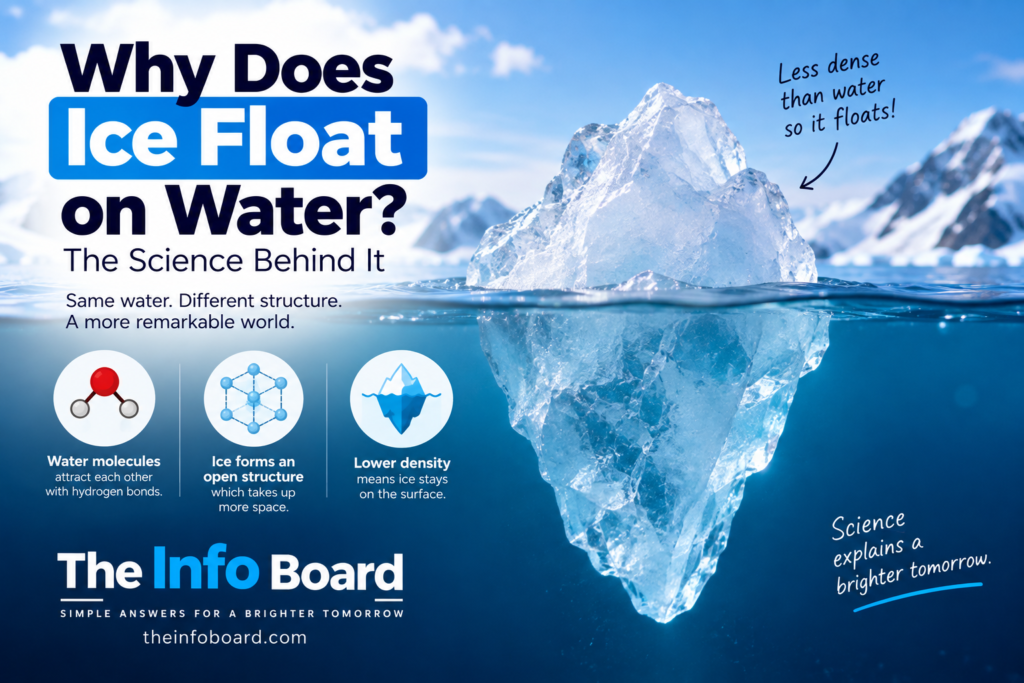
Why Does Ice Float on Water? The Science Behind It
What Does Density Mean?
To understand why ice floats, we first need to understand density.
Density describes how much mass is packed into a particular volume.
The basic relationship is:
Density = Mass ÷ Volume
Imagine two objects that are exactly the same size. If one contains more mass, it has a greater density.
Whether something floats in water depends largely on its density compared with the water around it.
An object that is less dense than water can float.
Ice is less dense than liquid water, so it stays at the surface.
Why Is Ice Less Dense Than Water?
The explanation lies in the structure of water molecules.
A water molecule contains:
Two hydrogen atoms + one oxygen atom = H₂O
Water molecules attract one another through interactions known as hydrogen bonds.
In liquid water, the molecules are constantly moving around. Hydrogen bonds continually form and break, allowing the molecules to remain relatively close together.
Something interesting happens as water freezes.
What Happens When Water Freezes?
As water cools towards its freezing point, its molecules lose kinetic energy and move more slowly.
When ice forms, the water molecules arrange themselves into a more organised crystal structure.
Hydrogen bonding helps hold the molecules in an open lattice arrangement.
This structure leaves more space between molecules than exists in liquid water.
The same amount of water therefore occupies more volume after it freezes.
More volume with approximately the same mass means lower density.
That’s why solid ice is less dense than liquid water.
Does Water Expand When It Freezes?
Yes.
Water expands by roughly 9% when it freezes.
You may have seen the consequences without thinking about the science behind them.
Leave a completely full bottle of water in a freezer and the expanding ice can deform or even rupture the container.
The same principle contributes to damage in frozen water pipes.
When water inside a confined space freezes and expands, substantial pressure can develop.
Why Do Most Other Solids Sink in Their Liquids?
Water is unusual.
For many substances, cooling causes particles to move less and pack more closely together.
Their solid form is therefore denser than their liquid form.
If water behaved this way, ice would sink.
Instead, hydrogen bonding creates an open crystalline structure when water freezes, making solid water less dense than the liquid.
This unusual behaviour has enormous environmental consequences.
Why Does Only Part of an Ice Cube Stick Out of the Water?
When ice floats, most of it remains underwater.
Ice has a density of roughly 0.92 grams per cubic centimetre, while liquid water around its maximum density is close to 1 gram per cubic centimetre.
That means roughly 90% of floating freshwater ice can sit below the surface, with only a smaller portion above it.
This is where the expression “tip of the iceberg” comes from.
What you can see above the surface may represent only a relatively small part of the whole structure.
Why Do Lakes Freeze From the Top?
This is one of the most important consequences of water’s unusual density behaviour.
As the surface of a lake cools, the colder water initially becomes denser and sinks.
But water reaches its maximum density at approximately 4°C.
When water cools below this temperature, it begins becoming less dense again.
Eventually, water at the surface reaches freezing point and forms ice.
Because ice is less dense than liquid water, it stays on the surface instead of sinking.
The lake therefore freezes from the top downward.
Read:Why Is the Sky Blue? The Science Explained Simply
Why Is Floating Ice Important for Fish?
A layer of ice on the surface of a lake can act as an insulating barrier.
Water remains liquid underneath the ice, allowing aquatic organisms to survive during cold winters.
Imagine the opposite situation.
If ice were denser than water, newly formed ice would sink.
More water at the surface could then freeze and sink as well.
Over time, lakes in sufficiently cold climates could potentially freeze much more extensively.
The fact that ice floats therefore helps maintain liquid-water environments beneath frozen surfaces.
It’s an excellent example of a seemingly simple physical property having major consequences for ecosystems.
Why Does Water Reach Maximum Density at About 4°C?
Liquid water doesn’t behave in a perfectly straightforward way as it cools.
Above roughly 4°C, cooling generally causes the water molecules to move less and come closer together, increasing density.
Below roughly 4°C, however, hydrogen bonding increasingly encourages the molecules into more open arrangements.
The water begins expanding slightly as it approaches freezing.
At freezing point, the organised crystal lattice of ice produces an even more open structure.
This unusual behaviour is sometimes called the density anomaly of water.
Why Can Freezing Water Crack Rocks?
Water can enter tiny cracks in rocks.
When temperatures fall sufficiently, that water can freeze and expand.
The expansion can exert pressure on the surrounding rock.
Repeated freezing and thawing can gradually widen cracks and contribute to the physical breakdown of rock.
This process is commonly associated with freeze-thaw weathering.
Over long periods, processes like this can contribute to changes in landscapes.
Why Can Frozen Pipes Burst?
A similar principle applies to plumbing.
Water trapped inside a pipe can freeze during sufficiently cold conditions.
As ice forms, expansion and pressure within the plumbing system can place considerable stress on the pipe.
The resulting damage may not become obvious until the ice thaws and liquid water begins escaping through the damaged section.
This is why protecting pipes against freezing is important in cold weather.
Does Salt Water Freeze Differently?
Yes.
Dissolved salt lowers the freezing point of water.
Ordinary freshwater freezes at approximately 0°C under standard atmospheric pressure, while seawater typically freezes at a lower temperature because it contains dissolved salts.
As seawater freezes, much of the salt is excluded from the growing ice structure, leaving the surrounding liquid water saltier.
Sea ice therefore has properties that differ from ordinary freshwater ice.
Why Do Icebergs Float in the Ocean?
For the same fundamental reason an ice cube floats in a glass.
The ice is less dense than the surrounding liquid water.
Seawater is also denser than freshwater because of the salts dissolved in it, which further supports the buoyancy of freshwater-derived glacial ice.
As a result, large icebergs can float while most of their mass remains below the ocean surface.
If Ice Melts in a Glass, Does the Water Level Rise?
Here’s an interesting experiment.
Place floating ice cubes in a glass of water and mark the water level.
When the ice melts, the water level remains approximately the same.
Why?
While floating, the ice displaces an amount of water whose weight equals the weight of the ice.
When the ice melts, it turns into essentially that same mass of water.
So floating ice melting doesn’t significantly raise the water level in the glass.
This principle is important when thinking about sea-level change.
What About Melting Ice on Land?
This is different.
An ice sheet or glacier sitting on land isn’t already displacing ocean water.
When land-based ice melts and the resulting water enters the ocean, it adds additional water to the sea.
That can contribute to rising sea levels.
So there is an important distinction between floating sea ice and land-based ice.
Why Is Ice Slippery?
This is actually more complicated than the simple explanation that “pressure melts the ice.”
A very thin, mobile layer of water-like molecules can exist at an ice surface, and friction and pressure can also influence conditions where objects such as skates contact the ice.
Scientists have studied the exact mechanisms involved for many years.
The important point is that the slippery behaviour of ice involves properties of its surface and the interaction between ice, temperature, pressure and friction.
Can Ice Ever Sink?
Under ordinary conditions, normal ice floats in liquid water.
However, scientists know of several different crystalline forms of ice that occur under extreme pressures.
Some high-pressure forms can have very different densities from the ordinary ice we encounter in everyday life.
For normal household and environmental conditions, though, the familiar rule holds:
Ice floats on water.
Why Is Water So Unusual?
Water has several properties that make it scientifically remarkable.
Its hydrogen bonding contributes to its unusual freezing behaviour, relatively high heat capacity and many of the characteristics that make water important for biological systems.
The fact that solid water floats instead of sinking is just one example.
It’s something we see every day, yet it arises from molecular interactions occurring on an extraordinarily small scale.
Frequently Asked Questions
Why does ice float in simple terms?
Ice floats because it is less dense than liquid water. When water freezes, its molecules form an open crystal structure that takes up more space.
Does water get bigger when it freezes?
Yes. Water expands by roughly 9% when it freezes under ordinary conditions.
Why don’t lakes freeze completely?
They sometimes can freeze extensively if they’re shallow or conditions are severe, but floating surface ice provides insulation while denser liquid water remains underneath. This helps deeper water remain liquid.
Why is most of an iceberg underwater?
Because the densities of ice and water are relatively close. Ice is only moderately less dense than water, so most of a floating iceberg must remain submerged to displace enough water to support its weight.
Does melting sea ice raise sea level?
Floating ice already displaces water approximately equal to its weight, so its melting has little direct effect on sea level. Melting land-based glaciers and ice sheets, however, adds water to the oceans and contributes to sea-level rise.
The Bottom Line
Ice floats because water behaves unusually when it freezes.
Instead of its molecules simply packing more tightly together, hydrogen bonds arrange water molecules into an open crystal structure.
The frozen water occupies more space while retaining approximately the same mass, making ice less dense than liquid water.
That simple molecular behaviour explains floating ice cubes, frozen pipes, freeze-thaw weathering and why lakes freeze from the surface downward.
More importantly, floating ice helps keep liquid water beneath frozen lakes — creating an environment in which aquatic life can survive cold winters.
Something as ordinary as an ice cube floating in your drink is actually a demonstration of some remarkable chemistry and physics.
External source: A strong authoritative reference is the US Geological Survey’s explanation of water’s properties: USGS — Water Density.
[…] Read:Why Does Ice Float on Water? The Science Behind It […]
[…] Read:Why Does Ice Float on Water? The Science Behind It […]