You’re chopping an onion for dinner when your eyes suddenly start burning.
A few seconds later, tears begin running down your face.
Nothing emotional has happened. Your eyes are simply reacting to chemicals released when the onion is cut.
But why does damaging an onion produce something capable of making humans cry?
The answer involves plant chemistry, enzymes and your eyes’ natural defence system.
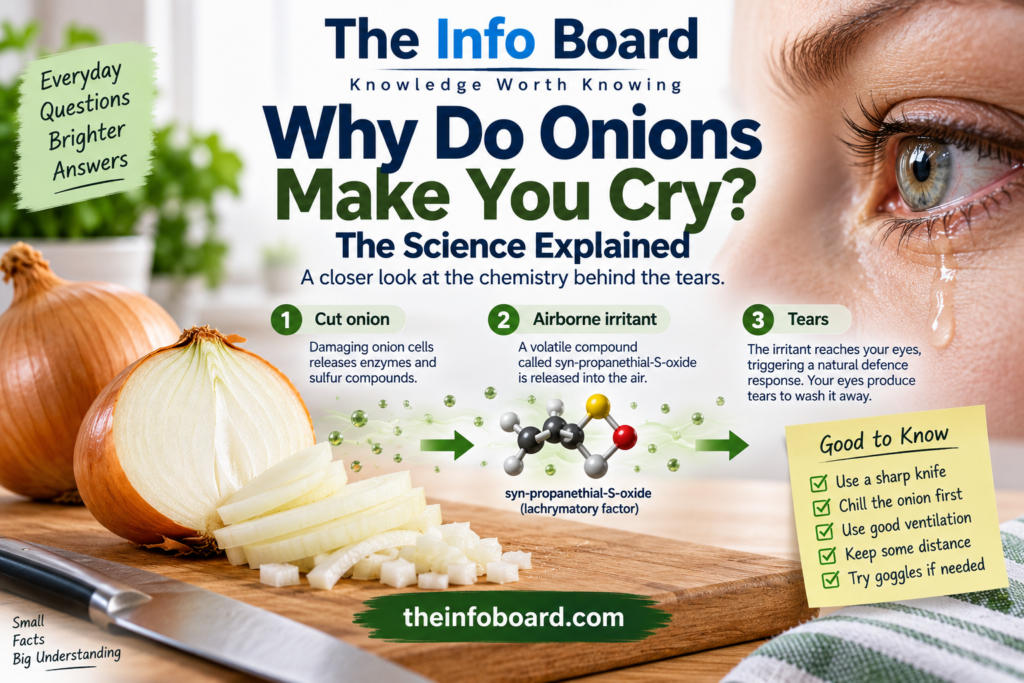
What Happens When You Cut an Onion?
An intact onion keeps different chemical compounds separated inside its cells.
When you slice into it, your knife damages thousands of those cells.
Substances that were previously separated can then mix together.
Enzymes begin reacting with sulfur-containing compounds in the onion.
Those reactions eventually produce a volatile chemical responsible for the familiar eye irritation.
In other words, the onion doesn’t contain a reservoir of ready-made “tear gas.”
Cutting the onion starts the chemistry that produces the irritant.
What Chemical Makes Your Eyes Water?
The main tear-producing substance released by a cut onion is commonly called lachrymatory factor, specifically syn-propanethial-S-oxide.
“Lachrymatory” relates to tears.
Because the compound is volatile, some of it can travel through the air after the onion is cut.
When it reaches the sensitive surface of your eyes, irritation follows.
Why Do Onions Contain Sulfur Compounds?
Onions belong to the Allium group of plants, which also includes garlic, leeks and shallots.
These plants contain a variety of sulfur-containing compounds.
Sulfur is taken up from the soil and incorporated into the plant’s chemistry.
These compounds contribute to the characteristic flavours and aromas we associate with onions and their relatives.
The chemistry also plays roles in the plant itself.
Why Does the Onion Produce the Irritant Only After It Is Damaged?
This is one of the most interesting parts.
Keeping reactive chemicals and enzymes separated inside intact cells allows the onion to avoid constantly producing the same reaction products.
When an animal bites the plant — or a human cuts it with a kitchen knife — cells rupture.
The previously separated substances meet.
Chemical reactions then occur rapidly.
This kind of damage-triggered chemistry is useful to plants because unpleasant flavours or irritating compounds can discourage animals and other organisms from eating them.
Your chopping knife effectively activates part of the onion’s chemical defence system.
Why Do Your Eyes Respond With Tears?
Your eyes have a delicate exposed surface that needs protection.
When an irritating substance reaches that surface, sensory nerves detect it.
Your nervous system responds by stimulating the lacrimal glands, which produce tears.
The extra tears help dilute and wash irritating substances away from the eye.
So the tears aren’t the onion directly “making water.”
They’re your body’s protective response to irritation.
Why Does It Burn?
The volatile compounds produced by the damaged onion reach the eye and stimulate sensitive nerve endings.
Your brain interprets those signals as irritation or burning.
The resulting tear production helps protect the eye.
This is similar in principle to other protective reflexes.
If dust enters your eye, you blink and produce tears.
If something irritates your nose, you may sneeze.
The body has rapid mechanisms designed to protect vulnerable surfaces.
Why Doesn’t the Onion Usually Irritate Your Hands?
The skin on your hands has a much stronger protective outer barrier than the exposed surface of your eyes.
Your cornea and surrounding tissues are considerably more sensitive to airborne irritants.
That’s why you can hold and chop an onion without your fingers feeling anything comparable to the burning sensation in your eyes.
However, touching your eyes after handling onions can obviously increase irritation, so washing your hands after preparation is sensible.
Why Do Some Onions Make You Cry More Than Others?
Not every onion has exactly the same chemical composition.
The amount and balance of sulfur-containing compounds can vary with factors including:
onion variety, growing conditions, storage and age.
How you prepare the onion also matters.
Crushing or extensively damaging the cells can release more material than making a few clean cuts.
That’s one reason one onion can seem surprisingly mild while another has you reaching for a tissue almost immediately.
Does a Sharp Knife Help?
It can.
A sharp knife generally makes cleaner cuts and may crush fewer onion cells than a blunt knife.
Since the irritating chemistry begins when cells are damaged, reducing unnecessary crushing can potentially reduce the amount of irritant released.
It won’t eliminate the effect completely because slicing an onion inevitably damages cells.
But using a properly sharpened kitchen knife also makes food preparation easier and more controlled.
Does Chilling an Onion Help?
Cooling an onion before cutting it may reduce the rate at which volatile compounds reach the air.
Lower temperatures generally reduce volatility and can slow chemical processes.
This is why chilling an onion for a short period before chopping is a commonly suggested technique.
However, onions are generally best stored according to appropriate food-storage guidance rather than permanently keeping whole onions in the refrigerator solely to prevent tears.
Does Cutting an Onion Under Water Work?
Water can reduce the amount of volatile irritant reaching your eyes because some compounds can interact with or become trapped by the water.
But chopping an onion submerged in water is inconvenient and can make safe knife handling more difficult.
A slippery onion plus a sharp knife is not a combination worth creating just to avoid a few tears.
There are easier methods.
Read:Why Does Ice Float on Water? The Science Behind It
What About Running Water Nearby?
You may have heard that chopping an onion beside running water prevents crying.
There is some logic behind attempts to redirect or capture airborne compounds, but simply turning on a tap isn’t a guaranteed solution.
Air movement around your cutting area matters more directly.
A kitchen extractor fan, for example, may help pull some airborne irritants away from your face.
Can a Fan Stop Onion Tears?
A fan can help if positioned appropriately.
The idea is simple:
move the irritating vapour away from your eyes before it reaches them.
An extractor hood or small fan directing air away from your face can reduce exposure.
Be sensible about positioning electrical equipment around kitchen surfaces and water.
Does Holding Bread in Your Mouth Work?
This is a popular kitchen myth.
People claim that holding bread in their mouth absorbs the onion vapour before it reaches their eyes.
There isn’t a convincing mechanism by which a piece of bread in your mouth would reliably capture the airborne irritant travelling toward your eyes.
If someone believes it works for them, that’s fine — but there are much more plausible methods, such as cooling the onion, using a sharp knife or improving ventilation.
What About Chewing Gum?
Another common claim is that chewing gum prevents onion tears.
Again, it isn’t a reliable solution.
Chewing may alter your breathing or distract you from the irritation, but it does not stop the onion from releasing volatile compounds.
The chemistry continues regardless of what flavour of gum you’re chewing.
Do Goggles Work?
Yes — if they form an effective barrier around your eyes.
The irritant has to reach the eye surface to trigger the reaction.
Properly fitting protective goggles can physically prevent much of the airborne compound from reaching your eyes.
Ordinary glasses are less effective because air can easily travel around them.
You may look slightly unusual chopping dinner in goggles, but the principle is sound.
Why Doesn’t Cooking an Onion Make You Cry as Much?
The tear-producing reaction is particularly noticeable when raw onion cells are freshly damaged.
Cooking changes the onion’s chemistry.
Heat affects enzymes and volatile compounds, and the flavour profile changes dramatically as onions cook.
That’s why standing over caramelising onions usually doesn’t produce the same eye-watering effect as chopping several raw onions.
Why Do Cooked Onions Taste Sweeter?
Raw onions contain sugars, even though their strong flavour can make that sweetness difficult to notice.
Cooking reduces some of the harsh flavours and drives a range of chemical reactions.
As onions cook slowly, water is lost and flavours become concentrated.
With sufficient heat and time, browning reactions contribute additional flavours and aromas.
The result can taste dramatically sweeter and richer than the raw vegetable you started with.
Why Does Garlic Behave Differently?
Garlic is related to onions and also uses sulfur chemistry when its cells are damaged.
But the exact chemistry is different.
When garlic is crushed or chopped, enzymes help form compounds including allicin, which contributes to fresh garlic’s distinctive smell and flavour.
So onions and garlic both use damage-triggered chemistry, but they don’t produce exactly the same mixture of compounds.
Is the Onion Trying to Make Humans Cry?
Of course not.
Plants don’t consciously decide to defend themselves.
Instead, chemical traits that help plants survive and reproduce can persist through evolution.
An onion’s chemistry existed long before humans started chopping onions on kitchen boards.
Our tears are simply an accidental interaction between that plant chemistry and the sensory systems protecting our eyes.
Why Don’t We Stop Crying After Cutting Onions Regularly?
Your eyes still need to respond to potentially irritating substances.
Even if you’ve chopped thousands of onions, the protective mechanism remains useful.
People can vary in sensitivity and may feel that they react more or less strongly than others, but repeated cooking doesn’t mean your eyes should simply disable their protective reflex.
That reflex exists for much more than onions.
Are Onion Tears Harmful?
For most people during ordinary food preparation, onion-induced tearing is temporary.
Once you move away from the irritant and the air clears, the discomfort usually resolves.
If your eyes become irritated, avoid rubbing them — particularly with hands that have just handled onions.
Move away from the source and allow clean air and your natural tears to clear the irritation.
Persistent, severe or unusual eye symptoms should not simply be assumed to be caused by an onion.
The Easiest Ways to Reduce Onion Tears
If onions regularly bother your eyes, try combining a few practical approaches:
Use a sharp knife.
Cleaner cuts can reduce unnecessary cell crushing.
Cool the onion briefly before chopping.
Lower temperature may reduce how quickly volatile compounds reach the air.
Use ventilation.
An extractor fan can help move vapour away from your face.
Keep some distance.
Avoid leaning directly over the cutting board.
Use eye protection if necessary.
A physical barrier is one of the most direct ways to prevent airborne irritants reaching the eyes.
None of these requires changing the onion itself.
The Bottom Line
Onions make you cry because cutting them breaks open their cells and triggers a series of chemical reactions.
Those reactions produce a volatile tear-inducing compound known as syn-propanethial-S-oxide.
The compound travels through the air and reaches your eyes.
Sensitive nerves detect the irritation, and your lacrimal glands respond by producing tears to help wash it away.
So when you’re crying over a chopping board, your eyes aren’t malfunctioning.
They’re doing exactly what they’re designed to do.
And all of it starts with the surprisingly sophisticated chemistry hidden inside an ordinary onion.
Read:Why Do We See Lightning Before We Hear Thunder?
Frequently Asked Questions
Why do onions make you cry?
Cutting an onion damages its cells and triggers chemical reactions that produce a volatile eye irritant. Your eyes respond by producing tears.
What chemical in onions makes you cry?
The principal tear-inducing compound is syn-propanethial-S-oxide, commonly referred to as onion lachrymatory factor.
Does a sharp knife stop onion tears?
It won’t completely stop them, but a sharp knife can cause less unnecessary crushing of onion cells and may reduce the amount of irritant released.
Does refrigerating an onion before cutting help?
Cooling an onion before chopping may reduce the release of volatile compounds and can make the effect less intense.
Do goggles prevent onion tears?
Properly fitting goggles can be effective because they physically prevent much of the airborne irritant from reaching your eyes.
Why does garlic not make you cry like onions?
Garlic uses related sulfur chemistry, but the compounds and reactions produced after its cells are damaged differ from those in onions.
Are onion tears dangerous?
Ordinary exposure during cooking usually causes temporary irritation. Move away from the source and avoid rubbing your eyes with onion-contaminated hands.
External source:
Library of Congress — Why does chopping an onion make you cry?
Leave a Comment