A flash suddenly lights up the sky.
Then, several seconds later:
BOOM.
Lightning and thunder are produced by the same event, yet they often seem separated by a noticeable delay.
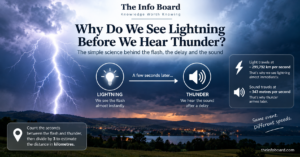
The reason is surprisingly simple: light travels enormously faster than sound.
The flash from a lightning strike reaches your eyes almost immediately, while the sound of thunder takes much longer to travel through the atmosphere.
That delay can even give you a rough idea of how far away the lightning is.
What Actually Causes Lightning?
Storm clouds contain enormous numbers of water droplets, ice crystals and other particles moving through turbulent air.
Inside a thunderstorm, collisions and movement help separate electrical charge within the cloud.
Different regions of the storm can develop different electrical charges.
When the electrical difference becomes large enough, the insulating properties of the surrounding air can break down.
A rapid electrical discharge occurs.
That discharge is what we see as lightning.
Lightning can occur within a cloud, between clouds or between a cloud and the ground.
What Causes Thunder?
Thunder is not a separate event that happens after lightning.
It is a direct consequence of the lightning discharge.
A lightning channel heats the surrounding air extremely rapidly to very high temperatures.
The heated air expands violently.
That rapid expansion produces a pressure wave that travels outward through the atmosphere.
When that wave reaches your ears, you hear thunder.
So lightning produces both the flash and the thunder.
The reason you experience them at different times is the enormous difference between the speeds of light and sound.
How Fast Does Light Travel?
Light is extraordinarily fast.
In a vacuum, it travels at approximately:
299,792 kilometres per second.
It travels slightly more slowly through air, but for the distances involved in an ordinary thunderstorm, the difference is negligible for everyday purposes.
If lightning strikes several kilometres away, its light reaches you so quickly that the delay is effectively impossible for you to notice.
You see the flash almost immediately.
How Fast Does Sound Travel?
Sound is dramatically slower.
Near room temperature, sound travels through air at roughly:
343 metres per second.
Its exact speed varies with atmospheric conditions, particularly temperature.
Even using the approximate figure, the difference is enormous.
Light can travel around 300,000 kilometres in one second.
Sound travels only around 0.34 kilometres in one second through ordinary air.
That is why thunder arrives later.
Why Does the Delay Get Longer When a Storm Is Far Away?
Imagine lightning occurs one kilometre away.
The light reaches you almost instantly.
The sound, travelling at roughly 343 metres per second, takes close to three seconds to cover that kilometre.
If the strike occurs several kilometres away, the sound has much farther to travel.
The delay therefore becomes longer.
This gives us a useful way of estimating distance.
Read:Why Does Fog Form? The Science Behind Misty Mornings
Can You Calculate How Far Away Lightning Is?
Yes — approximately.
A useful rule is:
Count the seconds between the lightning flash and the thunder, then divide by 3 to estimate the distance in kilometres.
For example:
If you see lightning and hear thunder 3 seconds later, the strike was roughly 1 kilometre away.
A 6-second delay suggests roughly 2 kilometres.
A 9-second delay suggests roughly 3 kilometres.
A 15-second delay suggests roughly 5 kilometres.
This is only an estimate because the speed of sound varies somewhat with atmospheric conditions.
What About Miles?
A commonly used approximation is to count the seconds between the flash and thunder and divide by 5 to estimate the distance in miles.
For example:
10 seconds ÷ 5 ≈ 2 miles.
Again, this is a rough estimate rather than a precision measurement.
Why Does Thunder Sometimes Sound Like a Sharp Crack?
Thunder does not always sound the same.
When lightning is relatively close, you may hear a sudden, sharp crack or explosive bang.
When it is farther away, thunder often sounds like a long, deep rumble.
Distance is part of the explanation, but the shape and length of the lightning channel matter too.
Why Does Thunder Rumble for So Long?
A lightning channel can extend for several kilometres.
Different sections of that channel are different distances from you.
The sound produced by the closest section reaches you first.
Sound from more distant sections arrives later.
Instead of hearing one perfectly simultaneous sound, you receive a sequence of overlapping sound waves.
This contributes to thunder’s characteristic rumbling.
Sound can also be affected by the atmosphere and surrounding terrain, making the rumble even more complex.
Why Can Thunder Sound Different Indoors?
Buildings change how sound reaches you.
Walls and windows can block or reduce some frequencies while transmitting others.
Sound can also reflect from buildings and nearby surfaces.
As a result, thunder heard from inside a house may sound deeper or more muffled than it does outdoors.
Very powerful nearby thunder can even make windows or objects vibrate because of the pressure wave.
Can You See Lightning Without Hearing Thunder?
Yes.
If a thunderstorm is sufficiently far away, you may be able to see its lightning while the thunder is too weak to hear.
Sound loses intensity as it travels and can also be affected by atmospheric conditions.
This phenomenon is sometimes informally called heat lightning, but it does not require a special type of lightning caused by hot weather.
It is usually ordinary lightning from a distant thunderstorm whose thunder cannot be heard from your location.
Can Thunder Happen Without Lightning?
Thunder is produced by lightning.
If you hear genuine thunder, a lightning discharge occurred somewhere.
You may simply not have seen the flash because it was hidden by clouds, buildings, terrain or daylight.
Some lightning also occurs entirely within clouds, making the discharge itself difficult to see clearly.
Why Can We See Lightning From So Far Away?
Light can travel huge distances through the atmosphere and still be visible, particularly at night.
A distant lightning flash can illuminate a large area of cloud.
Even if the actual lightning channel is hidden below the horizon or behind another cloud, the illuminated sky may still be visible.
Sound does not travel nearly as effectively over the same distances.
That is why distant storms can sometimes appear to flash silently.
Does Temperature Affect the Speed of Thunder?
Yes.
The speed of sound in air depends partly on temperature.
Sound generally travels faster through warmer air than colder air.
Humidity and atmospheric structure can also influence how sound propagates.
These effects are one reason the flash-to-thunder calculation should be treated as an approximation.
For judging storm safety, you should rely on official weather guidance rather than trying to calculate an exact strike position yourself.
Is Lightning Really Hotter Than the Sun?
You may have heard that lightning is hotter than the surface of the Sun.
There is truth behind the comparison.
The air within a lightning channel can briefly reach temperatures of around 30,000°C, according to the US National Weather Service.
The visible surface of the Sun is around 5,500°C.
However, the comparison needs context.
A lightning channel is extremely narrow and the intense heating lasts only a very short time.
The Sun contains vastly more energy overall.
The point is simply that the temperature inside a lightning channel can become extraordinarily high.
Read:Why Is the Sky Blue? The Science Explained Simply
Why Doesn’t the Hot Air Simply Burn Everything Around It?
The extreme temperature exists within a relatively narrow lightning channel for a very short period.
The heating is intense enough to make the surrounding air expand explosively and produce thunder.
But that does not mean the entire surrounding atmosphere suddenly reaches tens of thousands of degrees.
A direct lightning strike is still extremely dangerous and can start fires, damage structures and cause severe injury or death.
Is It Safe to Stand Outside and Count the Seconds?
No.
The flash-to-thunder method is an interesting way to understand the physics, but it should not be used as a reason to remain outside during a thunderstorm.
If you can hear thunder, lightning is close enough to represent a potential danger.
Seek appropriate shelter rather than waiting outside to calculate how close the next strike might be.
In the UK, the Met Office advises seeking shelter indoors when thunderstorms are forecast and avoiding unnecessary exposure to lightning.
Why Is a Car Safer Than Standing Outside?
A fully enclosed hard-topped vehicle can provide protection during lightning because the conducting exterior can help carry electrical current around the occupants.
It is not simply the rubber tyres that make a car protective — that common explanation is misleading.
If safe indoor shelter is available, follow official thunderstorm safety guidance.
Avoid isolated trees, exposed high ground and bodies of water during thunderstorms.
Why Is Lightning So Bright?
Lightning involves an extremely energetic electrical discharge.
The lightning channel becomes intensely hot, causing gases in the air to emit brilliant light.
Because the flash is so bright, it can be visible over considerable distances, particularly against a dark sky.
Your eyes therefore receive the visual signal almost immediately while your ears are still waiting for the much slower sound wave.
Lightning and Thunder Are a Perfect Demonstration of Physics
A thunderstorm gives us an enormous natural demonstration of two very different types of waves.
The lightning flash reaches us through electromagnetic radiation — light.
Thunder reaches us through a mechanical pressure wave — sound travelling through air.
They begin almost together.
But they travel at radically different speeds.
That’s why nature appears to show us the storm first and let us hear it afterwards.
The Bottom Line
We see lightning before hearing thunder because light travels vastly faster than sound.
The light from a lightning strike reaches your eyes almost instantaneously over normal thunderstorm distances.
The sound travels through air at only around 343 metres per second, so thunder arrives noticeably later.
Counting the delay can provide a rough estimate of distance:
about 3 seconds per kilometre, or about 5 seconds per mile.
But if you can hear thunder, don’t use the calculation as an excuse to remain outside.
The science is fascinating.
The safest place to appreciate it is from appropriate shelter.
Frequently Asked Questions
Why do we see lightning before hearing thunder?
Because light travels enormously faster than sound. The lightning flash reaches your eyes almost instantly, while the thunder takes longer to travel through the air.
How far away is lightning if thunder comes 6 seconds later?
Approximately 2 kilometres away using the rough rule of three seconds per kilometre.
How do you calculate lightning distance in miles?
Count the seconds between the flash and thunder and divide by approximately five.
What causes the sound of thunder?
Lightning rapidly heats the surrounding air, causing it to expand violently and create a pressure wave that travels through the atmosphere as sound.
Why does thunder rumble?
Different parts of a long lightning channel are different distances from you, so their sound reaches you at slightly different times. Atmospheric and terrain effects can contribute as well.
Is heat lightning a different type of lightning?
Usually not. What people call heat lightning is typically ordinary lightning from a distant storm whose thunder is too far away to be heard.
Is it safe outside if thunder takes a long time to arrive?
Do not rely on the delay as a safety guarantee. If you can hear thunder, follow appropriate lightning safety guidance and seek shelter.
External source for publication:
Met Office — Thunder and lightning
Safety note: Thunderstorms and lightning can be dangerous. Follow current official weather warnings and safety guidance during severe weather.
Leave a Comment