Look up on a clear day and the sky appears blue. Around sunrise or sunset, however, that same sky can turn orange, red, pink or even purple.
The Sun hasn’t suddenly changed colour, so what’s happening?
The answer involves sunlight, Earth’s atmosphere and a phenomenon called Rayleigh scattering.
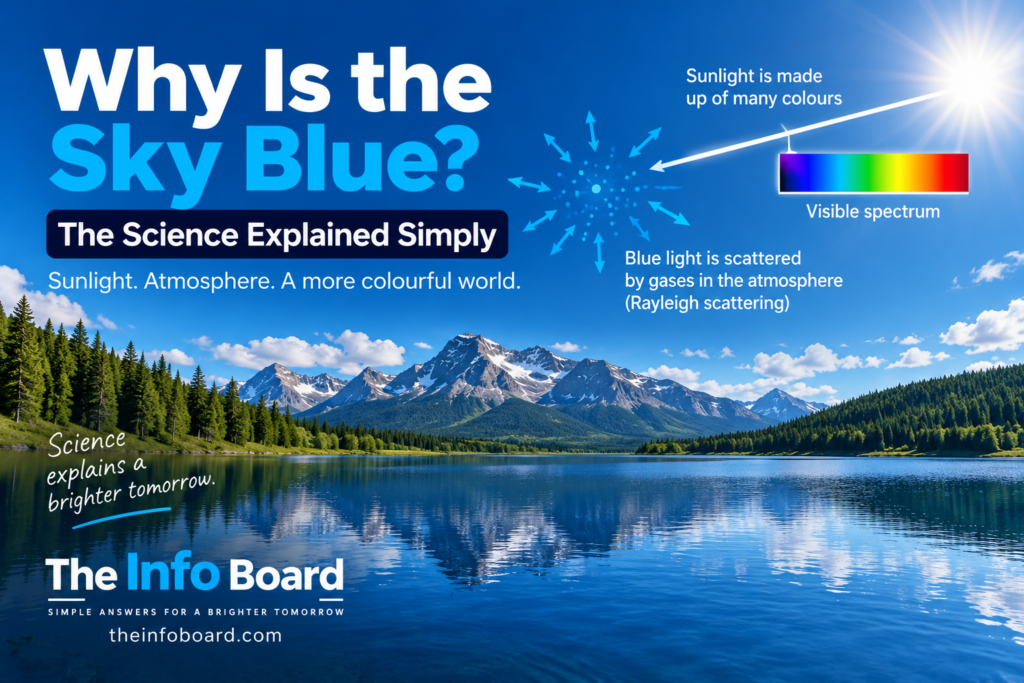
Why Is the Sky Blue? The Science Explained Simply
What Colour Is Sunlight?
Sunlight often looks white, but white light is actually made up of many different colours.
These are the colours of the visible spectrum, ranging approximately from:
Violet → Blue → Green → Yellow → Orange → Red
Each colour corresponds to a different range of wavelengths.
Red light has a relatively long wavelength, while blue and violet light have shorter wavelengths.
This difference becomes important when sunlight enters Earth’s atmosphere.
What Happens When Sunlight Reaches Earth?
Earth is surrounded by an atmosphere containing gases, primarily nitrogen and oxygen.
As sunlight travels through the atmosphere, it encounters tiny gas molecules.
The light interacts with those molecules and some of it is scattered in different directions.
But the different colours of visible light aren’t scattered equally.
Shorter wavelengths are scattered much more strongly than longer wavelengths.
This phenomenon is known as Rayleigh scattering.
What Is Rayleigh Scattering?
Rayleigh scattering describes how light is scattered by particles that are much smaller than the wavelength of the light.
In Earth’s atmosphere, molecules of gases such as nitrogen and oxygen are small enough for this type of scattering to occur.
Shorter wavelengths of visible light are scattered particularly strongly.
Blue light therefore gets scattered across the sky much more effectively than red light.
When you look away from the Sun, much of the blue light reaching your eyes has arrived after being scattered through the atmosphere.
That’s why the sky appears blue.
But Isn’t Violet Light Scattered Even More?
Yes — and this raises an interesting question.
Violet light has an even shorter wavelength than blue light, so Rayleigh scattering affects violet particularly strongly.
Why doesn’t the sky look violet?
There are several reasons.
The Sun emits different amounts of visible light at different wavelengths, and some violet light is absorbed in the upper atmosphere.
Most importantly, human eyes are considerably more sensitive to blue light than violet light.
The combination of the Sun’s spectrum, atmospheric effects and human vision means we perceive the daytime sky predominantly as blue.
Why Is the Sky a Deeper Blue on Some Days?
The appearance of the sky depends on atmospheric conditions.
Water droplets, dust, pollution, smoke and other particles can affect how light travels through the atmosphere.
A particularly clear, dry atmosphere may produce a rich blue sky.
When there are more aerosols or water droplets in the air, additional types of scattering can make the sky look paler, hazier or almost white near the horizon.
So the colour you see depends partly on what’s actually floating in the atmosphere.
Why Does the Sky Look Paler Near the Horizon?
When you look directly overhead, you’re looking through a relatively shorter path through the atmosphere.
When you look towards the horizon, you’re looking through a much longer path.
That means the light reaching you from near the horizon has interacted with more atmosphere.
Additional scattering involving molecules and larger particles can reduce the deep-blue appearance and make the horizon look paler or whiter.
Why Are Sunsets Red and Orange?
The same physics that makes the daytime sky blue also helps create colourful sunsets.
When the Sun is high in the sky, sunlight takes a relatively direct route through the atmosphere.
Near sunset, the Sun appears close to the horizon.
Its light therefore has to travel through much more atmosphere before reaching your eyes.
During this longer journey, much of the shorter-wavelength blue and violet light is scattered away from the direct path.
The light remaining in the direct beam is relatively richer in longer wavelengths such as:
Red, orange and yellow.
That’s why the Sun and surrounding sky can appear dramatically warmer in colour at sunrise and sunset.
Why Are Some Sunsets More Colourful Than Others?
Particles in the atmosphere can influence the appearance of a sunset.
Dust, smoke, pollution, water droplets and aerosols can all affect the way light is scattered.
Under certain atmospheric conditions, this can produce spectacular reds, oranges and pinks.
However, more particles don’t automatically mean a better sunset. Different particle sizes, concentrations, cloud positions and weather conditions all affect the result.
Why Is the Sky Black in Space?
Space doesn’t contain an atmosphere like Earth’s.
Without a dense atmosphere of gas molecules surrounding you, there isn’t enough Rayleigh scattering to spread sunlight across the sky.
An astronaut in space can therefore see the Sun while the surrounding sky appears black.
This demonstrates an important point:
The blue isn’t really a property of the sky itself.
It’s a consequence of sunlight interacting with Earth’s atmosphere.
Would the Sky Be Blue on Another Planet?
Not necessarily.
The colour of a planet’s sky depends on its atmosphere.
Different gases, dust particles, clouds and atmospheric densities interact with light differently.
For example, photographs from Mars often show a dusty reddish or butterscotch-coloured daytime sky.
Interestingly, sunsets on Mars can appear bluish around the Sun — almost the reverse of what we’re accustomed to seeing on Earth.
That’s because the Martian atmosphere contains large amounts of fine dust that scatters light differently from Earth’s atmosphere.
Why Are Clouds White?
Clouds contain water droplets or ice crystals that are much larger than the gas molecules responsible for Rayleigh scattering.
These larger particles scatter visible wavelengths more evenly.
Because many colours of visible light are scattered together, the combined light appears white.
Large or thick clouds can look grey because less sunlight reaches their lower portions and because of the complex way light travels through the cloud.
Why Is the Ocean Blue?
It’s tempting to assume the ocean is blue simply because it reflects the sky.
Reflection can influence the appearance of water, particularly at the surface, but it isn’t the whole explanation.
Water itself interacts with different wavelengths of light differently.
As sunlight travels through sufficiently deep, clean water, longer wavelengths such as red are absorbed more strongly, while blue light can penetrate and be scattered back more effectively.
That’s why large bodies of clear water can appear blue even when the sky isn’t perfectly blue.
Can You See Rayleigh Scattering Yourself?
You’re seeing its effects every time you look at a clear blue sky.
The phenomenon also explains why distant landscapes can sometimes appear bluish.
Light travelling through a large amount of atmosphere between you and distant mountains can be affected by scattering, creating a blue haze.
Does the Atmosphere Actually Have a Colour?
The gases making up ordinary air appear essentially colourless when viewed over short distances.
You don’t see blue air when looking across a room.
The blue sky becomes apparent because you’re looking through many kilometres of atmosphere, giving scattering enough distance to have a visible effect.
What Would Happen If Earth Had No Atmosphere?
If Earth suddenly had no atmosphere, there would be no atmospheric Rayleigh scattering.
Even during daytime, the sky would appear dark or black, similar to the view from the Moon.
The Sun itself would still be extremely bright, but the rest of the sky wouldn’t glow blue.
Of course, losing the atmosphere would create far more serious problems than changing the colour of the sky — Earth’s atmosphere is essential for life as we know it.
Frequently Asked Questions
Why is the sky blue in simple terms?
Sunlight contains many colours. When it passes through Earth’s atmosphere, shorter wavelengths such as blue are scattered strongly by tiny gas molecules. That scattered blue light reaches our eyes from across the sky.
Why isn’t the sky purple?
Violet wavelengths are scattered strongly too, but human vision is less sensitive to violet, atmospheric effects reduce some violet light, and the Sun’s spectrum also matters. Together these factors make the sky appear predominantly blue.
Why does the sky turn red at sunset?
When the Sun is near the horizon, its light travels through more atmosphere. Much of the blue light is scattered away from the direct path, leaving relatively more red and orange light to reach you.
Why does space look black?
Space lacks a substantial atmosphere to scatter sunlight across the sky. Without that scattering, the background remains dark even when the Sun is shining.
Are skies on other planets blue?
Not necessarily. Sky colour depends on the composition and particles within a planet’s atmosphere.
The Bottom Line
The sky is blue because sunlight interacts with Earth’s atmosphere.
White sunlight contains many colours, but shorter wavelengths are scattered more strongly by the tiny molecules in the atmosphere. Blue light becomes scattered across the sky and reaches our eyes from many different directions.
At sunset, sunlight travels through much more atmosphere, scattering much of that blue light away and allowing reds and oranges to dominate.
So every blue afternoon and red sunset is essentially a giant demonstration of physics happening above our heads.
[…] Read:Why Is the Sky Blue? The Science Explained Simply […]