Drop an ice cube into a glass of water and it floats. That seems completely ordinary—until you learn that the solid forms of many other substances are denser than their liquids and tend to sink.
Ice floats because freezing makes water less dense. Water molecules form an open crystal structure held together by hydrogen bonds. The same mass occupies more space as ice, so it experiences enough upward buoyant force to remain at the surface.
This unusual feature of water helps explain frozen lakes, icebergs, bursting pipes and even the survival of aquatic life during winter. Let’s start with the science, then see what it means in everyday situations.
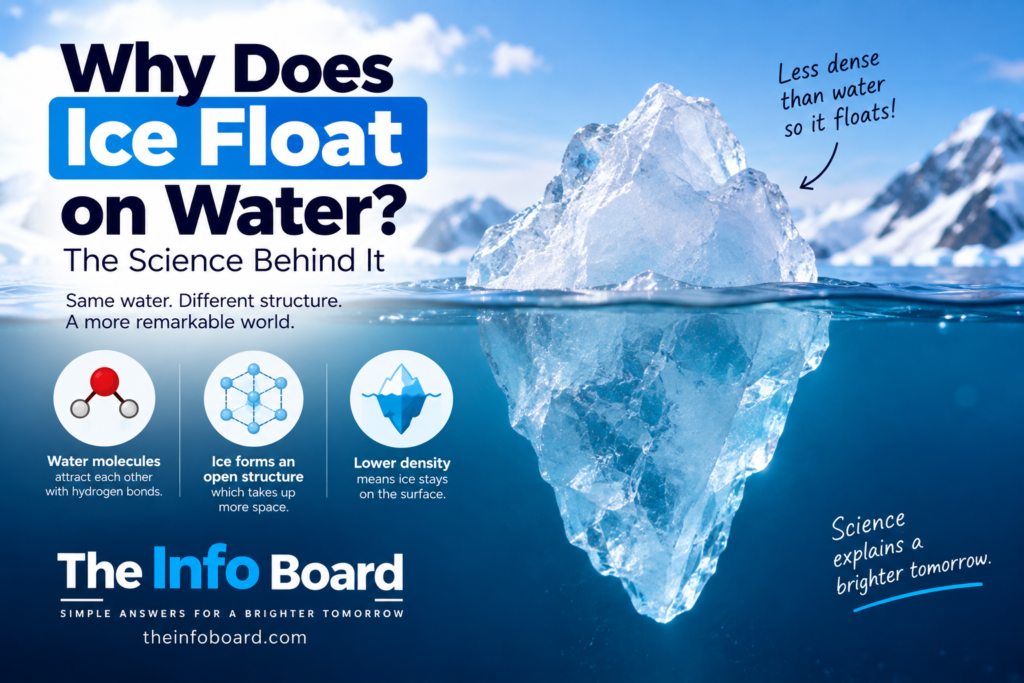
Why Does Ice Float on Water? The Science Behind It
What is density, and why does it determine whether ice floats?
Density describes how much mass occupies a given volume. The simple formula is density = mass ÷ volume. If two equally sized objects have different masses, the heavier one has a greater average density.
For objects placed in a liquid, density provides a useful first clue to whether they will float. Ordinary ice has a density of about 0.92 grams per cubic centimetre, while liquid freshwater close to 4°C has a density of about 1.00 gram per cubic centimetre.
Because normal ice is less dense than liquid water, it can float. The US Geological Survey’s water-density guide explains this difference and why it matters in nature.
What happens to water molecules when water freezes?
Each water molecule contains one oxygen atom bonded to two hydrogen atoms: H₂O. A water molecule has an uneven distribution of electrical charge, which allows attractions called hydrogen bonds to form between nearby molecules.
In liquid water, molecules move around and these attractions are constantly rearranged. On freezing, the molecules settle into an ordered crystalline structure. In ordinary ice, hydrogen bonding favours a relatively open arrangement with more empty space than in the liquid.
This is the crucial difference: freezing increases the volume occupied by a given mass of water. The mass does not disappear or become lighter, but the material is spread through more space, so its density falls.
Most substances do not behave quite this way. In many materials the solid form is packed more tightly and is denser than the liquid. Water’s hydrogen-bonded structure makes it a familiar exception.
How much does water expand when it freezes?
Under ordinary conditions, liquid water expands by approximately 9% when it becomes ice. That means a fixed amount of water requires more room after freezing.
For example, a rigid container filled to the brim with water may crack or deform in the freezer. The same principle can contribute to damage when water freezes inside plumbing or cracks in rock.
But expansion is not unlimited, and the exact behaviour depends on temperature, pressure, the substances dissolved in the water and the container. For a household demonstration, use a flexible, unsealed container and leave space at the top; never freeze water in a sealed glass bottle.
Ice versus liquid water: a quick comparison
| Property | Liquid freshwater | Ordinary ice |
|---|---|---|
| Molecular arrangement | Molecules move and rearrange | More ordered, open crystal lattice |
| Approximate density | About 1.00 g/cm³ near 4°C | About 0.92 g/cm³ near freezing |
| Volume for the same mass | Smaller | About 9% greater on freezing |
| What happens in freshwater? | Forms the surrounding liquid | Floats at the surface |
| Importance for lakes | Remains liquid beneath ice in many winters | Can form a surface layer that limits heat loss |
Values are approximate. Temperature, pressure and dissolved substances affect density.
Why is most of an ice cube underwater?
Floating does not mean that an object sits entirely on top of a liquid. A floating object pushes some of the liquid out of the way. This is called displacement.
According to Archimedes’ principle, the upward buoyant force equals the weight of displaced liquid. When that force balances the weight of the ice, the ice floats in equilibrium.
Because ice is only moderately less dense than water, it must displace a substantial volume to support its weight. In ordinary freshwater, roughly 90–92% of an ice cube’s volume is below the surface. The exact fraction varies with temperature and ice composition.
That is also why the visible tip of an iceberg can be a small fraction of the whole. Icebergs float in seawater, which is generally denser than freshwater, so the submerged fraction can differ slightly.
Why is water most dense at about 4°C?
Water does something unusual even before it freezes. As liquid water cools from a relatively warm temperature, it usually becomes denser. But its maximum density occurs at approximately 4°C under ordinary atmospheric pressure.
As it cools below that temperature toward 0°C, liquid freshwater begins becoming less dense. This behaviour reflects the way its hydrogen-bond network changes as the temperature falls.
The effect is known as the density anomaly of water. It helps determine how colder water moves around in lakes. USGS data show that liquid water is densest around 4°C. See its density measurements.
Why do lakes freeze from the top?
Imagine a freshwater lake as autumn turns to winter. Water at the surface loses heat to colder air. At first, cooling surface water becomes denser and can sink, allowing other water to rise and cool.
When the surface water cools below about 4°C, the trend reverses. This colder water is less dense than the water around 4°C beneath it, so it tends to stay near the surface. When conditions become cold enough, it freezes there.
Since ice is less dense than the water below, the new ice remains on top. That surface layer also reduces heat transfer, helping some deeper water stay liquid.
Not every lake stays partly liquid: very shallow lakes or sufficiently severe winters can produce extensive or complete freezing. But the usual top-down freezing pattern makes a major difference to many freshwater ecosystems.
Why does floating ice matter to fish and other wildlife?
A winter ice cover changes the environment beneath it. The ice acts as a barrier that reduces heat loss, allowing liquid water to remain below in many lakes and ponds. Fish and other aquatic organisms may survive in those unfrozen layers.
If ice were denser than liquid water and sank when it formed, the freezing process would be very different. Successive layers of ice could sink and permit further freezing at the surface. Aquatic ecosystems in cold regions could be much more difficult to maintain.
However, surface ice can also restrict gas exchange with the atmosphere. Thick snow and ice may reduce light and oxygen available beneath, so winter conditions can still be stressful for lake wildlife.
Why can freezing water burst pipes or break rocks?
Water expanding into ice can exert large forces when there is little space for it to expand. In plumbing, freezing can create pressure that damages a pipe, and the leak may become visible only after thawing.
To lower the risk, protect exposed pipes, follow appropriate home-heating guidance during freezing weather and seek professional help if a pipe is damaged. Do not use an open flame to thaw pipes.
Water can also enter natural cracks in rock. Repeated freezing and thawing can help widen those cracks, contributing to freeze-thaw weathering. It is one of several processes that gradually change landscapes.
Does salt water freeze differently from fresh water?
Yes. Dissolved salt reduces water’s freezing point. Pure freshwater freezes at about 0°C at standard atmospheric pressure, while typical seawater freezes at roughly -1.9°C, depending on its salinity.
As seawater freezes, much of its dissolved salt is excluded from the growing ice crystals. The resulting sea ice and the saltier water around it behave differently from an ordinary freshwater ice cube in a glass.
Floating icebergs are often formed from land-based glaciers and consist primarily of freshwater ice. They float in the sea because their average density is below that of the surrounding seawater.
If floating ice melts, will the water level rise?
This is a useful experiment. Put some ice cubes in a glass of water, mark the water level, and allow the cubes to melt. For ordinary freshwater ice floating in freshwater, the level should remain approximately unchanged.
Before melting, the floating ice displaces water with a weight equal to its own weight. After melting, it becomes the same mass of water, so it occupies approximately the volume it previously displaced.
This is a simplified example of Archimedes’ principle. It explains why the direct sea-level effect of melting already-floating sea ice is much smaller than the effect of melting ice from land. In seawater, differences in salinity introduce small corrections to the idealised glass-of-water explanation.
Melting sea ice versus melting land ice
| Type of ice | Where it is before melting | What melting does |
|---|---|---|
| Floating sea ice | Already floating in the ocean | Has little direct effect on sea level, though there are important indirect climate effects |
| Icebergs | Already floating in the ocean | Have relatively little additional direct sea-level effect as they melt |
| Glaciers and ice sheets on land | Resting on land | Add water to the ocean if meltwater reaches the sea, raising sea level |
NASA’s sea ice versus land ice explanation makes this distinction clear. Ocean warming also increases sea level through thermal expansion; melting land ice is not the only cause of sea-level rise.
Can you do a simple ice-floating experiment at home?
- Fill a clear glass about two-thirds full with freshwater.
- Place one or two ordinary ice cubes into the glass and observe how much of each cube sits above the surface.
- Mark the water line on the outside of the glass.
- Allow the ice to melt naturally, then compare the level with your mark.
- Discuss why ice displaced liquid water before it melted and why its visible portion was small.
For another simple science explanation, see Why Is the Sky Blue? The Science Explained Simply. Both articles show how molecular interactions create familiar effects in nature.
Frequently asked questions
Why does ice float in one sentence?
Water expands into an open hydrogen-bonded crystal structure when it freezes, making ordinary ice less dense than liquid water.
Does water really expand by 9% when frozen?
Approximately, under ordinary conditions. The exact figure depends on the temperatures and conditions being compared.
Why is only a small part of an iceberg visible?
Ice and liquid water have relatively similar densities, so most of the ice must remain submerged to displace enough liquid to support its weight.
Why does lake ice form on the surface?
Freshwater reaches its highest density around 4°C. Colder water near freezing stays higher in the lake, and the resulting ice floats.
Does melting sea ice cause sea-level rise?
Melting already-floating sea ice has little direct effect on ocean level. Melting land-based glaciers and ice sheets adds new water to the ocean and raises sea level.
Can ice ever sink?
Normal ice made from ordinary water floats under everyday conditions. Unusual ice forms under extreme pressure, or ice made from isotopically different heavy water, can behave differently.
Why is ice slippery?
The surface of ice can have a very thin layer of mobile water-like molecules, and friction, pressure and temperature can affect sliding. There is no single simple explanation that covers every condition.
The bottom line
Ice floats because its hydrogen-bonded crystal lattice occupies more space than liquid water of the same mass. The resulting lower density allows buoyancy to keep it at the surface.
What happens in an ice-filled glass is connected to enormous natural processes: frozen freshwater lakes, surviving winter wildlife, icebergs, weathered rocks and the different effects of melting land and sea ice.
Scientific references: USGS — Water Density and NASA — Melting Sea Ice and Land Ice.