Smart glasses are starting to look much more like ordinary glasses.
That’s part of what makes them useful — and part of what makes them controversial.
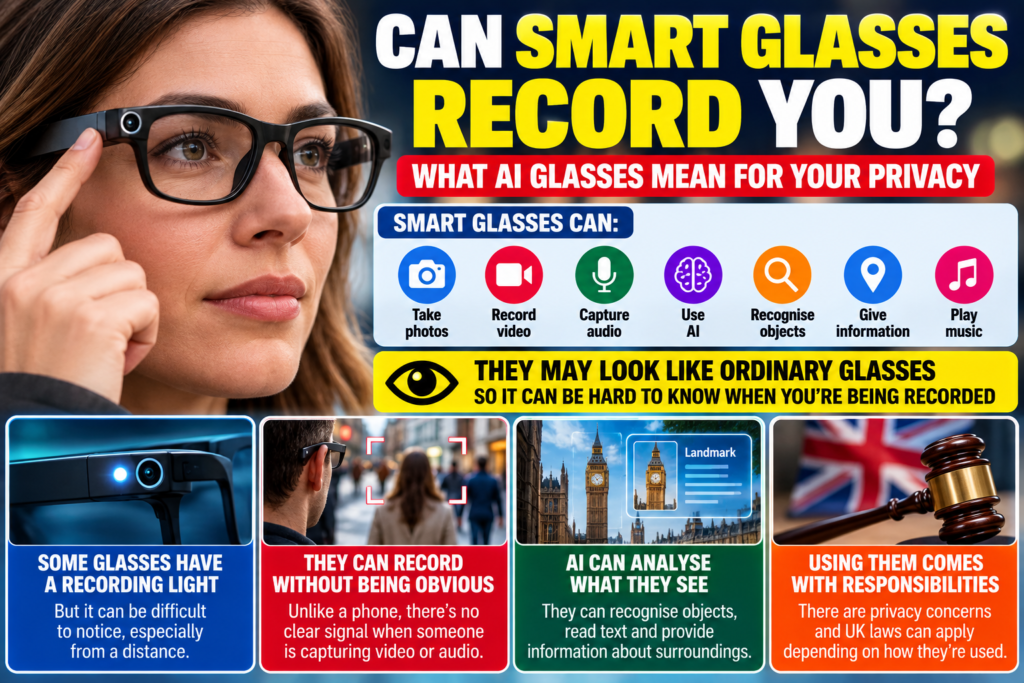
Some models can take photographs, record video, capture audio, play music, answer questions using artificial intelligence and provide information about whatever the wearer is looking at.
Unlike holding up a smartphone to take a video, however, someone wearing smart glasses may simply appear to be looking in your direction.
That raises an obvious question:
How do you know when you’re being recorded?
The issue has become increasingly important as AI-enabled glasses become more capable and more common. Privacy regulators, governments, businesses and consumers are now considering how wearable cameras and microphones should fit into everyday life. ICO
Here’s what smart glasses can actually do, why people are concerned, and what the technology could mean for privacy.
What Can Modern Smart Glasses Actually Do?
The term smart glasses covers several different kinds of wearable technology.
Some are relatively simple and provide audio through speakers built into the frame.
More advanced models can include:
- cameras,
- microphones,
- speakers,
- internet connectivity,
- voice assistants,
- artificial intelligence,
- image recognition,
- navigation features,
- and the ability to capture photographs and video.
The most important privacy difference between a smartphone and smart glasses is not necessarily the camera itself.
Smartphones have contained excellent cameras and microphones for years.
The difference is how the technology is worn.
When somebody raises a phone and points it toward you, it’s usually fairly obvious that they could be taking a photograph or recording video.
A camera built into a pair of glasses is much less conspicuous.
The wearer doesn’t necessarily need to hold anything in front of them.
That makes recording easier — but it can also make it harder for everyone else to understand what’s happening.
Some devices use indicator lights or other signals to show when recording is taking place. These safeguards can help, but they don’t completely solve the problem.
A small light can be difficult to notice, particularly from a distance, in bright conditions or when someone doesn’t know what to look for.
This is one reason the debate isn’t simply about whether smart glasses contain cameras.
It’s about whether people around the wearer can meaningfully understand when information about them is being captured.
Why AI Makes Smart Glasses Different
Adding artificial intelligence changes the privacy discussion again.
A conventional camera records an image.
An AI-enabled wearable can potentially do much more with what it sees and hears.
Depending on the device and service, AI may be able to analyse a scene, recognise objects, read text, answer questions about the wearer’s surroundings or process spoken requests.
Imagine looking at a restaurant menu and asking your glasses to explain an unfamiliar dish.
Or looking at a landmark and asking what it is.
For someone with impaired vision, similar technology could potentially describe objects or surroundings and make everyday environments easier to navigate.
These are genuinely useful applications.
The UK’s Information Commissioner’s Office has highlighted the potential accessibility benefits of smart glasses, including technology designed to help people with visual impairments and people living with dementia. ICO
But the same technical capabilities create difficult privacy questions.
If a device can understand what its wearer is looking at, what happens to that information?
it processed entirely on the device?
Is it transmitted to a server?
Is it stored?
For how long?
Could humans ever review it?
Could it be used to improve an AI system?
The answers depend on the particular product and its privacy policies.
That’s why saying “the glasses have AI” doesn’t tell you enough about the privacy implications.
You need to understand what information is collected and what happens to it afterwards.
Can Someone Legally Record You With Smart Glasses?
This is more complicated than a simple yes or no.
In the UK, merely using smart glasses or recording technology in a public place isn’t automatically illegal.
The circumstances and purpose of the recording matter.
The UK government has stated that people may lawfully use smart glasses and similar recording technologies in public spaces, but existing laws can apply when recording is connected with harmful behaviour.
Recording someone to cause alarm or distress, stalking, harassment, voyeurism and sharing intimate images without consent can potentially involve criminal offences depending on the circumstances. UK Parliament
Data-protection rules also don’t operate exactly the same way for every recording.
For example, purely personal or household use can fall outside parts of UK data-protection legislation.
The situation can change when personal information is processed by an organisation or recordings are used more broadly.
Uploading footage publicly can also create different privacy and legal considerations from keeping a personal recording.
So the idea that “you’re in public, therefore anyone can do absolutely anything with the footage” is far too simplistic.
Equally, the presence of a camera doesn’t automatically mean the wearer is breaking the law.
Context matters.
Read:What Is DNS and How Does It Help You Browse the Internet?
Why Privacy Regulators Are Paying Attention
Smart glasses expose a problem that already existed with smartphones and CCTV:
How do people know when information about them is being collected?
With CCTV, you may see a camera or sign.
With a smartphone, you may see someone holding the device toward you.
Wearable technology can make those visual signals much less obvious.
The UK’s ICO has specifically raised questions about how people can understand, avoid or object to data processing when devices become mobile, wearable and less visible. ICO
And the issue isn’t theoretical.
In September 2026, the UK Parliament confirmed that its policies around camera-, microphone- and AI-enabled smart glasses were under review. Recording in certain parliamentary areas isn’t permitted without appropriate authorisation. UK Parliament
Schools, workplaces, cinemas, healthcare settings and other organisations may also develop their own policies about wearable recording devices.
A business can have legitimate reasons for restricting cameras even when carrying the device itself isn’t illegal.
Think about places where confidentiality is particularly important:
a medical consultation,
a private business meeting,
a changing room,
a school,
or somewhere handling sensitive information.
The fact that a camera happens to be built into glasses rather than a phone doesn’t make those concerns disappear.
Smart Glasses Aren’t Only a Privacy Threat
It’s important not to treat the technology as inherently harmful.
Smart glasses can provide real benefits.
For people with visual impairments, AI could potentially describe surroundings, identify objects, read text or help with navigation.
A traveller could receive directions without repeatedly looking at a phone.
Someone working with their hands could access instructions without holding another device.
Glasses could provide translation, reminders or contextual information while leaving both hands free.
The privacy challenge therefore isn’t simply:
“Should smart glasses exist?”
A better question is:
“How can useful wearable technology exist without making everyone around the wearer feel permanently surveilled?”
That requires more than simply adding a tiny recording light.
Manufacturers can consider privacy at several levels.
Devices can minimise unnecessary data collection.
Sensitive processing can take place locally where practical instead of automatically sending everything to remote servers.
Recording indicators can be designed to be difficult to disable.
Users can receive clear information about what is stored and for how long.
Businesses can establish sensible rules for places where recording would be inappropriate.
And users themselves need to understand that owning a recording device doesn’t remove their responsibility to use it appropriately.
Privacy isn’t only a technical feature.
It’s also about behaviour.
How Can You Tell If Smart Glasses Are Recording?
There isn’t one universal sign because products differ.
Some camera-equipped glasses use a visible LED or other indicator when recording.
Others may provide different signals.
If you’re regularly around a particular model — perhaps at work — it can be useful to understand what its recording indicator looks like.
But this highlights one of the central problems.
The person being recorded shouldn’t need to become an expert in dozens of wearable products just to understand whether a camera is active.
As smart glasses become more common, manufacturers and regulators may need clearer and more consistent ways of signalling recording.
If you’re uncomfortable because someone appears to be recording you, you can ask them directly where appropriate.
In private premises, you can also speak to the organisation responsible for the location.
Workplaces, schools, venues and other organisations may have their own photography and recording policies.
And if recording forms part of threatening, harassing, voyeuristic or otherwise potentially criminal behaviour, the issue is much more serious than an ordinary disagreement about technology.
How to Use Smart Glasses Responsibly
If you own camera-enabled smart glasses, it’s worth thinking about privacy before pressing record.
Consider whether people would reasonably expect privacy in the situation.
Don’t assume that because recording is technically possible, it’s automatically appropriate.
Be particularly cautious around:
- children,
- medical situations,
- private conversations,
- confidential workplaces,
- changing areas,
- bathrooms,
- and people who have explicitly asked not to be recorded.
Understand your device’s privacy settings as well.
Check what data it collects, whether recordings are uploaded to cloud services, whether voice interactions are stored and what controls are available for deleting information.
Also keep the device’s software updated.
Connected wearables are computers, even if they look like ordinary glasses.
That means account security, software updates and strong authentication matter.
If somebody gains access to an account containing recordings or other personal information, the privacy implications can extend far beyond the physical glasses themselves.
The Bigger Question: What Happens When Cameras Become Invisible?
Smart glasses are part of a much larger technological shift.
Cameras, microphones and AI are becoming smaller and easier to integrate into everyday objects.
Today the debate is about glasses.
Tomorrow similar capabilities could be built into pins, earbuds, clothing or devices that don’t yet have familiar names.
That creates a social problem as much as a technical one.
For years, people developed informal signals around smartphones.
When someone raises a phone toward a group of people, everyone generally understands what might be happening.
Wearable technology weakens that signal.
Society may therefore need new expectations around when recording is acceptable, how devices communicate that they’re recording and what rights people should have when captured by them.
The technology is likely to keep improving.
The harder task will be ensuring that transparency improves with it.
Read:What Happens When You Delete a File? Is It Really Gone?
The Bottom Line
AI smart glasses combine technologies we’ve used for years — cameras, microphones, internet connectivity and software — in a much less obvious form.
That’s what makes them powerful.
It’s also what makes them controversial.
They can offer genuine benefits in accessibility, navigation, communication and hands-free computing.
But they can also make it harder for people nearby to know when they’re being recorded or when information about them is being processed.
The central privacy question isn’t simply whether smart glasses have cameras.
It’s whether people have meaningful transparency, control and protection as wearable technology becomes increasingly difficult to distinguish from ordinary clothing and accessories.
Smart glasses may eventually become as ordinary as smartphones.
If that happens, the technology won’t just change what computers can see.
It may change what society considers acceptable when people can record the world simply by looking at it.
Frequently Asked Questions
Can smart glasses secretly record people?
Camera-equipped smart glasses can make recording less obvious than using a handheld phone. Some devices use visible recording indicators, but their design and operation vary between products.
Is it illegal to wear smart glasses in public in the UK?
No general UK ban prevents people from simply wearing smart glasses in public. However, how recording technology is used can matter, and existing laws can apply to behaviour such as harassment, stalking, voyeurism and certain non-consensual sharing.
Do smart glasses always record everything?
No. Capabilities differ significantly between products. Wearing camera-equipped smart glasses doesn’t necessarily mean the camera is continuously recording.
Can businesses ban smart glasses?
Private organisations and venues can have policies restricting photography or recording equipment, particularly where privacy, security or confidentiality is important.
Are AI smart glasses useful for accessibility?
They can be. AI-enabled glasses can potentially describe surroundings, read information and provide audio assistance, which can offer significant benefits for some people with visual impairments and other accessibility needs.
Leave a Comment