Cold Weather Payments return on 1 November 2026. Some people receiving qualifying benefits in England, Wales and Northern Ireland can receive £25 for each qualifying seven-day period of very cold weather through to 31 March 2027. The payment is intended to help with additional heating costs during sustained cold spells.
But not everyone receiving Universal Credit qualifies, and a single frosty night does not automatically trigger a payment. This guide explains the 2026/27 rules, the temperature threshold, how to check your postcode and what to do if the money does not arrive.
Last checked: 31 October 2026. The 2026/27 scheme begins on 1 November. This is a guide to the rules, not a claim that a particular area has already triggered a payment.
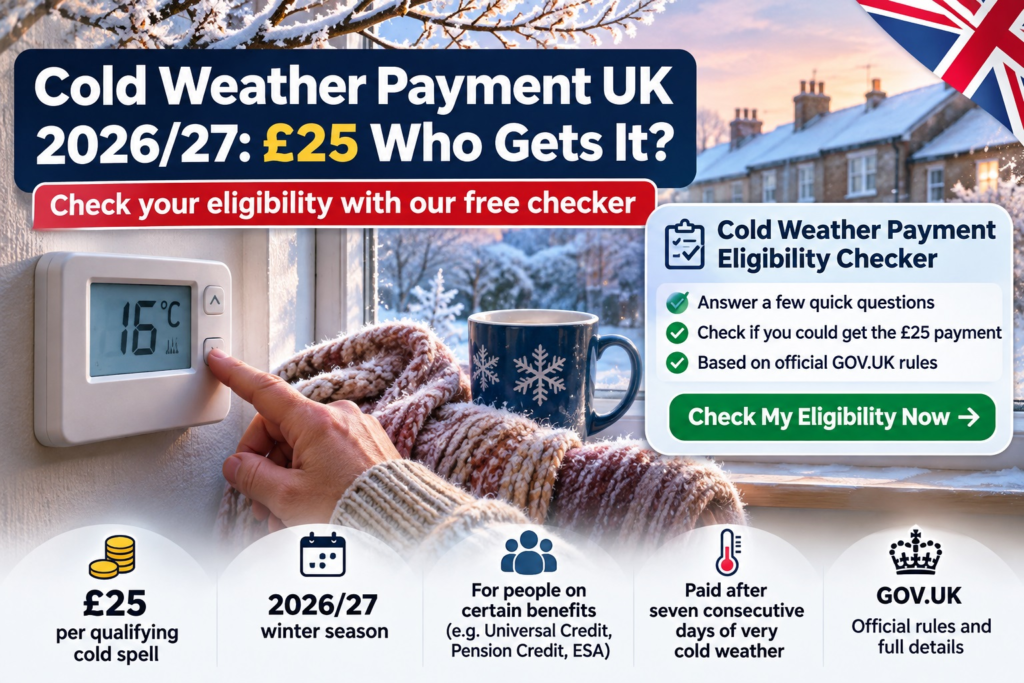
Cold Weather Payment 2026/27: key facts
| Question | Answer |
|---|---|
| How much is paid? | £25 for each qualifying seven-day cold-weather period |
| When does the scheme operate? | 1 November 2026 to 31 March 2027 |
| When does the weather trigger apply? | When average temperature is recorded as, or forecast to be, 0°C or below over seven consecutive days in the relevant area |
| Do you have to apply? | Normally no; eligible people are paid automatically |
| When should it arrive? | Usually within 14 working days after a qualifying cold period |
| Which countries? | England, Wales and Northern Ireland; Scotland has a separate scheme |
These are the published rules on the official GOV.UK Cold Weather Payment page.
Cold Weather Payment 2026/27 eligibility checker
Use this free, unofficial guidance checker to see whether your circumstances broadly match the government eligibility rules. It cannot check your benefit records, live weather triggers or guarantee a payment. Your answers stay in this browser; the tool does not submit them to us.
Check whether you may qualify for £25
Step 1. Answer the questions below.
Step 2. If you may qualify, use GOV.UK’s official postcode checker when available to see whether your area has triggered a payment. This tool does not check postcodes or live weather. Scotland uses Winter Heating Payment instead.
JavaScript is required for this on-page guidance checker. You can still check the official rules at GOV.UK.
Who gets the £25 Cold Weather Payment?
You may qualify if you receive one of the following benefits or forms of support, subject to the applicable additional conditions:
- Pension Credit
- Income-related Employment and Support Allowance (ESA)
- Universal Credit
- Support for Mortgage Interest (SMI)
Being on a low income does not, by itself, establish eligibility. Some qualifying benefits have extra conditions relating to children, disability, work and the kind of benefit award you receive. Check the official eligibility conditions before assuming you will get the payment.
Pension Credit: will you qualify?
People receiving Pension Credit will usually qualify if their area has an officially recognised qualifying cold spell. You do not need to submit a separate Cold Weather Payment application in the normal course of events. The payment goes to the bank or building society account used for your existing benefits.
Cold Weather Payment is not the same as Winter Fuel Payment. They are separate forms of support with different qualification rules. Receiving State Pension without Pension Credit does not, on its own, guarantee a Cold Weather Payment.
Universal Credit: does everyone qualify?
No. Universal Credit has additional rules. Generally, if neither you nor your partner is employed or gainfully self-employed, you may qualify if one of you has limited capability for work (with or without work-related activity) or you have a child under five living with you. A disabled child amount in your Universal Credit award can allow you to qualify regardless of whether you or your partner works.
This distinction is important. Two households can both receive Universal Credit but receive different Cold Weather Payment outcomes because of work status and award elements. If you are not sure what is included in your Universal Credit claim, check your award statement or ask through your Universal Credit journal.
For the full qualification wording and exceptions, use GOV.UK’s eligibility page, not a third-party eligibility checker that promises a definite outcome.
Income-related ESA: how does it work?
People receiving income-related ESA will usually qualify if they are in the work-related activity group or support group. Otherwise they may qualify if they receive a severe or enhanced disability premium or pensioner premium, have a disabled child, or have a child under five living with them.
It matters which type of ESA you receive. If your award letter does not make that clear, seek clarification from the relevant benefits service before making plans based on an expected payment.
What about Support for Mortgage Interest?
Support for Mortgage Interest can also be a route to qualification in some circumstances, depending on other relevant conditions such as specified premiums and children in the household. Because those conditions can be complex, check the individual rules on GOV.UK or with your benefit adviser.
How cold must it be to trigger payment?
The official trigger is an average temperature recorded as, or forecast to be, 0°C or below over seven consecutive days in the relevant area. The scheme uses designated weather-station information associated with postcodes.
That means a frosty car windscreen, a few hours of snowfall or one particularly cold night does not automatically qualify a postcode. Equally, the official trigger may apply even when temperatures at your particular home do not match every reading at the relevant weather station.
| Weather example | What it means |
|---|---|
| One night below freezing | Not enough by itself |
| Snow for a few hours | Snowfall alone is not the trigger |
| Seven consecutive days meeting the official 0°C average condition | Can trigger a £25 payment for eligible people |
| Two qualifying seven-day periods | Can produce £50 for an eligible recipient |
The 2026/27 scheme starts on 1 November 2026. At the date of this article, no qualifying period in the new season has yet finished.
How to check your postcode for Cold Weather Payments
GOV.UK provides an official postcode service to show whether an eligible area is due a payment. The 2026/27 postcode checker becomes available during November 2026.
- Go to GOV.UK — Cold Weather Payment.
- Choose the postcode checker for England and Wales, or Northern Ireland.
- Enter your full postcode when the 2026/27 checker is available.
- Read whether a qualifying cold spell has been recorded or forecast for your area.
- Check your individual benefit eligibility separately: a qualifying postcode does not make every resident eligible.
Do not rely on social-media posts claiming that everyone in a particular town will automatically receive £25. A weather trigger and personal eligibility are two separate tests.
When will the £25 arrive?
After a qualifying period of very cold weather, an eligible claimant should normally receive the payment within 14 working days. Money is paid into the same bank or building society account used for the qualifying benefit. There is generally no need to apply.
For example, if an eligible postcode has one qualifying seven-day period, the usual payment is £25. If there are two separate qualifying seven-day periods during the season, the amount could total £50. There is no fixed universal payment date because local cold-weather triggers vary.
See the official payment timetable and missing-payment guidance.
What if you qualify but do not receive the money?
First, check whether the postcode actually had a qualifying period and allow the normal payment window. If you still believe a payment is missing:
- Universal Credit: add a message to your Universal Credit journal. If you cannot access an online account, contact the Universal Credit helpline using the details on your claim correspondence.
- Pension Credit or other eligible benefits: contact the Pension Service or Jobcentre Plus, as appropriate.
- Change in your household: report relevant changes, especially having a baby or a child under five moving in, because the system may need current details to assess eligibility.
A request for information or a missing-payment query does not mean a payment is guaranteed. The government will assess your circumstances and the relevant local weather trigger.
Does Cold Weather Payment affect Universal Credit or other benefits?
No. According to GOV.UK, Cold Weather Payments do not affect your other benefits. They are additional support to help meet heating costs during eligible cold-weather periods.
They are also distinct from the £150 Warm Home Discount, which is an energy-bill discount under a separate scheme. For an explanation of that support, see our related article: Warm Home Discount 2026/27: Who Gets the £150 Energy Bill Discount?.
What happens in Scotland?
Scotland does not operate the £25 Cold Weather Payment scheme. It has a separate Winter Heating Payment, which is not dependent on an individual cold spell in your postcode.
For 2026/27, the Scottish Government’s guidance identifies the Winter Heating Payment as a fixed annual payment of £62 for eligible people on qualifying benefits. Its qualifying week is 2 to 8 November 2026. Check the Social Security Scotland eligibility guidance for the precise conditions.
Do not confuse Winter Heating Payment with Scotland’s Pension Age Winter Heating Payment, which is a different benefit.
Is Cold Weather Payment the same as Winter Fuel Payment?
No. Cold Weather Payment is a £25 payment triggered by a sustained period of very cold weather and linked to qualifying benefits. Winter Fuel Payment is a separate winter support scheme for eligible older people, with its own rules. The Warm Home Discount is different again: it provides a discount on qualifying electricity bills, not a Cold Weather Payment.
If you have seen claims online that everyone over a certain age automatically gets £25 whenever it snows, that is incorrect. Both the local weather trigger and the appropriate benefit eligibility conditions matter.
Practical ways to prepare for a cold spell
Even if your household does not qualify for Cold Weather Payments, it is worth planning for higher heating demand in winter. Check your heating controls, consider safe draught-proofing and make sure you understand the support available from your energy supplier if you struggle to pay.
Follow Met Office warnings for severe weather. For the science behind cold spells and winter conditions, see our existing articles Why Does Fog Form? and Why Does Ice Float on Water?.
Frequently asked questions
Is everyone on Universal Credit entitled to £25?
No. The Universal Credit rules include additional work, limited-capability-for-work and child-related conditions. Check your award and the official eligibility page.
Do I need to apply for a Cold Weather Payment?
Usually not. Eligible claimants should receive payments automatically once their area meets the qualifying weather trigger.
Can I get more than £25 in one winter?
Yes. The payment is £25 for each qualifying seven-day period, so multiple qualifying periods can result in multiple payments.
Will I get £25 if it snows tomorrow?
Not simply because it snows. The official test uses the seven-consecutive-day temperature threshold, not snowfall alone.
Will the payment reduce my other benefits?
No. GOV.UK says Cold Weather Payments do not affect other benefits.
Does Scotland pay the same £25?
No. Scotland uses its own Winter Heating Payment system, which has different rules and a fixed annual amount.
When can I check my postcode?
The 2026/27 scheme begins on 1 November 2026, with the official postcode-checking service becoming available in November.
The bottom line
For winter 2026/27, eligible households in England, Wales and Northern Ireland can receive £25 for every qualifying seven-day period of very cold weather between 1 November and 31 March. The payments are normally automatic, but eligibility depends on your benefits and household circumstances—not just your postcode or the fact that temperatures feel cold.
Use GOV.UK for the most up-to-date trigger and payment information. If you expect money that has not arrived, follow the official missing-payment process rather than repeatedly submitting claims through unofficial websites.
Editorial note: This article explains government support using publicly available official guidance. It is not an official DWP service, and it does not determine individual entitlement. Sources: GOV.UK overview, eligibility, payment guidance and Social Security Scotland.
Leave a Comment