One cold morning, your car windscreen is covered in ice and the grass looks white, even though there was no snow overnight. You check the forecast and find that the air temperature was 2°C. How can that happen?
Frost forms when surfaces become cold enough for ice crystals to develop from moisture in the air, or when water already on a surface freezes. In Britain, this can happen on clear, calm autumn and winter nights. The surprising part is that the ground or car glass can be colder than the air temperature shown on your weather app.
This guide explains how frost forms, why it is common in the UK, the difference between ground and air frost, and what it means for gardens and icy roads. The scientific explanations draw on guidance from the UK Met Office.
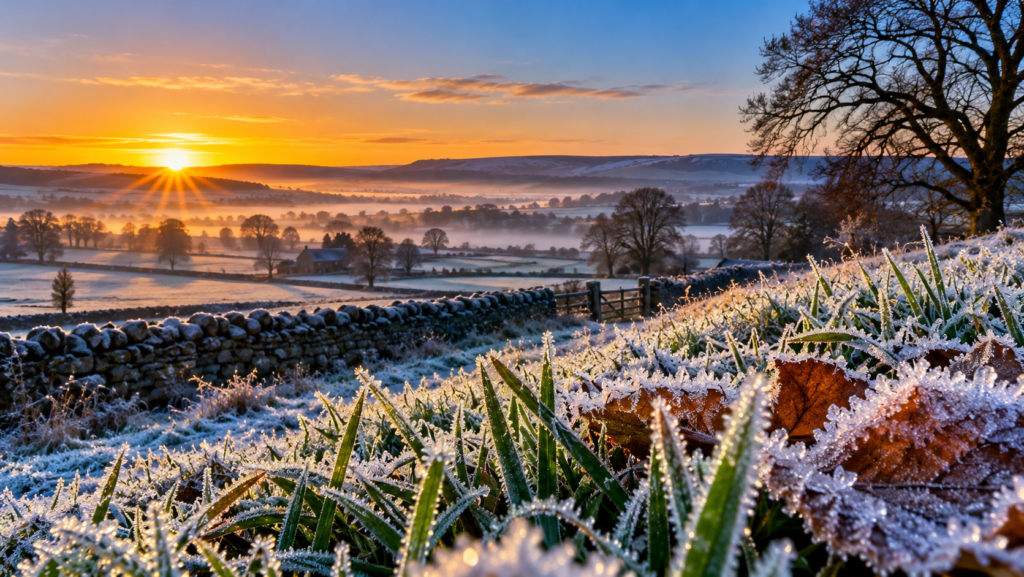
What is frost?
Frost is ice that develops on an exposed surface such as grass, leaves, fences, car windscreens or rooftops. It can look like a white dusting, tiny crystals or delicate feathery structures.
Some frost forms when invisible water vapour changes directly into solid ice. This process is called deposition. In other circumstances, liquid dew forms first and then freezes. Both can produce a white icy coating, although the appearance of the crystals varies.
Frost does not need to fall from a cloud. That is one of the important differences between frost and snow.
How does frost form? Four simple steps
- Heat escapes overnight. After sunset, exposed ground and objects lose energy, including through infrared radiation.
- Surfaces cool below freezing. On calm, clear nights, grass or glass may fall below 0°C even when the surrounding air is slightly warmer.
- Moisture reaches the surface. Water vapour may turn directly into ice crystals, or previously formed dew may freeze.
- The crystals build up. If there is enough moisture, a visible layer of frost develops by morning.
The Met Office’s explanation of how frost forms illustrates how surface temperature and moisture must work together. Cold temperatures alone do not guarantee a visible white coating: very dry air may offer too little moisture.
Why are clear and calm nights especially frosty?
Cloud cover and wind play major roles. A clear sky allows the ground to lose heat efficiently overnight. Clouds absorb and re-emit some infrared energy back toward the surface, which can slow cooling. That is why cloudy nights are often milder than clear ones.
Wind can also mix the cold air near the ground with warmer air above it. When the air is relatively still, a shallow cold layer may remain undisturbed, allowing the surface to cool further.
This explains a familiar British weather pattern: a sunny, settled afternoon followed by a surprisingly frosty morning. High pressure can bring clear skies and light winds, both of which favour overnight cooling.
What is the difference between ground frost and air frost?
These expressions describe temperatures recorded at different heights. In UK weather reporting, an air frost occurs when the measured air temperature falls below 0°C, while a ground frost refers to freezing conditions close to the ground, often assessed using a grass-minimum temperature.
| Type | What it means | Everyday example |
|---|---|---|
| Ground frost | Surface or grass-level temperature drops below 0°C | White lawn with air temperature still above freezing |
| Air frost | Air temperature at standard observation height falls below 0°C | Widespread freezing overnight conditions |
| Hoar frost | Ice crystals develop on a freezing surface, commonly from water vapour | Feathery crystals on branches |
| Rime | Supercooled fog droplets freeze onto a surface | Rough white coating on exposed fences |
| Glaze ice | Liquid water freezes into a smoother, often clear coating | Hard-to-see ice on a road or pavement |
The Met Office distinguishes these forms in its official frost and ice guidance. They are related but not identical.
How can frost form when the weather app says 2°C?
Forecast temperatures usually describe the air, not every individual surface. Exposed grass, a parked car and garden furniture exchange heat with their surroundings differently from the air measured at a weather station.
A car windscreen may radiate heat toward a clear night sky and drop below 0°C while the nearby air remains at +2°C. Grass may cool even more quickly than pavement, which can retain warmth from the previous day.
The Met Office notes that on a clear night with light winds, even forecast air temperatures of roughly 0°C to 4°C can coincide with frost at ground level. The exact risk depends on local conditions.
Why does frost appear on grass but not pavement?
Different surfaces store and release heat differently. Grass and thin leaves have relatively little stored warmth, while paving and tarmac may release heat absorbed during the day. Trees, buildings and walls also shelter some surfaces from the open sky.
As a result, a single garden can contain white grass beside unfrosted paving stones. The difference is particularly noticeable on calm mornings when small local temperature variations have time to develop.
Frost on grass is therefore not proof that the road is icy—and a clear-looking road is not proof that it is safe. Wet surfaces can still freeze into dangerous transparent ice.
What is hoar frost?
Hoar frost is a coating of ice crystals that can appear especially delicate or feathery. The crystals can form when water vapour deposits onto a cold surface rather than first collecting as liquid water.
Fences, leaves, wires and tree branches are common places to see it. The shape depends on temperature, humidity and how the ice crystals grow. You may see sparkling needles, plates or fern-like patterns.
Hoar frost is different from rime. Rime often develops when freezing fog contains supercooled liquid droplets that freeze after striking an object. The resulting deposit is typically rougher and can accumulate on the side facing the wind.
Why does the UK get frosty mornings?
The UK has a maritime climate, with the Atlantic moderating many temperature extremes. But cold air, long nights and settled conditions can still produce freezing temperatures, particularly inland.
Rural valleys are often prone to frost because cold, dense air can move downhill and collect in low-lying places. Meanwhile, town centres may remain warmer thanks to buildings and roads that store heat. This is part of the urban heat island effect.
The Met Office explains why frost can occur even in late spring, especially in rural and sheltered locations. A mild afternoon does not guarantee a frost-free night.
Can frost happen in October?
Yes. Frost is possible during autumn whenever surfaces cool sufficiently and moisture is available. It is not limited to December, January or February. In northern, inland and elevated parts of the UK, autumn frost can be particularly noticeable.
There is no fixed date when the first frost must arrive. Coastal areas may remain milder while nearby inland valleys turn white overnight. Weather forecasts for a specific postcode are more useful than a general seasonal rule.
How does frost differ from snow, hail and freezing fog?
| Weather feature | Where the ice develops | How it reaches the ground |
|---|---|---|
| Frost | On an exposed surface | Develops in place from vapour or freezing moisture |
| Snow | Inside clouds | Snowflakes fall as precipitation |
| Hail | Inside strong convective clouds | Ice pellets or stones fall during a storm |
| Freezing-fog rime | On objects within fog | Supercooled fog droplets freeze on contact |
Our related articles explain why fog forms and why ice floats on water. Both involve water changing form, but the processes are different.
Why does frost melt after sunrise?
As sunlight warms the ground and exposed objects, frost can melt into liquid water. Ice can sometimes also change directly into water vapour, a process known as sublimation.
This is why frost on a sunny lawn may vanish quickly while a patch beneath a tree or on the north-facing side of a building remains white. Shade slows warming.
However, sunshine does not immediately remove every ice hazard. Temperatures can remain below freezing in shaded locations, and road or pavement ice may persist long after sunrise.
Can frost damage garden plants?
It can. Tender plants may be damaged when their tissues experience freezing temperatures. The effects depend on the plant species, how long the cold lasts and whether the plant has hardened to cooler conditions.
Gardeners can protect vulnerable plants with suitable horticultural fleece or move pots into shelter when frost is forecast. Some hardy plants tolerate ordinary winter conditions well, while early spring blossoms can be particularly sensitive to a sudden cold snap.
Do not assume that every frosted leaf has been permanently damaged. Frost exposure and actual plant injury are not always the same thing.
Why is frost important for UK road safety?
Frost on a lawn may be attractive, but freezing moisture on a road or pavement can be hazardous. Black ice is a thin, transparent ice coating that may look like an ordinary wet patch.
Bridges, exposed roads, shaded paths and rural routes may freeze at different rates. Take particular care early in the morning and after temperatures have fallen overnight. Do not assume that a route is ice-free because nearby surfaces look dry.
Check current Met Office weather warnings and local transport advice before travelling in hazardous conditions. Frost science is useful, but a forecast cannot guarantee the condition of every individual road.
Three simple observations you can make
- Compare surfaces: after a cold night, see whether grass is frosted while a nearby path remains clear. Stay off slippery ground.
- Compare exposure: check whether the open lawn has more frost than the grass beneath an overhanging tree.
- Watch the thaw: notice whether sunny areas clear before shaded ones as the morning warms.
These observations reveal that frost is about local temperatures and moisture, not just a single number on a weather app.
Frequently asked questions
At what temperature does frost form?
Frost can develop when a surface is at or below 0°C and sufficient moisture is available. The surrounding measured air temperature may still be slightly above freezing.
Can there be frost without snow?
Yes. Frost commonly develops directly on objects and ground surfaces. It does not need precipitation.
Why does my windscreen freeze but the road does not?
Glass and road surfaces lose, absorb and store heat differently. A windscreen can cool below freezing while nearby paving remains slightly warmer.
Is frost the same as dew?
No. Dew consists of liquid water droplets. Frost consists of ice. Dew can freeze after forming, but some frost develops directly from water vapour.
Does frost always mean the air temperature fell below zero?
No. Ground and exposed surfaces may freeze even when the standard air temperature stays above 0°C.
What is the difference between hoar frost and rime?
Hoar frost commonly forms as ice crystals grow from vapour on a cold surface; rime forms as supercooled fog droplets freeze on contact.
Can frost form in spring?
Yes. Clear, calm nights can produce ground frost in parts of the UK well into spring, particularly in rural or elevated locations.
The bottom line
Frost is an everyday demonstration of how heat, moisture and the atmosphere interact. On a clear, calm night, exposed surfaces can cool below freezing and allow ice crystals to develop—even if the forecast air temperature remains slightly above zero.
Understanding the distinction between ground frost, air frost, hoar frost and freezing-fog ice helps explain why British lawns, cars and roads can look so different on the same morning.
Sources and further reading: Met Office: Frost and ice; Met Office: How temperature is measured; Met Office: Late spring frost.
Leave a Comment