Booking accommodation online has made travelling easier than ever.
Within minutes, you can compare apartments, hotels and holiday homes in another city or country, check photographs, read reviews and pay without ever speaking to the owner.
But that convenience creates an opportunity for scammers too.
A fake accommodation listing can look remarkably convincing. It may contain professional photographs, a believable address, detailed descriptions and even apparently attractive pricing.
The property might not exist.
The photographs may have been copied from somewhere else.
Or the address may belong to a completely unrelated building.
In September 2026, consumer investigators reported cases involving fake accommodation listings using real London addresses, including travellers arriving at a pub near Tower Bridge after booking what they believed were luxury apartments. Which?
Losing the booking money is bad enough. Discovering the problem after you’ve travelled can leave you stranded in an unfamiliar place with nowhere to stay.
Fortunately, there are several checks you can make before paying.
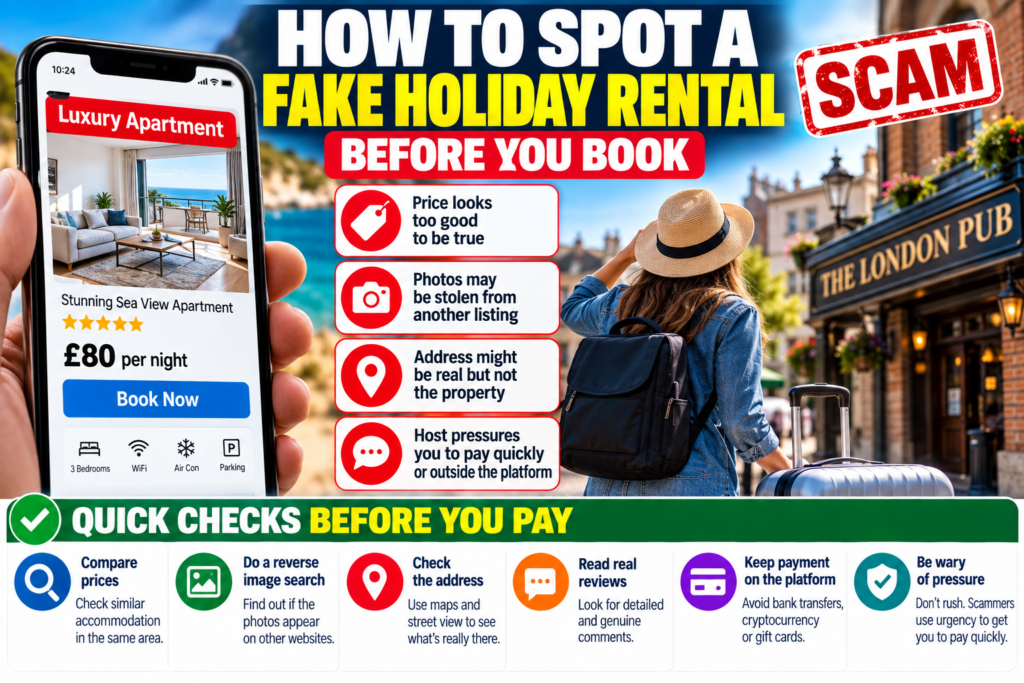
Why Fake Holiday Listings Can Look So Convincing
People often imagine scam websites as badly designed pages filled with spelling mistakes.
Modern accommodation fraud can be much more sophisticated.
A scammer doesn’t necessarily need to create photographs, floor plans or descriptions from scratch.
They can copy them from genuine properties.
A legitimate apartment advertised elsewhere can therefore be transformed into a convincing fake listing within a short time.
The photographs look real because they are real.
They simply don’t belong to the person taking your money.
Scammers may also use the address of a real building. That makes checking the location on a map less useful if it’s your only verification method.
Some fraudulent listings appear on established booking platforms rather than unknown websites, which can create another false sense of security.
Consumers may understandably think:
“If it’s listed on a major platform, somebody must have verified it.”
You shouldn’t assume that.
A recognised booking platform can reduce certain risks and may provide consumer protections, but the presence of a listing doesn’t guarantee that every claim made by the host is accurate.
The safest approach is to evaluate the property itself, not simply trust the logo at the top of the website.
Warning Signs to Check Before You Pay
One suspicious detail doesn’t automatically prove that a holiday rental is fraudulent.
Several warning signs appearing together, however, should make you much more cautious.
Start with the price.
If similar apartments in the same area cost £250 per night and one apparently luxurious property costs £80, ask why.
There can be legitimate discounts.
A newly listed property might offer introductory pricing. An owner may reduce prices because of a cancellation. Seasonal demand also changes.
But an unusually low price is one of the easiest ways to attract people quickly.
Scammers benefit when you think:
“I need to book this before somebody else does.”
That brings us to another warning sign: pressure.
Be cautious if a host repeatedly tells you:
- another traveller is about to book,
- the price will disappear within minutes,
- you must pay immediately,
- or you need to move the conversation away from the booking platform.
Urgency is particularly suspicious when it’s combined with an unusual payment request.
If a listing appears on a booking platform but the host asks you to pay by direct bank transfer, cryptocurrency, gift card or through an unrelated payment link, stop.
Moving payment outside the platform may remove protections you would otherwise have.
You should also examine the listing itself carefully.
Read:How to Tell If an Online Shopping Website Is Safe Before You Buy
Look for inconsistencies.
Does the description say there are three bedrooms while the photographs appear to show only one?
Does the exterior photograph match the address?
Does the description mention a balcony that isn’t visible anywhere?
Does the host describe the property as being beside a famous attraction when the map shows it several miles away?
Small inconsistencies can reveal a listing assembled from information copied from different sources.
Check the Property Beyond the Booking Page
Don’t make the booking page your only source of information.
Search the exact property name and address independently.
You may discover that the same photographs appear under a completely different name.
Or you may find that the supposed apartment address actually belongs to:
- an office,
- restaurant,
- pub,
- shop,
- public building,
- or completely different hotel.
Use an online map and, where available, street-level imagery to examine the location.
If the listing claims to be a detached countryside cottage but the address appears to be a block of offices, something is clearly wrong.
You can also perform a reverse image search on some of the property photographs.
This allows you to search the internet using an image rather than words.
If the same photograph appears on several unrelated accommodation listings in different cities or countries, that’s a serious warning sign.
However, duplicate photographs aren’t automatically evidence of fraud.
Legitimate properties can appear on several booking websites.
The question is whether the details are consistent.
If the same apartment is legitimately advertised by multiple platforms under the same name and address, that may be normal.
If a London apartment photograph also appears as a villa in Barcelona, you have a problem.
Reviews deserve scrutiny too.
Don’t simply look at the average star rating.
Read the actual comments.
A large number of vague reviews such as:
“Amazing stay!”
“Great host!”
“Perfect place!”
tell you much less than detailed reviews discussing the location, rooms, check-in process and nearby facilities.
Look at the dates as well.
A property supposedly operating for years but possessing only a sudden cluster of recent reviews may deserve closer examination.
No reviews isn’t automatically suspicious — every legitimate listing has to start somewhere — but a new property with no history deserves additional checking before you commit a large amount of money.
Keep Communication and Payment Protected
One of the safest habits when using a booking platform is to keep your communication inside the platform.
A scammer may try to move you to WhatsApp, email or another messaging service.
There can be innocent reasons for a host to communicate elsewhere, but moving conversations off-platform can make disputes harder to document.
If something goes wrong, an official message history provides evidence of what was promised.
Payment deserves even more care.
Where possible, use the payment system provided by the legitimate booking service.
Be particularly cautious if you’re told:
“The platform payment isn’t working. Transfer the money directly to me instead.”
That may be an attempt to bypass safeguards.
Credit cards can also provide valuable consumer protections in some circumstances.
In the UK, Section 75 of the Consumer Credit Act can provide protection for certain credit-card purchases where the cash price of an item or service is more than £100 and no more than £30,000, although eligibility depends on the circumstances.
Debit and credit card payments may also sometimes qualify for chargeback, depending on the situation and card scheme.
A direct bank transfer can be much harder to recover once the recipient has moved the money.
Before paying, take screenshots or save copies of important information, including:
- the listing,
- price,
- address,
- cancellation terms,
- property description,
- and important messages from the host.
If the listing later disappears, you’ll still have evidence of what you purchased.
What to Do Just Before You Travel
Don’t assume the job is finished once you’ve paid.
A few days before travelling, check the booking again.
Confirm that:
- the property is still listed,
- the reservation remains active,
- you have clear check-in instructions,
- the address hasn’t changed,
- and the host can still be contacted through the official platform.
Be suspicious if you’re suddenly told at the last minute that the original property is unavailable but the host has another property for you.
There are legitimate situations where accommodation becomes unavailable because of flooding, maintenance problems or another emergency.
But unexpected property substitutions are also used in accommodation scams.
If the replacement is substantially different from what you booked, contact the booking platform through its official website or app rather than relying solely on contact details supplied by the host.
The same rule applies if you receive an unexpected message asking you to “verify” your booking by entering card information again.
Don’t automatically trust a message simply because it contains genuine information about your reservation.
Instead, open the booking service yourself and check whether any action is actually required.
What to Do If the Property Doesn’t Exist
Imagine you’ve arrived.
The address is correct.
But there is no holiday apartment.
First, document what you’ve found.
Take photographs of the location and screenshots of the listing and your booking confirmation.
Don’t delete messages from the host.
Contact the booking platform immediately through its official customer-service channels.
Explain clearly that the accommodation appears not to exist or isn’t available as advertised.
If you’ve paid by card, contact your card provider as well and explain that you believe you’ve paid for fraudulent or nonexistent accommodation.
If you transferred money directly to a scammer, contact your bank immediately.
The faster you report suspected fraud, the better the chance that financial institutions may be able to take action.
UK consumers who have lost money to fraud can also report it through the appropriate national fraud-reporting service.
Most importantly, don’t send the supposed host more money in an attempt to fix the problem.
A scammer may claim that your original payment failed, that another deposit is required, or that they can move you to a different property for an additional fee.
Once you suspect fraud, stop following the scammer’s instructions.
A Two-Minute Check Before Booking
You don’t need to conduct a full investigation every time you book a weekend away.
A short routine catches many obvious problems.
Before paying, ask yourself:
Is the price realistic for the area?
Search comparable accommodation nearby.
Does the address match the property?
Check the map and street imagery where available.
Do the photographs appear elsewhere?
Try a reverse image search if anything looks suspicious.
Do the reviews look genuine and detailed?
Read them instead of relying only on the star rating.
Is the host trying to move payment elsewhere?
Don’t abandon the platform’s official payment system simply because you’re promised a discount.
Am I being rushed?
A countdown or urgent message should make you more careful, not less.
Can I verify the booking independently?
Never let a suspicious email, text or message determine which website or phone number you use to investigate.
Those checks take only a few minutes.
They can save you from discovering the truth with your suitcase in your hand hundreds of miles from home.
Read:How to Spot a Scam Text Message Before You Click Anything
The Bottom Line
Fake holiday accommodation doesn’t always look fake.
That’s the problem.
Scammers can copy genuine photographs, use real addresses and advertise through platforms people already recognise.
The strongest protection is therefore not trying to spot one magical sign of fraud.
It’s verification.
Check the address.
Research the property independently.
Read the reviews carefully.
Compare the price with similar accommodation.
Keep conversations and payments within the legitimate booking platform where possible.
And be extremely cautious if somebody asks you to transfer money elsewhere.
The time to discover that a luxury apartment doesn’t exist is before you travel, not when you’re standing outside its supposed address.
Frequently Asked Questions
Can fake accommodation appear on legitimate booking websites?
Yes. A recognised platform doesn’t guarantee that every listing is genuine or that every claim made by a host is accurate. Check the individual property before paying.
Is a cheap holiday rental automatically a scam?
No. Genuine discounts exist. But a price dramatically below comparable accommodation is a reason to investigate further.
Should I pay a holiday-rental host by bank transfer?
Be cautious if a host asks you to move payment outside an established booking platform, particularly when the platform provides its own payment system.
How can I check whether rental photographs are stolen?
A reverse image search can help you find other websites using the same photographs. Compare the property name, address and description across the results.
What should I do if I arrive and the accommodation doesn’t exist?
Document the situation, contact the booking platform through its official channels and contact your payment provider or bank promptly if you believe you’ve been defrauded.
Leave a Comment