Compound interest is often explained as a way savings grow, but the same principle can also help explain why borrowing becomes expensive.
In the UK, understanding compounding means knowing more than the basic formula. It also means recognising the difference between AER, commonly used when comparing savings accounts, and APR, used to describe borrowing costs.
This guide explores how compounding relates to savings, credit cards, debt repayments and investment returns, with practical examples and explanations of the financial terms you may encounter.
For a step-by-step introduction to the calculation itself, see our basic compound interest guide.
What Is Compound Interest?
Compound interest means that interest is calculated on an amount that can include both:
the original principal and previously accumulated interest.
The principal is the amount of money you started with.
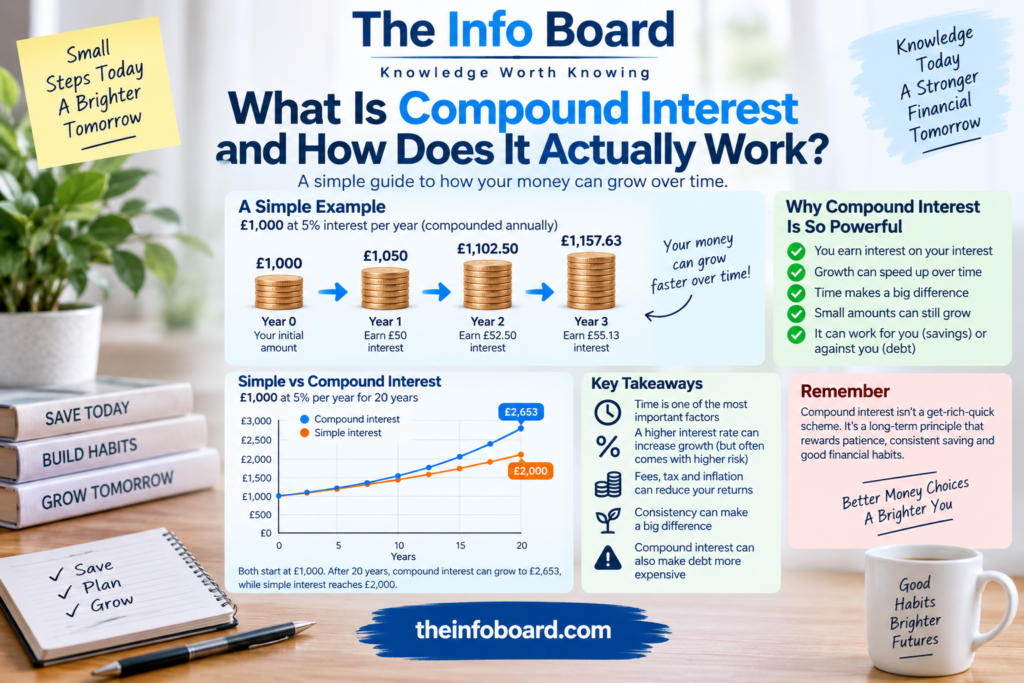
Suppose you deposit £1,000 into an account earning 5% interest per year, ignoring taxes, fees and changes in the rate.
After one year:
£1,000 + £50 interest = £1,050
If the next year’s 5% interest is calculated on £1,050 rather than the original £1,000, you earn:
£52.50
Your new balance becomes:
£1,102.50
That extra £2.50 may not look impressive.
But that’s exactly where compounding begins.
Simple Interest vs Compound Interest
The difference becomes clearer when we compare compound interest with simple interest.
With simple interest, interest is calculated only on the original principal.
Using £1,000 at 5% per year:
Year 1: £50 interest
Year 2: £50 interest
Year 3: £50 interest
After three years, the total would be £1,150.
With annual compounding:
Year 1: £1,050
Year 2: £1,102.50
Year 3: £1,157.63 approximately
The difference after only three years is small.
Over longer periods, however, that gap can become much larger.
Why Does Compound Interest Become More Powerful Over Time?
Because the amount generating interest can keep increasing.
At first, most of the growth comes from your original money.
Later, accumulated interest can itself contribute increasingly to future growth.
Think of it as a snowball rolling downhill.
At the beginning, it’s small.
As it rolls, it collects more snow.
A larger snowball can then collect even more snow.
Compound growth works differently mathematically, but the analogy captures the central idea:
growth can build upon previous growth.
A Longer Example
Suppose £1,000 earned a hypothetical fixed 5% annually, compounded once per year, with no withdrawals, fees or taxes.
After 1 year: £1,050
After 5 years: approximately £1,276
After 10 years: approximately £1,629
After 20 years: approximately £2,653
After 30 years: approximately £4,322
You haven’t added another penny in this simplified example.
The difference comes from time and compounding.
Of course, real savings and investment returns may change, and these figures are illustrative rather than a promise of future returns.
How Is Compound Interest Calculated?
A basic compound-interest formula is:
A = P(1 + r/n)^(nt)
Where:
A = final amount
P = starting principal
r = annual interest rate expressed as a decimal
n = number of compounding periods per year
t = number of years
You don’t need to calculate this manually every time.
Banks, financial calculators and spreadsheets can do it automatically.
But understanding the formula reveals the factors that matter most:
starting amount, interest rate, compounding frequency and time.
Why Is Time So Important?
Time gives compounding more opportunities to work.
Consider two people who eventually save the same amount of money but start at different ages.
The person whose money has longer to compound may end up with a different result, depending on returns and contributions.
This is why financial education often emphasises starting to save early.
It isn’t because starting with a huge amount is required.
It’s because time itself can be valuable.
What Does the Interest Rate Change?
The rate has a major effect on long-term outcomes.
At higher rates, the balance grows faster — assuming the rate remains the same.
For example, £1,000 compounded annually for 20 years would produce very different results at 2%, 5% and 8%.
But higher potential returns can also come with higher risk, particularly when moving from protected savings products into investments.
A high advertised return should therefore never be considered in isolation.
You also need to understand risk, fees, access conditions and whether the return is guaranteed or variable.
What Does “Compounded Daily” or “Monthly” Mean?
Interest doesn’t always compound once per year.
Depending on the financial product, it may be calculated or compounded at different intervals.
For example:
daily, monthly, quarterly or annually.
More frequent compounding can produce a slightly different effective return when other factors are identical.
However, consumers shouldn’t compare accounts based only on the words “compounded daily” or “compounded monthly.”
A standardised annual rate or equivalent measure can be more useful when comparing products.
Read:What Is a Direct Debit and How Does It Work?
What Is AER?
In the UK, savings accounts commonly display an AER, or Annual Equivalent Rate.
AER is designed to show what the interest rate would effectively be over a year if interest were paid and compounded according to the product’s terms.
That makes it easier to compare savings accounts that may calculate or pay interest differently.
For example, one account might pay interest monthly while another pays annually.
Looking at the AER helps provide a more consistent comparison.
Always check the account’s full terms as well, particularly if there are withdrawal restrictions, introductory rates or balance requirements.
Is APY the Same Thing?
You may encounter APY — Annual Percentage Yield — when reading US financial information.
Like AER, APY reflects the effect of compounding over a year.
The terminology and regulatory conventions vary between countries, so it’s important to know which measure applies where you live.
For The Info Board’s UK readers, AER is generally the more familiar savings-account term.
Compound Interest Isn’t Only About Savings
Compounding can work for you when money is growing.
But it can also work against you when you owe money.
This distinction is extremely important.
Interest charged on borrowing can increase the amount you owe, and depending on the product and how interest is calculated, unpaid interest and charges may contribute to a growing balance.
So the same broad mathematical concept that helps savings grow can make certain debts increasingly expensive.
How Does Compounding Affect Credit Cards?
Credit cards are more complicated than a simple savings-account example.
Interest can be calculated according to the card’s terms, and different types of transactions may have different rates or conditions.
If you carry a balance and interest is charged, the cost of borrowing can accumulate.
Continuing to spend while making only small repayments can make the debt take much longer to clear.
This is one reason the APR, repayment terms and total cost of borrowing matter when evaluating credit.
What Is APR?
APR stands for Annual Percentage Rate.
It is commonly used to help consumers understand and compare the cost of borrowing.
APR and AER are not interchangeable.
A simple way to remember the distinction is:
AER is commonly associated with savings.
APR is commonly associated with borrowing.
The exact calculations and rules behind these measures are more detailed, but this distinction is useful for everyday financial literacy.
Why Minimum Payments Can Be Expensive
Credit-card statements generally specify a minimum payment.
Paying at least the required minimum is important, but consistently paying only the minimum can mean the balance takes considerably longer to repay and may result in much more interest being paid.
A small monthly payment can therefore make debt appear more manageable than its total cost really is.
When assessing borrowing, don’t ask only:
“Can I afford this month’s payment?”
Also ask:
“How much will this cost me in total, and how long will repayment take?”
That is often the more important question.
Can Compound Growth Apply to Investments?
Yes, although investment growth is not the same as guaranteed bank interest.
Investment returns can potentially generate further returns when gains or income remain invested.
For example, reinvested dividends may purchase additional investments, which can themselves potentially generate future returns.
However, investments can also fall in value.
Returns aren’t normally fixed or guaranteed.
So although compounding is an important concept in investing, examples using constant annual growth rates should never be mistaken for predictions.
What Is Reinvesting?
Reinvesting means putting income or gains back into an asset or account rather than taking the money out for spending.
Suppose an investment produces income.
If you withdraw that income, it no longer participates in future investment growth.
If you reinvest it, the additional amount may itself generate future returns.
This can contribute to compounding over long periods.
Again, investment values can rise and fall, so the result is not guaranteed.
Does Inflation Matter?
Absolutely.
Seeing your account balance increase doesn’t automatically mean your purchasing power has increased by the same amount.
Inflation means the general price level of goods and services rises over time.
Suppose your savings grow by 2% during a period when prices rise by 4%.
Your account contains more pounds, but those pounds may buy less in real terms than the headline balance suggests.
This is why financial decisions often distinguish between nominal returns and real returns after inflation.
What About Tax?
Tax can also affect the amount you actually keep.
The treatment of savings and investments depends on your country, circumstances and the type of account or product being used.
In the UK, certain tax allowances and tax-advantaged accounts may affect how savings or investment income is treated.
Rules can change, so current official guidance should be checked rather than relying on an old article for individual tax decisions.
What About Fees?
Fees can have a compounding effect too — unfortunately in the opposite direction.
If an investment product charges ongoing fees, those costs reduce the amount remaining to generate potential future returns.
A difference that looks small as an annual percentage can become meaningful over many years.
When comparing financial products, look beyond headline returns.
Consider:
fees, taxes, inflation, risk and access restrictions.
The advertised percentage is only part of the picture.
Can Small Amounts Really Make a Difference?
Yes, particularly when contributions are consistent and have time to accumulate.
You don’t necessarily need a large lump sum to benefit from compound growth.
Regular contributions can gradually increase the amount working for you.
For example, someone saving a manageable amount every month isn’t relying solely on interest.
They’re combining:
new contributions + previous savings + potential returns + time.
Consistency can therefore matter as much as the starting balance.
What Is the Rule of 72?
The Rule of 72 is a quick mental estimate for how long money might take to double at a fixed compound annual rate.
Divide 72 by the annual percentage rate.
For example:
At 6%:
72 ÷ 6 = approximately 12 years
At 8%:
72 ÷ 8 = approximately 9 years
It’s only an approximation, not a precise financial calculation.
It also assumes a constant positive rate, which may not reflect real investment performance.
Still, it’s a useful way to develop intuition about compounding.
Why Does Starting Earlier Matter So Much?
Imagine giving a snowball more hill to roll down.
The longer the period, the more opportunities there are for growth to build upon earlier growth.
Starting earlier doesn’t guarantee wealth.
Interest rates change. Investments fluctuate. Inflation matters. Life interrupts savings plans.
But mathematically, more time creates more potential compounding periods.
That’s why even modest early savings can be valuable.
Common Compound-Interest Mistakes
One mistake is assuming an advertised rate will remain unchanged forever.
Variable savings rates can change.
Investment returns fluctuate.
Another mistake is ignoring fees.
A third is assuming all debt compounds in exactly the same way.
Financial products have different terms and calculation methods.
And perhaps the biggest mistake is treating a hypothetical compound-growth calculator as a prediction.
It isn’t.
It’s a mathematical illustration based on assumptions.
How Can You Use Compounding Sensibly?
The principle is straightforward:
Start saving when you’re able to.
Contribute consistently where practical.
Understand the rate you’re receiving or paying.
Pay attention to fees.
Don’t ignore inflation.
Understand the risks of investments.
Be particularly careful when compounding is working against you through expensive debt.
And always read the terms of the actual financial product.
Compound interest is powerful, but it isn’t magic.
Read:What Is a Sinking Fund and How Does It Work?
The Bottom Line
Compound interest means earning interest on both your original money and interest that has already accumulated.
That creates the possibility of growth building upon previous growth.
At first, the difference may seem tiny.
Over many years, it can become much more significant.
But compounding has two sides.
When you’re saving or investing successfully, it can help your money grow.
When you’re paying interest on debt, accumulating costs can work in the opposite direction.
The most important ingredient is often something you can’t buy later: time.
Understanding that simple principle can make compound interest one of the most useful concepts in everyday personal finance.
Frequently Asked Questions
What is compound interest in simple terms?
Compound interest is interest calculated on your original money plus interest that has already accumulated.
What is the difference between simple and compound interest?
Simple interest is calculated only on the original principal. Compound interest can also be calculated on previously accumulated interest.
Why is compound interest powerful?
Because growth can build on previous growth. Over long periods, this can significantly increase the difference between simple and compounded returns.
What does AER mean?
AER stands for Annual Equivalent Rate. It helps consumers compare savings accounts by reflecting the effect of interest over a year according to the product’s terms.
What does APR mean?
APR stands for Annual Percentage Rate and is commonly used when describing and comparing the cost of borrowing.
Can compound interest make debt grow?
Interest and charges can cause borrowing costs to accumulate, depending on the terms of the debt. This is why understanding the total cost of borrowing is important.
Is compound interest guaranteed on investments?
No. Investments can rise or fall in value, and future returns are not guaranteed.
Further reading: MoneyHelper provides independent guidance on saving money and understanding savings options. Visit MoneyHelper for more information.
Important information: The calculations in this article are illustrative examples. Actual interest rates, fees, tax treatment and investment returns vary depending on the product and individual circumstances. This article provides general educational information, not personalised financial advice.