Direct Debits are everywhere. They are commonly used to pay energy bills, council tax, broadband, mobile contracts, insurance, subscriptions and many other regular expenses.
Yet it is easy to use Direct Debits for years without really understanding what happens behind the scenes.
A Direct Debit is an instruction that allows an organisation to collect money directly from your bank or building society account, provided you have authorised it to do so.
Unlike a standing order, the organisation collecting the payment can usually change the amount or payment date when necessary — but it must follow the rules of the Direct Debit scheme and normally tell you about changes in advance.
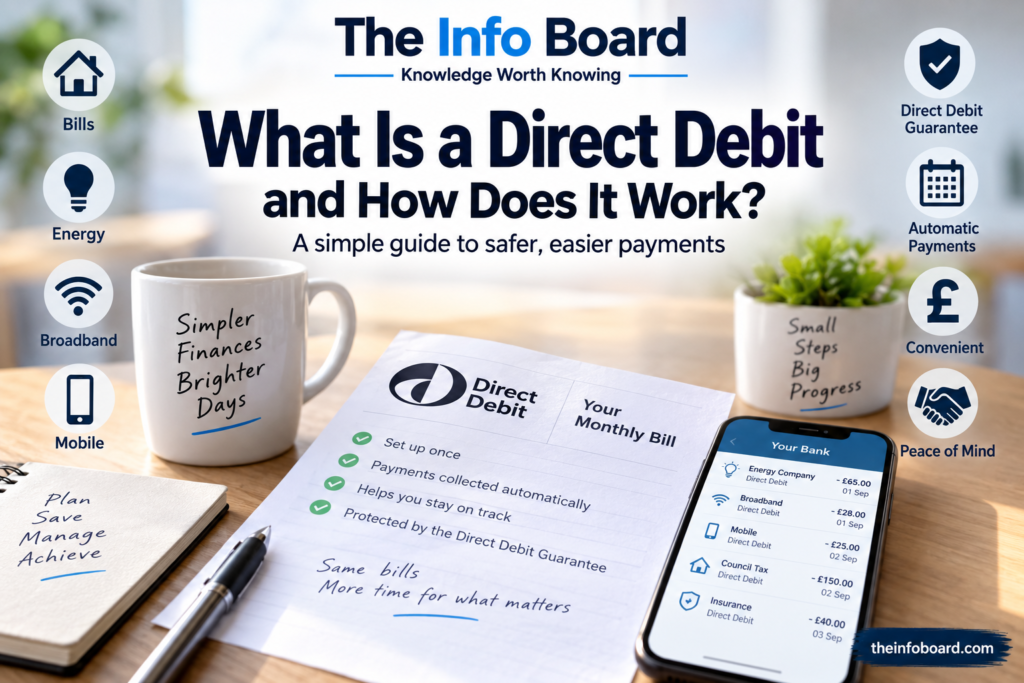
Here is how it works.
What Is a Direct Debit?
A Direct Debit gives an organisation permission to collect payments from your bank account.
The organisation requesting the money is sometimes referred to as the service user.
For example, imagine you pay your electricity company by Direct Debit.
You provide permission for the company to collect your electricity payments from your bank account. Your bank then processes those requests when the company submits them.
This makes Direct Debit particularly useful for bills where the amount can change.
How Does a Direct Debit Work?
The process usually begins when you give a company permission to set up a Direct Debit.
This may be done online, over the telephone or using a paper form, depending on the organisation.
Once established, the company can request payments from your account according to the agreed arrangement.
A simplified version looks like this:
You authorise the Direct Debit → the company requests payment → your bank processes the request → the money leaves your account.
You do not have to manually make each individual payment.
Can the Amount of a Direct Debit Change?
Yes.
This is one of the major differences between a Direct Debit and a standing order.
A Direct Debit can be used for fixed payments, but it can also collect variable amounts.
For example, your mobile bill might normally be £30 but increase one month because of additional charges.
An energy supplier may also adjust your regular payment based on your expected usage or account balance.
However, companies cannot simply take whatever they want without rules. Changes to the amount, date or frequency of a Direct Debit normally require advance notice under the Direct Debit scheme.
What Is the Difference Between a Direct Debit and a Standing Order?
People often confuse these two payment methods, but there is an important distinction.
With a Direct Debit, you authorise an organisation to collect money from your account.
With a standing order, you instruct your own bank to send a specific amount to another account at regular intervals.
For example, you might create a standing order to transfer £200 into a savings account on the first day of every month.
The amount will continue to be £200 unless you change the standing order.
A Direct Debit gives the collecting organisation more flexibility, which is why it works well for bills that may vary.
What Is the Direct Debit Guarantee?
One of the most important features of Direct Debit in the UK is the Direct Debit Guarantee.
It provides protection when something goes wrong with a Direct Debit payment.
If an error is made in the payment of your Direct Debit by the organisation or your bank or building society, you are entitled to a full and immediate refund from your bank or building society.
This protection is one reason Direct Debit is widely used for regular payments in the UK.
However, the guarantee is designed to correct Direct Debit payment errors. It does not automatically resolve a separate contractual dispute over whether you legitimately owe a company money.
Can You Cancel a Direct Debit?
Yes.
You can normally cancel a Direct Debit through your bank or building society. Many banks allow this through online or mobile banking.
It is sensible to notify the organisation as well.
There is an important distinction here:
Cancelling the Direct Debit does not necessarily cancel the contract or debt behind it.
For example, if you have a 12-month broadband contract and cancel its Direct Debit after three months, you may still owe the broadband company money.
You have stopped the payment instruction, not necessarily your contractual obligation.
What Happens If There Isn’t Enough Money in Your Account?
If your account does not contain enough available money when a Direct Debit is requested, the payment may be rejected.
What happens next depends on your bank, your account and the company collecting the payment.
The organisation may attempt to collect the payment again or contact you for another payment method.
A missed payment could also have more serious consequences when it relates to a credit agreement or another important financial obligation.
If you know you will struggle to make an upcoming payment, contacting the company early can often be better than simply allowing the payment to fail.
Can a Direct Debit Be Taken Early?
The organisation should collect payments according to the arrangement and notifications it has provided.
If the amount, date or frequency changes, the Direct Debit scheme generally requires the organisation to notify you in advance, normally using the notice period agreed when the Direct Debit was established.
If a Direct Debit is taken incorrectly, the Direct Debit Guarantee may apply.
This is why checking your bank transactions regularly is worthwhile even when most of your bills are automated.
Are Direct Debits Safe?
Direct Debit is a well-established UK payment system and includes consumer protections through the Direct Debit Guarantee.
But you should still monitor your account.
Check that you recognise organisations collecting money and that the amounts broadly match what you expect.
If you discover a Direct Debit you do not recognise, contact your bank rather than assuming it is legitimate.
You should also be cautious about giving banking information to unknown organisations.
Can Someone Take Money Just Because They Know Your Bank Details?
Knowing an account number and sort code does not simply give somebody unrestricted permission to withdraw whatever they want from your account.
Direct Debits operate through an established banking scheme involving authorised organisations and payment instructions.
Nevertheless, banking information should still be handled carefully.
Unexpected transactions should always be investigated promptly.
Why Do Companies Prefer Direct Debit?
Direct Debit makes payment collection predictable and automated.
Instead of sending customers reminders and waiting for individual payments, companies can collect agreed payments directly.
Customers benefit too because they do not need to remember to manually pay the same bills every month.
Some businesses even offer cheaper prices to customers who pay by Direct Debit because automated payments can reduce administration and missed payments.
Are Direct Debits Good for Budgeting?
They can be.
Scheduling regular bills around payday can make monthly expenses easier to manage.
For example, if most of your important Direct Debits leave shortly after your salary arrives, you can quickly see how much money remains for other spending and saving.
However, automation has a downside.
It is easy to forget about subscriptions or services you no longer use because the payments continue without requiring any action from you.
Reviewing your Direct Debits periodically can therefore reveal unnecessary spending.
Read:What Is a Credit Score and Why Does It Matter?
Should You Cancel Old Direct Debits?
If a service has genuinely ended and no further payments are due, an old Direct Debit may no longer be necessary.
Before cancelling, make sure there are no outstanding payments or contractual obligations.
It is especially worth reviewing Direct Debits for:
unused memberships, old insurance policies, subscriptions, software services and other recurring expenses.
A small monthly payment can become surprisingly expensive over a year.
For example, an unused £15 monthly subscription costs:
£15 × 12 = £180 per year.
Can You Get a Refund for a Direct Debit?
If an error has been made in a Direct Debit payment, the Direct Debit Guarantee provides for a full and immediate refund from your bank or building society.
For example, this might apply if an incorrect amount was collected under the scheme.
But the guarantee should not be treated as a way of avoiding legitimate bills.
If the amount was correctly collected and you genuinely owe the money under a contract, that is a different matter.
Does Cancelling a Direct Debit Affect Your Credit Score?
Simply cancelling a Direct Debit is not inherently the same thing as damaging your credit history.
The potential problem is what happens after you cancel it.
If the Direct Debit was paying a credit card, loan, mobile contract or another financial obligation and cancellation causes you to miss payments, those missed payments could potentially affect your credit record.
So before cancelling an important Direct Debit, make sure you understand what it is paying.
Can You Have Too Many Direct Debits?
There is nothing inherently wrong with having numerous Direct Debits if they all correspond to services you genuinely use.
The problem arises when you lose track of them.
A useful habit is to review your bank account every few months and ask:
Do I recognise this payment, do I still use the service, and is the amount what I expected?
That simple check can prevent forgotten subscriptions from quietly draining your account.
Direct Debit vs Recurring Card Payment
These are also different.
A Direct Debit normally uses your bank account details and operates through the Direct Debit scheme.
A recurring card payment, sometimes called a continuous payment authority, allows a business to charge your debit or credit card repeatedly.
They can look similar on the surface because both automate payments, but the underlying payment mechanisms and protections are different.
It is therefore worth knowing which type of payment you are actually using.
Why Direct Debits Are So Common
The popularity of Direct Debit comes down to convenience.
For customers, bills can be paid automatically.
For organisations, payments become easier to collect.
And because the amount can change, Direct Debit works particularly well for expenses such as energy bills, credit cards and other payments that are not necessarily identical every month.
The important thing is not to completely forget about them simply because they’re automatic.
Check your account, understand what each Direct Debit pays for and investigate anything you don’t recognise.
Automation is most useful when you still keep an eye on it.
Frequently Asked Questions
What is a Direct Debit in simple terms?
A Direct Debit is permission you give an organisation to collect payments directly from your bank or building society account.
Is a Direct Debit the same as a standing order?
No. With a Direct Debit, the organisation requests payments from your account. With a standing order, you instruct your bank to send a specified amount.
Can a company change my Direct Debit amount?
Direct Debits can collect variable amounts, but organisations must follow the scheme’s rules and provide appropriate advance notice when payment details change.
Can I cancel a Direct Debit myself?
Yes. You can normally cancel it through your bank or building society. You should also consider informing the organisation collecting the payment.
Does cancelling a Direct Debit cancel my contract?
No. Cancelling the payment instruction does not necessarily terminate the underlying contract or remove money you legitimately owe.
What happens if a Direct Debit is taken incorrectly?
The Direct Debit Guarantee provides protection for errors. If an error is made in the payment of your Direct Debit, you are entitled to a full and immediate refund from your bank or building society.
Should I check my Direct Debits regularly?
Yes. Regular checks can help you identify incorrect payments, price increases and subscriptions or services you no longer need.
External source for publication:
Direct Debit — The Direct Debit Guarantee
Financial disclaimer: This article provides general information only and should not be considered financial advice. Banking arrangements, contracts and individual circumstances can vary.
[…] Read:What Is a Direct Debit and How Does It Work? […]