Some expenses are unexpected.
A broken boiler, an urgent car repair or suddenly losing your income can arrive without warning.
But many expensive bills aren’t really surprises at all.
Christmas happens every year. Your car will eventually need another MOT. Annual insurance renewals arrive on schedule. Holidays are usually planned months in advance.
These are exactly the kinds of expenses a sinking fund can help you prepare for.
A sinking fund is simply money that you gradually put aside for a specific future expense you already know is coming.
Instead of finding £600 all at once when the bill arrives, you might save £50 each month for a year.
The expense hasn’t become cheaper — but it can become much easier to manage.
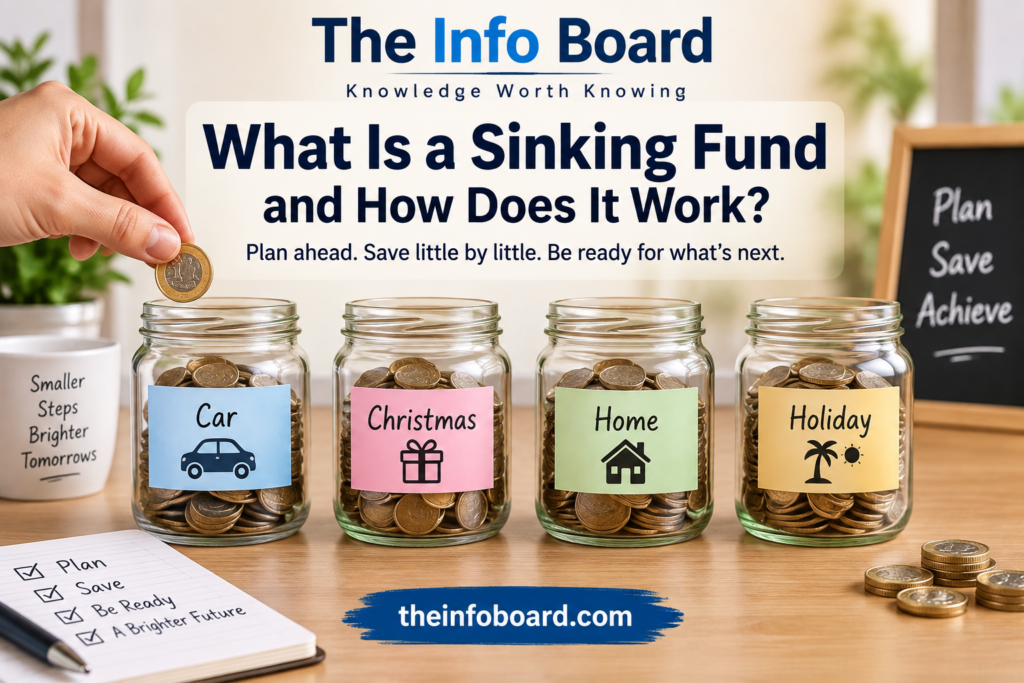
What Is a Sinking Fund?
A sinking fund is a separate pot of money that you build gradually for a known future cost.
You decide:
what you’re saving for → how much you’ll need → when you’ll need it → how much to save regularly.
For example, imagine you expect your car insurance to cost around £600 when it renews in 12 months.
Rather than waiting until renewal month and trying to find £600, you could put aside:
£600 ÷ 12 = £50 per month.
After 12 months, you would have approximately £600 ready for the bill.
MoneyHelper similarly describes a sinking fund as money regularly set aside for an expense you know is coming.
Why Is It Called a Sinking Fund?
The term has been used in finance for a long time and can have more technical meanings in business and government finance.
For personal budgeting, however, the concept is straightforward.
You gradually build a dedicated pot and then use that money when the planned expense arrives.
Think of it as paying part of a future bill every month before the bill is actually due.
What Can You Use a Sinking Fund For?
Almost any predictable expense can have its own sinking fund.
Common examples include:
- Christmas and gifts
- holidays
- car insurance
- MOT and vehicle servicing
- home maintenance
- school expenses
- annual subscriptions
- birthdays
- weddings and celebrations
- replacing appliances
- planned dental costs
- furniture
- technology replacements
- home improvements
The important word is planned.
You know — or have a reasonable expectation — that the expense will eventually happen.
Sinking Fund vs Emergency Fund
These two are easy to confuse, but they serve different purposes.
A sinking fund is for an expense you expect.
An emergency fund is primarily for expenses or financial shocks you cannot reliably predict.
Suppose your car’s annual insurance renewal is due in six months.
That’s a sinking-fund expense because you know the bill is coming.
But suppose your car suddenly develops a serious mechanical fault tomorrow.
That is much closer to an emergency-fund situation because you didn’t plan for the breakdown.
MoneyHelper makes the same distinction: sinking funds prepare for known upcoming costs, while emergency savings are designed to provide a financial buffer against unexpected expenses or difficult circumstances.
Do You Need Both?
Ideally, they perform different jobs.
Imagine you have £1,000 saved for a holiday.
Your boiler then unexpectedly breaks.
Without separate savings, you may have to choose between cancelling the holiday or borrowing money for the boiler.
With separate pots, the distinction is clearer:
Holiday sinking fund → planned holiday
Emergency fund → unexpected boiler repair
Separating goals can make it easier to see what money is genuinely available for each purpose.
How Do You Calculate a Sinking Fund?
The basic calculation is simple:
Total amount needed ÷ number of months remaining = monthly saving target
Suppose Christmas is 10 months away and you want a £500 budget.
£500 ÷ 10 = £50 per month
Or perhaps you expect a £360 annual bill in six months:
£360 ÷ 6 = £60 per month
You now have a specific monthly target instead of a vague intention to “save something.”
What If You Don’t Know the Exact Cost?
That’s normal.
Many future expenses cannot be predicted perfectly.
Your next car service might cost more than the previous one. A holiday price can change. Christmas spending isn’t identical every year.
Start with a reasonable estimate based on previous costs and current prices.
If last Christmas cost around £600, that’s more useful information than pretending next Christmas will somehow cost nothing until December arrives.
You can adjust the target later.
Where Should You Keep Sinking Funds?
You don’t necessarily need a completely separate bank account for every goal.
Some banks allow customers to create separate digital pots, spaces or similar subdivisions within an account.
You could have pots labelled:
Car
Christmas
Holiday
Home
Another option is to use separate savings accounts where appropriate.
MoneyHelper notes that dividing money into separate pots can help people organise bills, spending and savings goals.
Whatever system you use, the objective is to make it obvious which money has already been allocated to future expenses.
Read:What Is a Direct Debit and How Does It Work?
Why Not Keep Everything in One Savings Account?
You can.
But psychologically, one large balance can be misleading.
Imagine your savings account contains £3,000.
It may feel like you have £3,000 available.
But perhaps:
£1,000 is your emergency fund.
£800 is reserved for a holiday.
£600 is for annual bills.
£400 is for Christmas.
£200 is genuinely unallocated.
Without some way of separating those goals, it can be easy to accidentally spend money that already has a job.
Automate Your Sinking Funds
One of the easiest approaches is to move money automatically shortly after payday.
Suppose your monthly targets are:
Car: £50
Christmas: £40
Holiday: £75
Home maintenance: £35
Your total sinking-fund contribution would be:
£200 per month.
Automating those transfers can make saving part of your normal monthly budget rather than something you remember only when money happens to be left over.
MoneyHelper recommends regular saving and notes that standing orders can be used to automate transfers into savings.
What If You Can’t Afford Every Sinking Fund?
Then prioritise.
A sinking fund should help your budget, not make essential bills unaffordable.
Start with predictable expenses that would cause the biggest difficulty if you had to pay them from one month’s income.
For example:
annual insurance may be more important than a holiday fund.
Essential car maintenance may be more important than upgrading your phone.
Necessary home repairs may be more important than entertainment.
You can add other sinking funds as your finances allow.
Start Small
You don’t need hundreds of pounds available immediately.
Even a modest sinking fund can reduce the size of a future financial shock.
Suppose you know a £500 expense is coming but manage to save only £300 beforehand.
You still need another £200.
But finding £200 is considerably easier than suddenly finding the full £500.
Progress still matters even when you cannot fully fund the goal.
Sinking Funds Can Make Irregular Bills Feel Monthly
Many budgets are easy to understand until an annual bill arrives.
Suppose an expense costs £240 once per year.
It can feel like a sudden £240 problem.
But mathematically:
£240 ÷ 12 = £20 per month.
Thinking of annual expenses in monthly terms can give you a more realistic picture of what your lifestyle actually costs.
That £240 bill isn’t really an isolated expense.
It effectively costs you £20 for every month of the year.
Don’t Forget Annual Subscriptions
Small annual charges are easy to overlook.
Streaming services, software, memberships, insurance policies and other subscriptions may be paid annually rather than monthly.
Look through your previous bank statements and make a list of irregular recurring expenses.
You may discover several bills that you had mentally forgotten about.
Once identified, you can either prepare for them or decide that you no longer need the service.
Sinking Funds Can Help With Christmas
Christmas is a classic example because the date is not a surprise.
If you want to spend £600 and begin saving in January:
£600 ÷ 12 = £50 per month.
By December, the money can already be available.
Compare that with reaching December with no savings and trying to absorb the entire £600 from one month’s income.
The total cost is the same.
The financial pressure can feel very different.
Sinking Funds Can Help With Car Costs
Cars are full of irregular but predictable expenses.
You may need to budget for:
MOT tests, servicing, tyres, insurance, breakdown cover and eventually repairs or replacement.
Not every cost can be predicted exactly, but you know that owning a car involves more than simply buying fuel.
A dedicated car fund can help spread those costs throughout the year.
What About Homeowners?
Homes also produce irregular expenses.
Appliances eventually fail.
Rooms need decorating.
Roofs, plumbing and heating systems require maintenance.
Some problems are genuine emergencies, while others can reasonably be anticipated over time.
A home-maintenance sinking fund can reduce the temptation to treat every repair as an unforeseeable financial disaster.
Should You Use Credit Instead?
Credit can be useful in some circumstances, but borrowing for an expense you knew was coming may make that expense more expensive if interest or fees are involved.
MoneyHelper notes that sinking funds can reduce the likelihood of needing credit cards or Buy Now Pay Later for planned expenses.
Saving beforehand effectively reverses the process:
Save first → buy later
rather than:
Buy first → repay later.
Read:What Is an Emergency Fund and How Much Should You Save?
Don’t Make the System Too Complicated
You could theoretically create 25 different savings pots.
That doesn’t mean you should.
A complicated system can become difficult to maintain.
Instead, you might group similar expenses together:
Car fund — MOT, servicing and tyres
Home fund — maintenance and appliances
Celebrations fund — birthdays and Christmas
Travel fund — holidays and trips
Choose a system you can actually manage consistently.
Review Your Funds Occasionally
Your targets will change.
Insurance prices change.
Holiday plans change.
Your income can change.
A £30 monthly contribution that made sense last year might need to become £40 this year.
Reviewing your sinking funds every few months helps ensure they still match your real expenses.
What Happens After You Spend the Fund?
Start rebuilding it if the expense will happen again.
Suppose you’ve saved all year for your car insurance and then use the fund at renewal.
The balance may return to zero.
But another renewal is already approximately 12 months away.
So the cycle begins again.
This is why sinking funds work particularly well for recurring annual expenses.
Sinking Funds Don’t Have to Be Perfect
Personal budgeting often fails when people think the system must be perfect.
You might miss a month.
An expense may cost more than expected.
You may need to temporarily reduce contributions because another essential bill has increased.
That’s okay.
The purpose is not to predict the future perfectly.
The purpose is to be better prepared for predictable expenses than you would have been otherwise.
The Bottom Line
A sinking fund is one of the simplest budgeting tools available.
You identify an expense you know is coming, estimate how much it will cost, divide that amount across the time available and gradually save towards it.
The basic formula is:
Expected cost ÷ months until needed = monthly saving target
Sinking funds won’t prevent expensive bills.
They simply give you time to prepare for them.
And when a £600 annual expense arrives with £600 already waiting for it, the bill feels very different.
Frequently Asked Questions
What is a sinking fund in simple terms?
A sinking fund is money you gradually save for a specific future expense that you know or reasonably expect is coming.
Is a sinking fund the same as an emergency fund?
No. Sinking funds are generally for planned or predictable expenses, while emergency funds provide a buffer for unexpected financial problems.
How much should I put into a sinking fund?
Estimate the total amount you’ll need and divide it by the number of months until the expense is due.
Do I need a separate bank account for every sinking fund?
No. You can use separate accounts, digital savings pots or another budgeting system that clearly separates money allocated to different goals.
What happens if I don’t save enough?
The amount you have saved still reduces what you need to find when the expense arrives. You can also adjust future contributions as your circumstances change.
Can I have several sinking funds?
Yes. Many people save simultaneously for several predictable costs, although keeping the system reasonably simple can make it easier to manage.
What should I save for first?
Prioritise essential and predictable expenses that would be difficult to cover from one month’s normal income.
External source for the published article:
MoneyHelper — Sinking funds explained
Financial disclaimer: This article provides general information only and is not financial advice. Your appropriate savings priorities will depend on your individual circumstances.
Leave a Comment