You’re chopping an onion for dinner when your eyes start stinging. A few seconds later, tears are running down your cheeks. This isn’t an emotional reaction: cutting an onion releases an airborne chemical that irritates your eyes and triggers a protective tearing reflex.
The good news is that a few changes to how you prepare onions can reduce the irritation. Here is the science, followed by practical methods worth trying—and popular tricks that are less convincing.
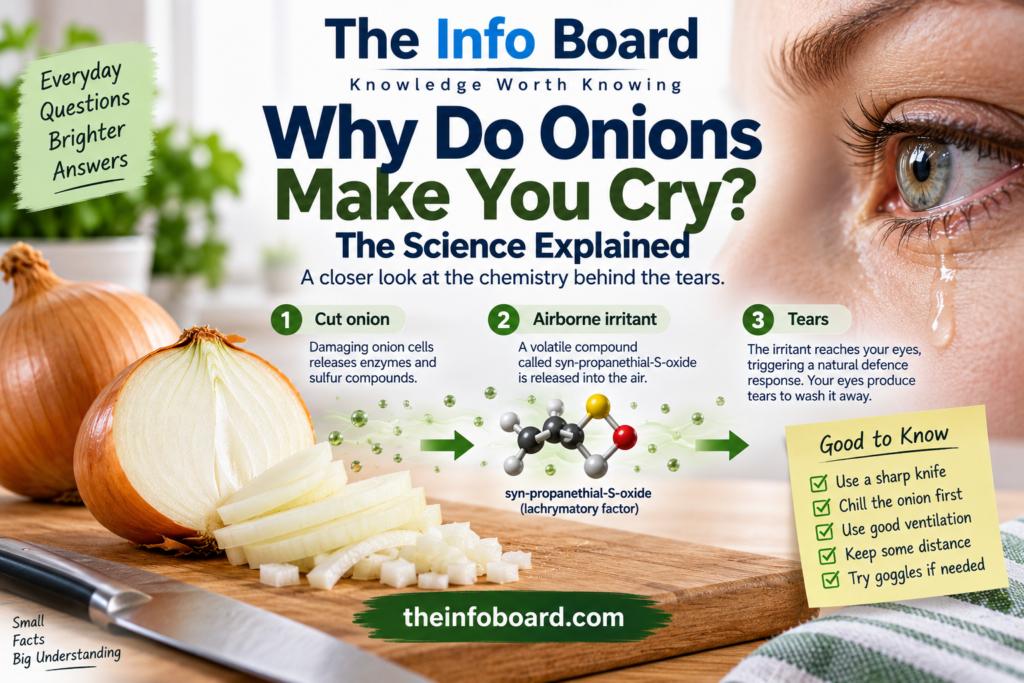
Why do onions make your eyes water?
An onion contains sulphur-containing substances and enzymes that are largely kept apart while its cells remain intact. Slicing, crushing or grating the onion breaks open those cells. The ingredients can then interact and form a volatile substance known as syn-propanethial-S-oxide, often called the onion lachrymatory factor.
Because it is volatile, some of this irritant moves into the air around your chopping board. If it reaches the surface of your eyes, sensory nerves detect the irritation. Your tear glands—called lacrimal glands—produce extra tears to help dilute and wash it away.
The Library of Congress explains the chemistry of onion tears, including the role of the enzyme known as lachrymatory-factor synthase.
What happens inside an onion when you cut it?
- Cells break: Your knife cuts through the onion’s structure.
- Previously separated substances mix: Enzymes act on sulphur-containing compounds in the damaged tissue.
- The tear-producing irritant forms: A sequence of reactions produces syn-propanethial-S-oxide.
- The irritant enters the air: Some reaches your eyes, especially if you lean close to the board.
- Your eyes protect themselves: Nerves detect irritation and trigger blinking and tear production.
This is why an uncut onion sitting on the worktop usually causes no problem, whereas chopping several onions in quick succession can leave you blinking and reaching for a tissue. The process starts when the onion’s tissue is damaged; it is not simply a gas stored inside a whole onion.
Why do some onions make you cry more than others?
Different onions contain different quantities and combinations of sulphur compounds. Variety, growing conditions and storage can influence how pungent an onion is. Your cutting technique matters, too: a blunt knife may crush more tissue, and finely grating an onion damages far more cells than cutting it into a few large pieces.
Personal sensitivity also varies. One person might prepare an onion with little discomfort while someone nearby experiences stinging eyes. The difference does not necessarily mean either person has a medical problem.
How to chop onions without crying as much
There is no single guaranteed trick, but the following methods target the actual problem: limiting the production of airborne irritant, moving it away from your face or protecting your eyes.
1. Use a sharp knife and a stable chopping board
A sharp blade generally cuts more cleanly than a dull one, potentially crushing fewer cells. It will not stop onion chemistry completely, but it may help. Make sure the board is stable and keep your fingers away from the cutting edge. Never sacrifice safe knife handling just to avoid tears.
2. Try chilling the onion briefly
A cooler onion may release its volatile irritant more slowly. Some home cooks find that briefly chilling an onion before slicing makes preparation more comfortable, although the effect varies. Chill it safely and do not freeze it into a hard, slippery object that is difficult to cut. This is a preparation tip, not a reason to ignore normal food-storage guidance.
3. Use your extractor fan or improve ventilation
If an extractor hood is available above or near your preparation area, using it may help move airborne irritants away. A fan may also help if the airflow goes away from your face. Blowing air directly from the onion towards your eyes can make the problem worse.
4. Avoid leaning directly over the onion
Keeping your face back from the chopping board can reduce how much irritant reaches your eyes. Work at a comfortable counter height and do not put your face close to freshly cut surfaces to check their smell.
5. Wear well-fitting protective goggles if needed
Properly fitted goggles provide a physical barrier between airborne irritants and your eyes. This is one of the most straightforward approaches when preparing large batches. Ordinary glasses may offer some shielding but leave gaps around the sides. Use clean, suitable eye protection that does not interfere with your vision or knife handling.
Which onion-tear remedies are worth trying?
| Method | Why it might help | Practical verdict |
|---|---|---|
| Sharp knife | May reduce unnecessary crushing of cells | Reasonable, practical first step |
| Brief chilling | May slow release of volatile compounds | Worth trying; results vary |
| Good ventilation | Can move irritant away from your eyes | Useful if airflow is correctly directed |
| Well-fitting goggles | Physically block exposure | Direct and often effective |
| Running a nearby tap | Claimed to capture irritant from the air | Not reliably demonstrated; wastes water |
| Holding bread in your mouth | Claimed to absorb onion vapour | No convincing reason to rely on it |
| Chewing gum | Claimed to stop the irritation | Does not prevent irritant formation |
| Chopping completely under water | May limit irritant reaching the air | Not recommended: awkward and potentially unsafe with a knife |
Best everyday combination: use a sharp knife, work in a ventilated kitchen and keep your face out of the rising vapour. If that is not enough, try cooling the onion or wearing goggles.
Does cutting the root end last help?
You may hear advice to leave the root end intact until the final cuts. This can make an onion easier to hold together when dicing, but it is not a foolproof way to prevent tears. The irritant forms when onion cells are damaged throughout the bulb, not only in one small part. Choose a cutting method that keeps your grip secure and reduces the risk of the knife slipping.
Does water stop an onion making you cry?
Some onion irritant can be prevented from reaching your eyes when cutting is done in water, but submerging an onion makes knife control difficult and is not a sensible routine technique. Likewise, leaving a tap running beside the chopping board has no dependable evidence of preventing irritation. Proper ventilation is a more direct way to manage the airborne irritant without wasting water.
Why does chopping garlic feel different?
Onions, garlic, leeks and shallots are related Allium plants, but they do not produce identical chemicals when cut. Crushing fresh garlic produces compounds including allicin, which contributes to its strong aroma. Ordinary garlic preparation usually does not release the same quantity of the onion’s characteristic tear-producing factor, so your eyes may react differently.
Why do cooked onions usually make you cry less?
The strongest eye irritation is typically associated with cutting fresh, raw onion tissue. Cooking changes the enzymes and volatile compounds involved. Once the onion is heated, it does not behave like a freshly cut raw bulb. However, vapour from hot cooking can still irritate some people, and care is needed around hot pans and steam.
Cooked onions often taste sweeter because their sharp raw flavours become less noticeable and cooking changes and concentrates flavour compounds. That change in taste is separate from the eye-watering response, although both arise from the onion’s chemistry.
What should you do if onion vapour irritates your eyes?
For mild discomfort during ordinary cooking, stop chopping, step away from the source and let the irritation settle. Do not rub your eyes, especially if there is onion juice on your fingers. Wash your hands before touching your face. If onion juice or particles get directly into an eye, gently rinse with clean water.
Do not assume severe or persistent symptoms are merely onion tears. Seek prompt medical advice for unusual redness, significant pain or continuing irritation. Sudden changes in vision or severe eye pain require urgent assessment. See the NHS advice on eye injuries for first aid and when to get help.
A practical example: preparing onions for a large meal
Imagine you need to chop six onions for a family meal. Instead of cutting them all rapidly with a dull knife while leaning over a crowded counter, try this sequence:
- Clear your worktop and stabilise the chopping board.
- Check that your knife is sharp and suitable for the job.
- Turn on the extractor fan if its airflow helps clear the preparation area.
- Keep a comfortable distance between your face and the onion.
- Slice in controlled movements and place the pieces into a bowl as you go.
- If your eyes begin to sting, stop, step back and allow the air to clear before continuing.
This is an illustrative kitchen routine, not a controlled scientific test. The benefit will differ from person to person, but each step addresses either safe preparation or exposure to the airborne irritant.
Frequently Asked Questions
What chemical in onions makes you cry?
The main tear-inducing irritant is syn-propanethial-S-oxide, known as the onion lachrymatory factor. It forms after cutting damages onion cells and starts a sequence of enzyme-driven reactions.
Does putting an onion in the fridge stop tears?
Briefly chilling an onion may reduce the rate at which the irritant reaches the air, but it cannot guarantee that you will not cry. Use appropriate food-storage practices.
Are red onions less likely to make you cry than white onions?
Not always. Pungency varies by variety and growing conditions, so colour alone is not a reliable measure of how irritating an onion will be.
Will a sharp knife completely stop onion tears?
No. Even the cleanest cut damages some cells. A sharp knife may minimise crushing, but the chemistry will still occur.
Do onion-cutting goggles actually work?
Well-fitting goggles can substantially limit contact between airborne irritants and the surface of your eyes. They are particularly useful if you are sensitive or preparing many onions.
Can onion tears harm your eyes?
Mild, temporary watering while chopping onions is common. Persistent pain, marked redness or changes in vision should be assessed rather than dismissed as a normal reaction.
Related reading
For more everyday science, read why ice floats on water and why we see lightning before hearing thunder.
The Bottom Line
Onions make you cry because cutting them breaks cells and creates an airborne irritant. Your eyes detect that irritant and produce extra tears to protect themselves. To reduce the effect, use a sharp knife, keep the vapour away from your face, ventilate the area and consider well-fitting goggles. These practical precautions are more dependable than kitchen myths about chewing gum or holding bread in your mouth.
Sources: Library of Congress — Why does chopping an onion make you cry?; NHS — Eye injuries.