A flash lights up the sky. A few seconds later comes a crash of thunder. Both come from the same lightning discharge, so why do we see one before hearing the other?
Light travels vastly faster than sound. The lightning flash reaches your eyes almost immediately, but the pressure wave that produces thunder takes several seconds to travel each mile. This difference also makes it possible to estimate how far away a flash occurred—although counting seconds is not a way to decide whether it is safe to stay outdoors.
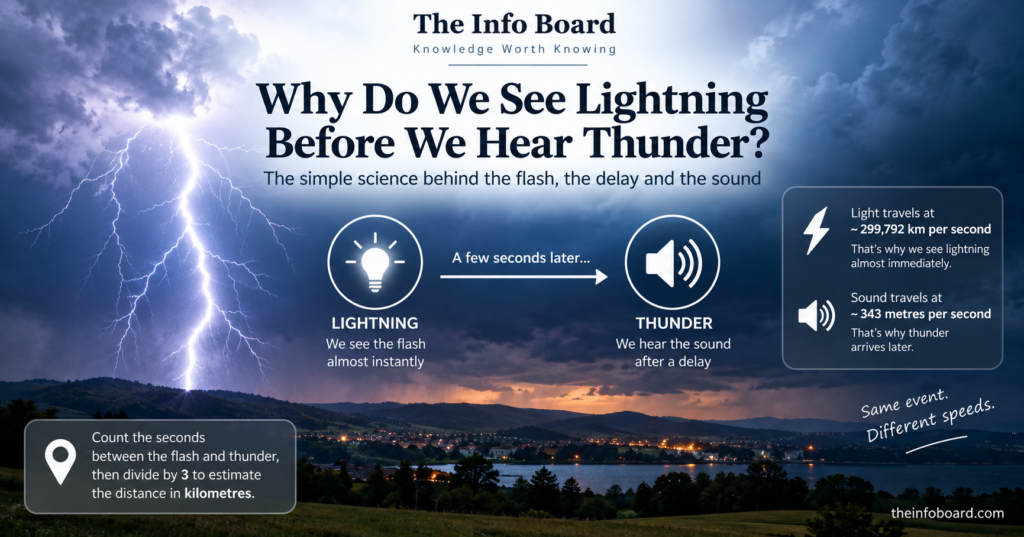
Why Does Lightning Arrive Before Thunder?
Lightning produces a bright flash and heats the air along its path. That rapid heating creates the sound we call thunder. The light and sound originate in essentially the same event, but travel through the atmosphere at dramatically different speeds.
| What travels? | Approximate speed | How long to travel 1 km? |
|---|---|---|
| Light | About 300,000 km per second | About 0.000003 seconds |
| Sound in air, near 20°C | 343 metres per second | About 2.9 seconds |
These values are rounded for illustration. Air temperature affects the speed of sound, while the time taken by light is negligible at ordinary storm distances. The Met Office explains the same flash-to-thunder delay.
What Causes Lightning in the First Place?
Inside a thunderstorm, moving ice particles, water droplets and turbulent air contribute to the separation of electrical charge. Different parts of a cloud—and sometimes the ground beneath it—can develop a large electrical potential difference.
When that difference becomes great enough, air can no longer insulate the charged regions effectively. A rapid electrical discharge occurs: lightning. Not every flash reaches the ground. Lightning can take place within a single cloud, between clouds, or between a cloud and the ground.
How Does Lightning Make Thunder?
The air surrounding a lightning channel becomes extremely hot in a fraction of a second. It expands violently, generating a shock wave that moves outward and develops into the sound waves we hear as thunder.
The US National Oceanic and Atmospheric Administration (NOAA) explains that temperatures inside a lightning channel may briefly approach 30,000°C. This is hotter than the visible surface of the Sun, although the comparison concerns a very narrow, short-lived channel—not the total heat or energy of the Sun. See NOAA’s explanation of lightning and thunder.
How Do You Work Out How Far Away Lightning Is?
If you are already in safe shelter, you can estimate the distance to a flash by timing the gap between seeing the lightning and hearing the first thunder associated with it.
Distance in kilometres ≈ seconds ÷ 3
Distance in miles ≈ seconds ÷ 5
For example, if the sound arrives 9 seconds after the flash, the lightning was roughly 3 kilometres away. If the delay is 10 seconds, it was roughly 2 miles away. This is a useful science demonstration, not a precise tracking method.
| Flash-to-thunder delay | Approximate distance in kilometres | Approximate distance in miles |
|---|---|---|
| 3 seconds | 1 km | 0.6 miles |
| 6 seconds | 2 km | 1.2 miles |
| 9 seconds | 3 km | 1.8 miles |
| 15 seconds | 5 km | 3 miles |
| 30 seconds | 10 km | 6 miles |
The figures are rounded. The rule assumes the observed flash and thunder come from the same discharge; echoes, long lightning channels and changing atmospheric conditions make the estimate less exact. NOAA provides a distance-to-thunderstorm exercise using the same rule.
Important: Do Not Wait Outside to Count the Seconds
If you hear thunder, you may already be within range of a lightning strike. Lightning can strike some distance from the centre of a storm, so a long delay does not guarantee safety. Move into a substantial enclosed building or a fully enclosed hard-topped vehicle rather than standing outside to time a flash.
- Check the Met Office’s lightning safety advice and current weather warnings before outdoor activities.
- Avoid exposed hills, open fields, isolated trees and bodies of water during a thunderstorm.
- Do not shelter under a lone tree or assume an umbrella makes you safe.
- In a vehicle, the enclosed metal body—not the rubber tyres—is the main protective feature.
- As a cautious rule, stay in proper shelter for at least 30 minutes after the last thunder, as recommended by the US National Weather Service.
If lightning is occurring nearby, also avoid contact with wired electrical equipment and plumbing until the storm has passed. Follow instructions issued for your location.
Why Does Thunder Sometimes Crack and Sometimes Rumble?
Thunder does not come from one tiny point in the sky. A lightning channel can extend over a considerable distance, and each part generates sound. Waves from nearer sections reach you before waves from farther sections. Atmospheric conditions and reflections can stretch and reshape what you hear.
A sharp crack may be associated with a relatively close part of the discharge. A longer, deeper rumble often reflects sounds from multiple sections arriving at different times. Buildings and terrain can also influence the sound. You cannot reliably judge safety from whether thunder sounds loud, soft, sharp or distant.
Can You See Lightning Without Hearing Thunder?
Yes. Distant flashes may remain visible even after their thunder becomes too faint to hear. Clouds can also illuminate when the lightning channel itself is hidden from sight. Some people call this heat lightning, but it is generally ordinary lightning from a distant thunderstorm—not a separate form caused by hot air.
This is one reason a silent flashing horizon should not automatically be dismissed. Check the forecast and warnings if you plan to be outside, especially if the storm appears to be approaching.
Can Thunder Happen Without Lightning?
Thunder is the sound created by lightning. If you hear genuine thunder but cannot see a flash, the discharge may have occurred inside a cloud, behind buildings or beyond your direct view. It can also be difficult to spot in daylight.
Conversely, a visible flash without audible thunder is possible when the discharge is sufficiently far away or sound propagation is unfavourable. The flash and sound belong to the same physical phenomenon even when only one reaches your senses.
Does Weather Change the Delay Between Lightning and Thunder?
The speed of sound in air changes with temperature, and winds and atmospheric layers can affect how sound travels towards you. Warmer air generally transmits sound slightly faster than colder air. These effects are small enough for the simple three-seconds-per-kilometre rule to remain useful as an approximation, but they matter when greater accuracy is required.
Thunder can also be distorted or weakened over distance. That is why weather services and lightning-detection networks are more appropriate than counting seconds when assessing real storm movement and risk.
Try the Calculation: A Worked Example
Imagine you are indoors and see a lightning flash through a window. You start counting and hear the first associated thunder 12 seconds later.
- Record the delay: 12 seconds.
- For kilometres, divide by three: 12 ÷ 3 = about 4 km.
- For miles, divide by five: 12 ÷ 5 = about 2.4 miles.
- Remember the result is an approximate distance to the discharge, not a guarantee about the distance or direction of the next strike.
If a later flash has a much shorter delay, some lightning activity may be closer. However, thunderstorms cover large areas and individual strikes can occur away from the previous flash, so the sequence alone is not a reliable measure of safety.
Three Common Lightning Myths
| Myth | What is more accurate? |
|---|---|
| “The storm is far enough away because I can count several seconds.” | If thunder is audible, seek shelter; the next strike may occur nearer. |
| “Thunder happens after lightning.” | The sound is produced at the time of the flash; it simply travels more slowly. |
| “Car tyres stop lightning.” | A fully enclosed hard-topped vehicle offers protection mainly because of its conducting exterior. |
Related Everyday Science
Interested in how conditions in the atmosphere affect what we see? Read our guide to why fog forms and our explanation of why the sky looks blue.
Frequently Asked Questions
Why do we see lightning before hearing thunder?
Because light travels at roughly 300,000 kilometres per second while sound travels at only about 343 metres per second in air near room temperature.
How far away is lightning if thunder follows after six seconds?
Roughly two kilometres, or about 1.2 miles, using the flash-to-thunder rule. This estimate should not be used to judge whether it is safe outside.
Is the five-second rule accurate?
It is a useful approximation of one mile per five seconds. Air temperature, echoes, lightning-channel length and other conditions can affect the result.
Why can I see lightning but not hear thunder?
The lightning may be too far away for its thunder to reach you audibly, or atmospheric conditions may weaken or redirect the sound.
Is it safe to go outside if the thunder sounds distant?
No. If you hear thunder, you may be within striking distance. Use safe indoor shelter and follow official weather advice.
The Bottom Line
We see lightning before hearing thunder because light reaches us almost instantly while sound takes about three seconds to travel a kilometre, or five seconds to travel a mile. The time difference makes a useful rough distance estimate. But the most important rule is safety: if you hear thunder, seek proper shelter rather than remaining outside to measure the delay.
Safety note: This article is educational and cannot replace current Met Office warnings or emergency advice for your location.