You’re sitting quietly when suddenly you feel it coming.
Your mouth opens, you take a deep breath, your jaw stretches and your eyes may even water.
You have just yawned.
Sometimes there seems to be an obvious reason: you’re tired, bored or waking up. But yawning is surprisingly complicated. Scientists still don’t have one single explanation that accounts for every yawn.
Even stranger, simply seeing another person yawn, hearing someone yawn or sometimes even thinking about yawning can make you do it yourself.
So why do humans yawn — and why can yawning spread from one person to another?
What Is a Yawn?
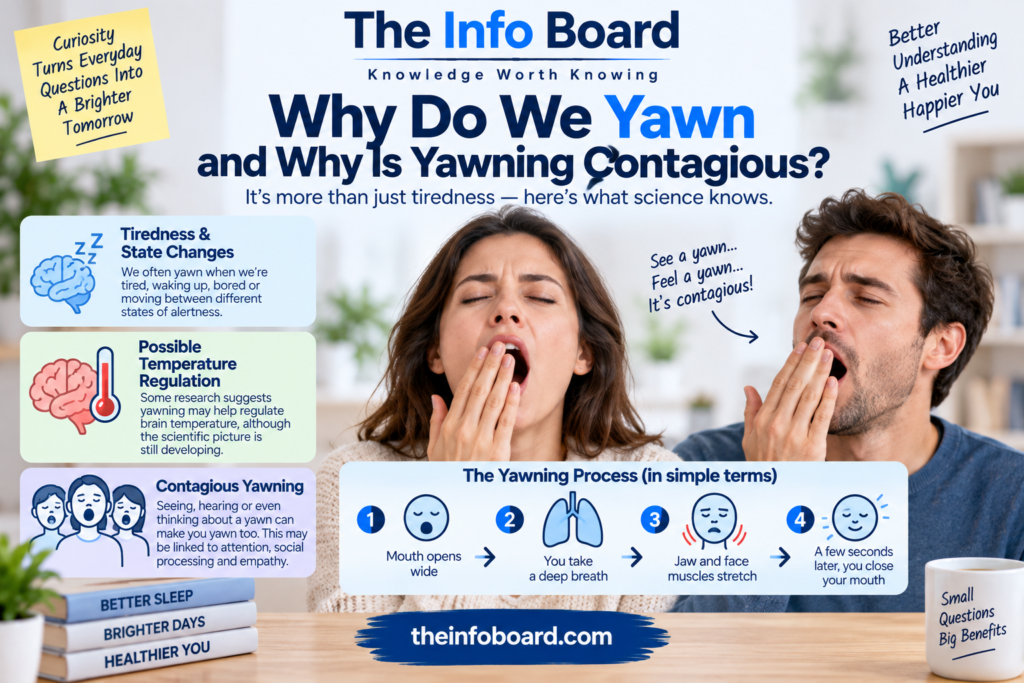
A yawn is an involuntary behaviour involving a wide opening of the mouth, a deep inhalation and stretching of muscles around the jaw and face.
A typical yawn lasts only a few seconds.
Although we often associate yawning with sleepiness, it occurs in many different situations.
People commonly yawn:
- after waking up,
- before going to sleep,
- when tired,
- during monotonous activities,
- during changes in alertness,
- and sometimes when stressed or anticipating an event.
Yawning isn’t unique to humans either. Various other vertebrate animals display yawn-like behaviours.
Why Do We Yawn When We’re Tired?
Yawning is strongly associated with transitions in our level of alertness.
You may yawn when you’re becoming sleepy, but you can also yawn shortly after waking.
That suggests yawning isn’t simply the body’s way of saying:
“I need sleep.”
Instead, yawning may be associated with changes between behavioural states.
For example, the brain may be moving from greater alertness toward sleep — or from sleepiness toward greater alertness.
Researchers have proposed several possible functions for yawning, but the complete biological purpose remains under investigation.
Does Yawning Mean Your Body Needs More Oxygen?
This is one of the most persistent myths about yawning.
For many years, people suggested that we yawn because the body detects low oxygen or excessive carbon dioxide and responds by taking a large breath.
It sounds reasonable.
But experimental evidence has not supported this as a sufficient explanation for ordinary yawning.
Changing oxygen and carbon-dioxide concentrations doesn’t simply produce the expected changes in yawning frequency that this theory would predict.
So a yawn is not best understood as an emergency breath caused by insufficient oxygen.
Could Yawning Help Us Become More Alert?
One hypothesis is that yawning may contribute to changes in arousal or alertness.
Think about what happens physically during a large yawn.
Your jaw stretches.
Facial muscles contract.
You take a deep breath.
Your body may stretch at the same time.
These changes occur frequently around transitions between states of wakefulness and sleepiness.
This doesn’t necessarily mean yawning instantly wakes the brain. But its timing suggests it may be associated with physiological changes that accompany shifts in alertness.
Does Yawning Cool the Brain?
Another scientific hypothesis proposes that yawning may play a role in brain thermoregulation — helping regulate brain temperature.
The idea is more sophisticated than simply saying that a yawn “blows cold air onto the brain.”
Yawning involves changes in jaw movement, blood flow and breathing that could potentially influence heat exchange.
Some experimental findings have been interpreted as supporting a relationship between yawning and temperature regulation.
However, research continues, and brain cooling should not be presented as the single proven explanation for all yawning.
Yawning may have multiple functions rather than one simple purpose.
Why Do We Stretch When We Yawn?
Yawning is often accompanied by stretching, especially after waking.
There is even a term for the combination of yawning and stretching:
pandiculation.
You may have seen cats and dogs do something similar after resting.
Stretching activates muscles and changes posture after periods of relative inactivity.
The frequent combination of stretching and yawning fits with the idea that both behaviours can occur during transitions in activity and alertness.
Why Do Our Eyes Water When We Yawn?
Some people develop watery eyes during a strong yawn.
Yawning causes substantial movement of facial muscles around the eyes, cheeks and jaw.
Those movements can affect structures involved in tear production and drainage.
As a result, tears may temporarily accumulate around the eyes.
It doesn’t mean you’re sad.
It’s simply a physical consequence that can accompany the facial movements of a yawn.
Why Do Our Ears Sometimes Pop When We Yawn?
Yawning moves the jaw and muscles around the throat.
This can help open the Eustachian tubes, which connect the middle ears with the upper throat area.
These tubes help equalise air pressure across the eardrum.
That’s why yawning can sometimes produce a popping sensation in your ears.
It’s also why people often try yawning when their ears feel blocked during an aeroplane’s ascent or descent.
Why Is Yawning Contagious?
This is where yawning becomes particularly interesting.
Seeing another person yawn can sometimes trigger a yawn in you.
This phenomenon is called contagious yawning.
It differs from spontaneous yawning because it is triggered by perceiving or thinking about another yawn rather than arising entirely on its own.
Visual cues aren’t always necessary.
For some people, hearing a yawn, reading about yawning or even discussing it can be enough to create the urge.
You may have already yawned while reading this article.
Does Everyone Catch Yawns?
No.
Contagious yawning varies substantially between individuals.
One person may yawn almost immediately after seeing somebody else do it.
Another may feel nothing.
Factors such as age, attention, individual differences and social context may influence the response.
This variability is one reason researchers remain interested in contagious yawning.
It gives scientists a relatively simple behaviour through which they can investigate broader questions about social processing and automatic responses.
Read:Why Do We Get Hiccups and How Can You Stop Them?
Is Contagious Yawning Caused by Empathy?
You may have heard that people who catch yawns are more empathetic.
The reality is more complicated.
Some studies have explored relationships between contagious yawning, social familiarity and measures related to empathy or social cognition.
However, the evidence does not justify using contagious yawning as a simple test of whether someone is empathetic.
Human empathy is far too complex to diagnose from whether someone yawns after watching another person.
So if your friend doesn’t catch your yawn, don’t conclude that they don’t care about you.
Could Contagious Yawning Be a Social Behaviour?
Possibly.
Humans are highly social animals, and many behaviours can become synchronised within groups.
We unconsciously respond to other people’s:
facial expressions, posture, gaze, laughter and movements.
Contagious yawning may be another example of a behaviour influenced by social perception.
Researchers have proposed that synchronising states within a group could potentially have had adaptive value, although evolutionary explanations are difficult to prove conclusively.
Why Can Reading About Yawning Make You Yawn?
Your brain doesn’t respond only to things physically happening in front of you.
Language can activate mental representations of actions and sensations.
When you repeatedly read words such as yawn, imagine someone opening their mouth and think about how a yawn feels, your attention becomes focused on the behaviour.
For susceptible people, that may be enough to trigger the response.
In other words, the idea of yawning can sometimes become a cue for yawning.
Do Babies Yawn?
Yes.
Yawning begins remarkably early in development, and yawn-like movements have even been observed before birth.
However, contagious yawning appears to have a different developmental pattern from spontaneous yawning.
Young children may yawn spontaneously without consistently responding to other people’s yawns in the same way many older children and adults do.
This distinction supports the idea that spontaneous and contagious yawning involve at least partly different processes.
Do Animals Yawn?
Many animals display yawning or yawn-like behaviour.
It has been observed in numerous vertebrate species.
But the meaning of a yawn may differ depending on the species and context.
In some animals, yawning can occur around rest and waking.
In others, yawn-like displays may appear during social interactions, stress or threat displays.
So we shouldn’t automatically assume an animal yawns for exactly the same reasons humans do.
Can Animals Catch Yawns From Each Other?
Contagious yawning has been studied in several social species, although findings and interpretations vary.
Researchers have also investigated whether some domesticated animals respond to human yawns.
These studies are interesting because they may help scientists examine how social attention and behavioural contagion work across species.
But animal behaviour is complex, and a single yawn shouldn’t be overinterpreted.
Why Do We Yawn When We’re Bored?
Boredom often involves reduced stimulation and changes in attention.
That overlaps with the kinds of low-arousal situations in which yawning commonly occurs.
Imagine sitting through a repetitive presentation in a warm room.
You’re not necessarily ready to fall asleep, but your level of stimulation may be low.
Yawning may occur alongside that change in state.
This is probably why yawning became culturally associated with boredom.
Unfortunately, that association can make yawning look rude even when it is involuntary.
Why Do We Sometimes Yawn Before Something Important?
Yawning doesn’t happen only when we’re relaxed.
Some people yawn before competitions, performances or stressful events.
This seems strange if we assume yawning means only “I’m sleepy.”
But it makes more sense if yawning is connected with changes in arousal and behavioural state.
Athletes and performers may be moving from one physiological state into another as they prepare for action.
Again, this illustrates why yawning is more complicated than simple tiredness.
Can You Stop Yourself From Yawning?
You can sometimes suppress a yawn temporarily, particularly in social situations.
But the urge can be difficult to control because yawning is largely involuntary.
You may close your mouth or alter the visible expression, but the underlying urge can remain.
And once you’ve started thinking about trying not to yawn, you may ironically become even more aware of it.
Why Does a Yawn Feel Satisfying?
A large yawn stretches several muscles around the jaw, face and throat.
It may also be accompanied by a whole-body stretch.
That combination can create a temporary sensation of release, particularly after sitting still or waking from sleep.
The feeling is somewhat similar to the satisfaction of stretching stiff muscles after remaining in one position for a long time.
Is Frequent Yawning Normal?
Yawning is a normal human behaviour, and people vary in how often they do it.
Tiredness, sleep deprivation, boredom and changes in routine can all affect yawning.
However, a sudden or unexplained major increase in yawning, especially when accompanied by other symptoms, can occasionally be associated with medical conditions or medication effects.
Persistent excessive yawning shouldn’t be diagnosed from an internet article.
If it is new, severe or accompanied by concerning symptoms, appropriate medical advice is more useful than trying to determine the cause yourself.
Does Yawning Mean You’re Sleep-Deprived?
Not necessarily.
Everyone yawns.
But frequent yawning combined with persistent daytime sleepiness can be a sign that you’re simply not getting enough good-quality sleep.
Adults’ sleep needs vary, and sleep quality matters as well as total time in bed.
If you’re regularly struggling to stay awake during normal daytime activities, the underlying sleepiness is more important than the yawning itself.
Why Do We Yawn After Waking Up?
Waking is a major transition in behavioural state.
Your body moves from sleep toward active wakefulness.
Yawning and stretching commonly occur during this transition.
This is another reason the idea that yawning simply means “the brain needs oxygen” doesn’t adequately explain the behaviour.
We can yawn both when moving toward sleep and when moving away from sleep.
The common feature may be the transition itself.
Is Yawning Useful or Just a Reflex?
Scientists have not settled on one universal answer.
Yawning may involve several overlapping functions.
Research has explored connections with:
arousal, state transitions, temperature regulation, social behaviour and physiological changes associated with stretching and breathing.
Different types of yawning may not even serve exactly the same purpose.
That is an important scientific point.
Sometimes a familiar behaviour doesn’t have one neat explanation.
Read:Why Is Sleep Important? What Happens While You Sleep
Why Haven’t Scientists Solved Yawning Yet?
Yawning seems simple, but studying its function is difficult.
A researcher can observe when people yawn, manipulate environmental conditions and measure physiological responses.
But demonstrating exactly why evolution preserved a behaviour is much harder.
Multiple hypotheses can also explain parts of the evidence.
Science therefore progresses by testing predictions, rejecting explanations that don’t fit and refining those that remain plausible.
Yawning is a good example of an everyday phenomenon for which science has learned a great deal without reducing the answer to a single sentence.
The Bottom Line
We know plenty about when people yawn, but the complete answer to why we yawn remains an active scientific question.
Yawning commonly occurs during changes in alertness — when we’re becoming tired, waking up, bored or shifting into a different behavioural state.
The old idea that yawning simply provides extra oxygen isn’t supported as a complete explanation.
Researchers have instead investigated roles involving arousal, temperature regulation and other physiological processes.
Contagious yawning adds another layer.
Seeing, hearing or even thinking about a yawn can trigger the behaviour in some people, suggesting that attention and social processing are involved.
So if you’ve yawned while reading this article, you have just demonstrated the phenomenon we were trying to explain.
Frequently Asked Questions
Why do humans yawn?
There is no single universally established explanation. Yawning is associated with changes in alertness and behavioural state, while researchers have also investigated possible roles in thermoregulation and other physiological processes.
Do we yawn because we need more oxygen?
The traditional low-oxygen explanation is not supported as an adequate explanation for ordinary yawning.
Why is yawning contagious?
Contagious yawning appears to involve attention and social processing, although researchers are still investigating exactly why the response occurs.
Does catching a yawn mean you’re empathetic?
Not necessarily. Research has explored possible relationships with social cognition, but whether someone catches a yawn is not a reliable test of empathy.
Why do my eyes water when I yawn?
The facial movements involved in a strong yawn can affect the structures involved in tears and tear drainage, causing moisture to accumulate around the eyes.
Why do my ears pop when I yawn?
Yawning can help open the Eustachian tubes, allowing pressure to equalise across the eardrum.
Is excessive yawning a problem?
Ordinary yawning is normal. A significant unexplained increase in yawning, particularly with other symptoms or severe daytime sleepiness, may warrant medical advice.