Sleep can sometimes feel like a period when nothing is happening.
You close your eyes, become less aware of your surroundings, and several hours later you wake up.
But behind the scenes, your brain and body remain remarkably active.
While you sleep, your brain processes information, your body carries out important maintenance, hormones are regulated, and numerous biological systems continue working.
So why exactly is sleep so important?
What Is Sleep?
Sleep is a naturally recurring state in which awareness of the environment is reduced and the body moves through several distinct stages.
It isn’t simply the brain “switching off.”
Scientists generally divide normal sleep into two major types:
NREM sleep — non-rapid eye movement sleep
and
REM sleep — rapid eye movement sleep
During a typical night, you cycle through different stages of NREM and REM sleep multiple times.
Each stage has different patterns of brain activity and appears to play different roles in maintaining healthy brain and body function.
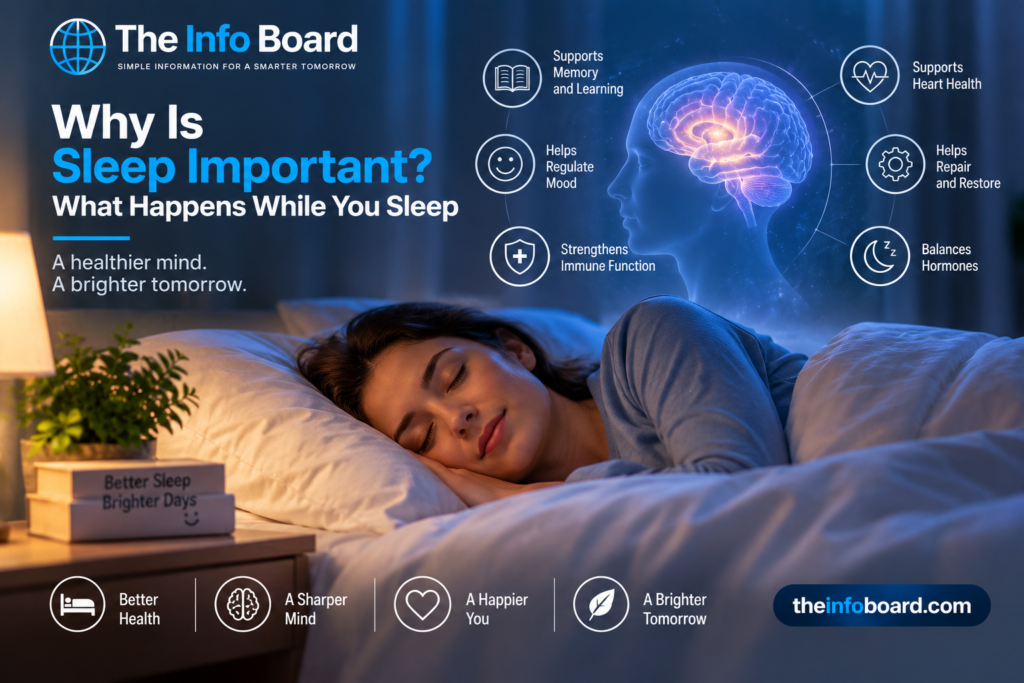
Why Is Sleep Important? What Happens While You Sleep
What Happens When You Fall Asleep?
As you begin falling asleep, your body gradually changes.
Your heart rate tends to slow, muscles relax, breathing changes, and brain activity shifts.
You move from wakefulness into progressively deeper stages of sleep.
During deeper NREM sleep, brain-wave activity becomes slower and waking up can become more difficult.
Later, you enter REM sleep, when brain activity becomes more similar in some respects to wakefulness.
This cycle repeats throughout the night.
What Happens During REM Sleep?
REM stands for rapid eye movement.
As the name suggests, the eyes can move rapidly beneath closed eyelids during this stage.
Dreaming can occur during different stages of sleep, but vivid dreaming is commonly associated with REM sleep.
During REM sleep, brain activity increases while many voluntary muscles become temporarily much less active.
This temporary muscle suppression is a normal feature of REM sleep.
REM sleep is thought to have important roles in processes including learning, memory and emotional processing.
What Happens During Deep Sleep?
Deep sleep occurs during NREM sleep.
During this stage, heart rate and breathing generally slow and the body becomes deeply relaxed.
Deep sleep is associated with several restorative processes and is considered important for physical recovery and healthy functioning.
It can also be particularly difficult to wake someone during deep sleep.
The amount and pattern of deep sleep can vary with age and other factors.
Why Does the Brain Need Sleep?
Your brain doesn’t simply stop working when you sleep.
One important function associated with sleep is memory processing.
Throughout the day, your brain receives enormous amounts of information.
During sleep, processes involved in strengthening and organizing memories take place.
This is one reason adequate sleep can be important for learning.
Trying to learn something while severely sleep-deprived can be difficult because sleep loss can affect attention, concentration and memory.
Does Sleep Help You Learn?
Yes, sleep and learning are closely connected.
Good sleep can support your ability to pay attention and absorb information while awake.
Sleep after learning also appears to contribute to memory consolidation—the process through which newly acquired information becomes more stable in memory.
That’s why sacrificing most of a night’s sleep to study isn’t necessarily an effective strategy.
Being awake for more hours doesn’t automatically mean your brain will learn more effectively.
Why Does Lack of Sleep Make Concentration Difficult?
When you haven’t had enough sleep, several aspects of cognitive performance can suffer.
You may notice difficulty with:
- Concentration
- Attention
- Reaction time
- Decision-making
- Memory
- Problem-solving
- Emotional regulation
The effects can become especially important during activities that require sustained attention, such as driving.
Sleepiness can seriously impair performance and reaction time.
Why Does Sleep Affect Your Mood?
Most people have experienced feeling irritable after a poor night’s sleep.
Sleep and emotional regulation are closely connected.
Insufficient sleep can make it more difficult to regulate emotions and respond appropriately to stressful situations.
At the same time, stress and emotional difficulties can themselves interfere with sleep.
This can sometimes create a cycle in which poor sleep affects mood while stress makes it harder to sleep well.
What Does Sleep Do for the Body?
Sleep supports far more than the brain.
While you sleep, multiple systems throughout the body continue regulating and repairing themselves.
Sleep is associated with healthy:
Immune function
Metabolism
Hormone regulation
Cardiovascular function
Physical recovery
This helps explain why regularly getting adequate sleep is considered an important part of overall health.
Read:Why Does Condensation Form on Windows?
Does Sleep Affect the Immune System?
Sleep and immune function are interconnected.
The immune system follows daily biological rhythms, and sleep influences various aspects of immune activity.
Persistent insufficient sleep can interfere with normal immune function.
Sleep should therefore be viewed alongside other health fundamentals such as balanced nutrition, physical activity and appropriate medical care—not as a replacement for them.
Does Your Brain Clean Itself During Sleep?
Researchers have found evidence that a waste-clearance system in the brain, often called the glymphatic system, is active during sleep.
This system helps move fluid through brain tissue and remove certain metabolic waste products.
Research into exactly how sleep interacts with this system in humans continues.
It’s an interesting example of how sleep involves active biological processes rather than simply shutting the brain down.
Why Do Humans Need Sleep Every Day?
Humans have an internal biological timing system known as the circadian rhythm.
This roughly 24-hour cycle influences when we naturally feel awake and sleepy.
Light is one of the strongest signals affecting this internal clock.
As evening approaches and light levels change, the body adjusts the production and timing of hormones involved in sleep and wakefulness.
One of these hormones is melatonin.
Your need for sleep is also influenced by “sleep pressure,” which generally builds the longer you remain awake.
Together, the circadian system and sleep pressure help regulate when you sleep.
How Much Sleep Do Adults Need?
Sleep requirements vary between individuals and across different stages of life.
For most healthy adults, major health organizations generally recommend around seven or more hours of sleep per night, with some guidance describing 7–9 hours as a typical range.
Children and teenagers generally need more sleep than adults.
Importantly, sleep needs aren’t determined only by a single number.
Sleep quality, regularity, health conditions, age and individual circumstances also matter.
Can You Catch Up on Lost Sleep?
Sleeping longer after a period of insufficient sleep may help reduce some accumulated sleep pressure and improve how you feel.
However, repeatedly sleeping too little during the week and trying to compensate entirely at weekends isn’t generally considered equivalent to consistently obtaining sufficient sleep.
A regular sleep schedule is often recommended where practical.
What Is Sleep Debt?
“Sleep debt” is a convenient term used to describe the accumulated difference between the sleep your body needs and the sleep you’re actually getting.
For example, consistently sleeping less than you require can cause the deficit to accumulate.
The concept isn’t as simple as keeping a bank account where every lost hour can always be perfectly repaid later.
The effects of chronic sleep restriction can be more complicated.
Does Everyone Need Eight Hours?
No.
“Eight hours” is a useful shorthand, but it isn’t a universal requirement for every person.
Some adults naturally function well toward the lower end of recommended ranges, while others require more.
Age also matters considerably.
Babies, children and teenagers generally require substantially more sleep than adults.
The important question is whether you’re consistently obtaining enough good-quality sleep to support healthy daytime functioning.
What Can Help Support Better Sleep?
Basic habits that may support healthy sleep include:
- Keeping reasonably consistent sleep and wake times
- Creating a dark, quiet and comfortable sleeping environment
- Getting appropriate daylight exposure during the day
- Exercising regularly
- Limiting caffeine too close to bedtime
- Avoiding large amounts of alcohol before sleep
- Developing a relaxing bedtime routine
- Reducing stimulating activities close to bedtime when they interfere with sleep
Not every strategy works equally well for everyone.
Persistent sleep difficulties may have underlying causes that simple lifestyle changes don’t address.
When Should Sleep Problems Be Taken Seriously?
Occasionally having a poor night’s sleep is common.
Persistent problems are different.
It may be worth discussing sleep with a qualified healthcare professional if you regularly struggle to fall or stay asleep, experience significant daytime sleepiness despite allowing enough time for sleep, or have symptoms such as loud snoring accompanied by choking or gasping during sleep.
Sleep disorders such as insomnia and obstructive sleep apnoea are genuine medical conditions and may require proper assessment.
Final Thoughts
Sleep isn’t wasted time.
It’s a fundamental biological process during which the brain and body carry out important functions related to memory, learning, emotional regulation, immune activity, metabolism and physical recovery.
Scientists are still discovering more about exactly what happens while we sleep.
But one conclusion is already clear: regularly obtaining adequate, good-quality sleep is an important part of maintaining overall health and functioning well during the day.
Frequently Asked Questions
Why is sleep important for the brain?
Sleep supports attention, learning, memory consolidation and emotional regulation, among other brain functions.
How much sleep does an adult need?
Individual needs vary, but major health organizations generally recommend that most adults regularly obtain at least seven hours of sleep, with 7–9 hours commonly cited for many adults.
What happens during REM sleep?
Brain activity increases, rapid eye movements occur, vivid dreams are common, and most voluntary muscles become temporarily less active.
Why do I feel tired after sleeping?
Possible reasons range from insufficient sleep and waking at an inconvenient point in the sleep cycle to disrupted or poor-quality sleep. Persistent unexplained tiredness should be discussed with a healthcare professional.
Is sleeping too little bad for you?
Regular insufficient sleep is associated with impaired daytime functioning and a range of adverse health outcomes.
Can I function normally on five hours of sleep?
Although individual needs differ, five hours is below the amount recommended for most adults. People can also underestimate how much sleep deprivation is affecting their performance.
[…] Read:Why Is Sleep Important? What Happens While You Sleep […]