Most of us associate the Moon with nighttime.
The Sun appears during the day, the Moon comes out at night — at least, that’s how it can seem.
But look carefully at the sky on certain mornings or afternoons and you may see something surprising:
the Moon clearly visible in broad daylight.
It might appear as a pale white crescent or a bright half-circle against a blue sky.
Nothing unusual is happening.
In fact, the Moon spends a large amount of time above the horizon during daylight hours.
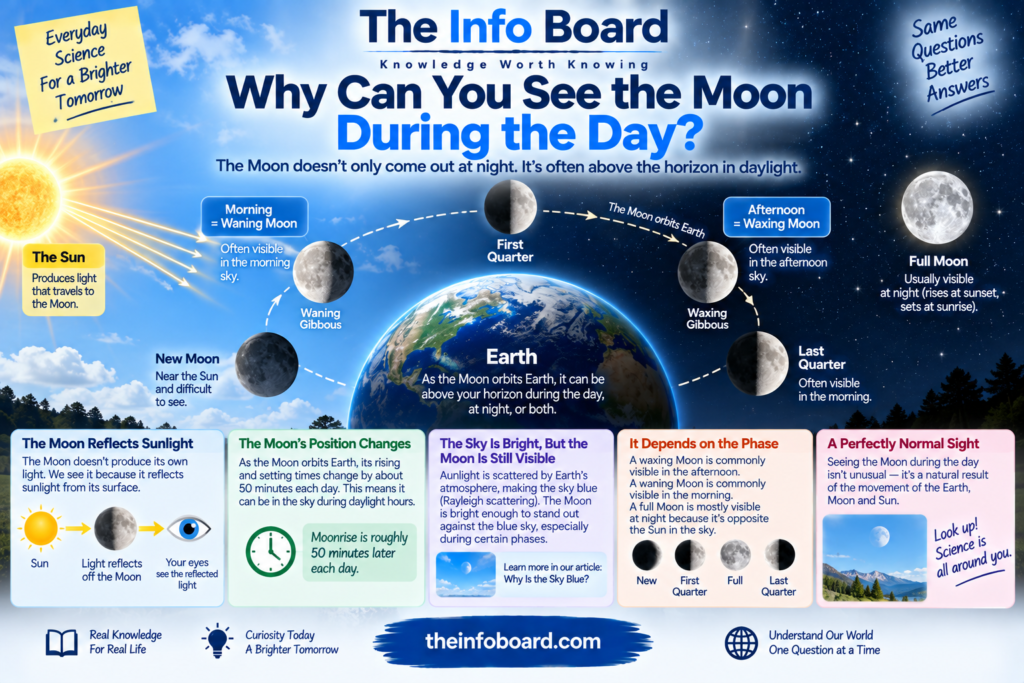
The reason we don’t always notice it comes down to the Moon’s orbit, its phases, its position relative to the Sun and Earth, and the brightness of the daytime sky.
So why exactly can we see the Moon during the day?
The Moon Doesn’t Belong to the Night
The first misconception to clear up is that the Moon only rises at night.
It doesn’t.
The Moon orbits Earth continuously.
As it travels around us, the times at which it rises and sets change from day to day.
Depending on its position in its orbit, the Moon may be above your horizon:
during the night, during the day, or for portions of both.
So seeing it in daylight is perfectly normal.
Why Can We See the Moon at All?
The Moon does not produce visible light in the way the Sun does.
Instead, we see the Moon primarily because it reflects sunlight.
Sunlight reaches the lunar surface.
Some of that light is reflected away.
A portion reaches Earth and enters our eyes.
That’s what makes the Moon visible.
This happens during the daytime too.
The Sun doesn’t stop illuminating the Moon just because your part of Earth is experiencing daylight.
But Isn’t the Daytime Sky Too Bright?
The daytime sky is extremely bright compared with the night sky.
Yet the Moon is also bright enough to remain visible under many conditions.
The Moon’s surface is illuminated by direct sunlight, and it occupies a relatively large area in our sky compared with stars.
Although the blue sky reduces the contrast between the Moon and its background, the Moon can still stand out clearly.
Many stars, by contrast, become extremely difficult to see because the bright sky overwhelms their much weaker apparent brightness.
Why Is the Sky Blue?
The blue daytime sky is caused primarily by Rayleigh scattering.
Sunlight contains many wavelengths of visible light.
When sunlight enters Earth’s atmosphere, it interacts with molecules in the air.
Shorter visible wavelengths are scattered more strongly than longer wavelengths.
Blue light is therefore scattered widely across the sky.
When you look away from the Sun during the day, much of the blue light you see has been scattered through the atmosphere.
This creates the bright blue background against which the daytime Moon appears.
Why Doesn’t Scattered Sunlight Hide the Moon Completely?
Because visibility depends partly on contrast.
The daytime sky is bright, but under suitable conditions the Moon is still sufficiently brighter than the surrounding portion of sky for your eyes to distinguish it.
Its visibility also depends on:
- the Moon’s phase,
- its position in the sky,
- atmospheric conditions,
- the Sun’s position,
- and how clear the sky is.
A thin crescent can be more difficult to notice than a bright gibbous Moon.
What Determines the Moon’s Phase?
The Moon is always roughly half illuminated by the Sun, except during special alignments such as lunar eclipses.
What changes is how much of that illuminated half we can see from Earth.
As the Moon orbits our planet, the viewing geometry changes.
This creates the familiar lunar phases:
new Moon
waxing crescent
first quarter
waxing gibbous
full Moon
waning gibbous
last quarter
waning crescent
Then the cycle begins again.
Does Earth’s Shadow Cause the Moon’s Phases?
No.
This is a common misconception.
The ordinary phases of the Moon are not caused by Earth’s shadow.
They happen because our viewing angle of the Moon’s sunlit half changes as the Moon moves around Earth.
Earth’s shadow becomes important during a lunar eclipse, when the Sun, Earth and Moon align closely enough for the Moon to pass through Earth’s shadow.
An eclipse is a special event.
Moon phases happen continuously every lunar cycle.
What Happens at New Moon?
Around new Moon, the Moon lies approximately in the same direction as the Sun from Earth’s perspective.
The side facing Earth is mostly unilluminated.
That makes the Moon extremely difficult to see.
It is also relatively close to the Sun in the sky, meaning the surrounding sky is very bright.
This combination makes an ordinary new Moon essentially invisible to the unaided eye.
What Happens After New Moon?
As the Moon continues moving in its orbit, a thin illuminated crescent becomes visible.
This is the waxing crescent phase.
A waxing crescent is commonly visible in the western sky after sunset.
But depending on its position and the time of observation, the Moon may also be above the horizon during daylight before sunset.
As the days pass, more of the illuminated portion becomes visible.
What Happens at First Quarter?
At first quarter, we see approximately half of the Moon’s visible disk illuminated.
Despite the name “quarter Moon,” it looks like a half-Moon from Earth.
The term refers to the Moon being roughly one-quarter of the way through its cycle.
A first-quarter Moon typically rises around midday, is high in the sky around sunset and sets around midnight.
That means it can spend several hours in the daytime sky.
This is an excellent phase for spotting the Moon during the afternoon.
Read:Why Is the Sky Blue? The Science Explained Simply
What About a Full Moon?
A full Moon occurs when Earth is approximately between the Sun and Moon.
The side of the Moon facing Earth appears almost completely illuminated.
Because the full Moon is roughly opposite the Sun in the sky, it generally rises around sunset and sets around sunrise.
That’s why a full Moon is primarily associated with nighttime.
You may sometimes see it close to sunrise or sunset, but it spends much less of the main daytime period above the horizon than some other phases do.
What Happens After Full Moon?
After full Moon, the Moon begins waning.
During the waning gibbous phase, it rises later in the evening and remains visible into the morning.
This makes the waning Moon particularly easy to see during daylight hours in the morning.
If you’ve ever looked west in the morning and seen a large pale Moon against a blue sky, you were probably looking at a waning Moon.
What Happens at Last Quarter?
Around last quarter, approximately half of the visible lunar disk appears illuminated again.
But now the Moon is in the later half of its cycle.
A last-quarter Moon typically rises around midnight, reaches a prominent position around sunrise and sets around midday.
So it can remain clearly visible for much of the morning.
Again, daylight Moon sightings are exactly what orbital geometry predicts.
Why Does the Moon Rise at Different Times Every Day?
The Moon is moving around Earth in the same general direction that Earth rotates.
During roughly one day, the Moon travels a noticeable distance eastward relative to the background stars.
Earth therefore has to rotate a little farther before the Moon reaches the same position in the sky.
As a rough average, moonrise occurs about 50 minutes later each day, although the actual difference varies.
This shifting schedule is one of the main reasons the Moon appears at so many different times.
How Long Does the Moon Take to Orbit Earth?
Relative to the distant stars, the Moon takes about 27.3 days to orbit Earth.
This is called its sidereal period.
However, the complete cycle from one new Moon to the next takes about 29.5 days.
This is called the synodic month.
Why the difference?
Because Earth is also orbiting the Sun.
By the time the Moon completes one orbit relative to the stars, Earth has moved along its solar orbit.
The Moon must travel a little farther to return to the same Sun-Earth-Moon geometry.
Why Is the Daytime Moon Usually White?
At night, the Moon can look extremely bright because it is surrounded by a dark sky.
During the day, the surrounding sky is already bright.
The contrast is much lower.
The Moon therefore often appears:
pale white, greyish or slightly washed out.
The Moon itself hasn’t suddenly changed colour.
Your perception changes because of the bright atmospheric background.
Why Can the Moon Look Yellow or Orange Near the Horizon?
When the Moon is low in the sky, its light travels through more of Earth’s atmosphere before reaching you.
Shorter wavelengths are scattered more strongly along the long atmospheric path.
This can make the Moon appear:
yellow, orange or even reddish.
The same general principle contributes to the warm colours of sunrise and sunset.
Atmospheric dust, smoke and pollution can further influence the colour.
Can You See the Moon Every Day?
Not necessarily from a particular location at a convenient time.
There are periods when the Moon is:
- below your horizon,
- too close to the Sun’s direction,
- in a very thin phase,
- hidden by clouds,
- or simply difficult to notice against the bright sky.
But over the course of a lunar month, there are many opportunities to see it during daylight.
What’s the Best Time to See the Moon During the Day?
Two particularly useful periods are:
Afternoon during the waxing phases
and
Morning during the waning phases.
A first-quarter Moon is often easy to find during the afternoon.
A last-quarter Moon is often visible during the morning.
You don’t need a telescope.
Under clear conditions, the Moon is easily visible with the unaided eye.
How Can You Find It?
The easiest method is to start observing the Moon regularly.
Once you know approximately what phase it is, you can predict whether to look in the morning or afternoon.
For a waxing Moon, try looking during the afternoon.
For a waning Moon, try the morning.
You can also use a reputable astronomy application or lunar calendar to determine its position.
Once you spot it, you’ll probably start noticing daytime Moons much more frequently.
Can You See Stars During the Day?
Stars are still in the sky during the daytime.
The Sun doesn’t make them disappear.
Instead, Earth’s atmosphere scatters sunlight and makes the sky so bright that most stars lack sufficient contrast to be visible to the unaided eye.
The Moon is much easier to see because of its apparent brightness and large angular size.
Very bright celestial objects can sometimes be observed under daylight conditions with appropriate techniques and equipment, but you should never point optical equipment near the Sun without proper solar safety procedures.
Can You See Planets During the Day?
Some planets can be bright enough to observe during daylight under suitable conditions.
Venus is a famous example.
However, locating a planet in a bright sky is much harder than finding the Moon.
And there is an important safety issue:
Never scan casually around the daytime sky with binoculars or a telescope when the Sun is nearby.
Accidentally viewing the Sun through optical equipment can cause severe and permanent eye damage.
The daytime Moon can be enjoyed perfectly well without magnification.
Is the Moon Visible From Everywhere at the Same Time?
No.
Different locations on Earth have different horizons and local times.
At a particular moment, the Moon may be above the horizon for observers in one region and below it for observers elsewhere.
Its apparent position also changes somewhat depending on your location.
So two people in different parts of the world won’t necessarily see the Moon in exactly the same part of their sky.
Why Does the Moon Sometimes Look Huge?
When the Moon is near the horizon, it can appear much larger than when it is high in the sky.
This is known as the Moon illusion.
Interestingly, photographs show that the Moon’s apparent angular size does not suddenly become enormous at the horizon.
The dramatic size difference is largely a perceptual effect produced by the way our brains interpret the Moon relative to foreground objects and the surrounding landscape.
It is another example of how our visual perception doesn’t always correspond directly to physical measurements.
Is the Daytime Moon Different From the Nighttime Moon?
No.
It’s the same Moon, illuminated by the same Sun.
The main difference is your observing environment.
At night, the background sky is dark.
During the day, sunlight scattered by Earth’s atmosphere makes the sky bright.
That changes the contrast dramatically.
The Moon hasn’t switched into a special “daytime mode.”
Does the Moon Affect Daylight?
The amount of sunlight reflected from the Moon is tiny compared with the direct sunlight illuminating Earth during the day.
So although you can see the Moon, it makes no meaningful difference to ordinary daytime brightness.
At night, moonlight becomes much more noticeable because the Sun is below your horizon and the sky is dark.
Read:Why Does Your Voice Sound Different in a Recording?
Why Don’t We Notice the Daytime Moon More Often?
Partly because people simply aren’t looking for it.
During the day, our attention is usually focused on:
roads, buildings, work, phones, other people and things happening around us.
The pale Moon doesn’t attract attention in the same way it does against a dark night sky.
Once someone points it out, however, it can suddenly seem obvious.
After learning when to look, many people are surprised by how frequently they can find it.
A Simple Observation You Can Try
Over the next few weeks, watch the Moon whenever the sky is clear.
Note:
the date
the time
the phase
where it appears in the sky
You’ll see its schedule gradually shift.
After new Moon, watch for the waxing Moon increasingly visible in the afternoon and evening.
After full Moon, look for the waning Moon in the late night and morning sky.
Doing this for one lunar cycle makes the relationship between the Moon’s orbit and its visibility much easier to understand than memorising a diagram.
The Bottom Line
You can see the Moon during the day because the Moon doesn’t belong exclusively to the nighttime sky.
It continuously orbits Earth, causing its rising and setting times to change throughout the month.
During many phases, the Moon is above your horizon while the Sun is also above it.
The Moon reflects sunlight strongly enough that, under suitable conditions, we can distinguish it against Earth’s bright blue daytime sky.
A waxing Moon is commonly visible during the afternoon.
A waning Moon is commonly visible during the morning.
A full Moon, by contrast, is mostly associated with nighttime because it lies roughly opposite the Sun in the sky.
So the next time you see a pale Moon floating against a bright blue sky, you’re not witnessing anything unusual.
You’re seeing the normal geometry of the Sun, Earth and Moon playing out directly above you.
Frequently Asked Questions
Why can you see the Moon during the day?
Because the Moon is often above the horizon during daylight and reflects enough sunlight to remain visible against the bright sky.
Does the Moon produce its own light?
No. The visible Moon is primarily illuminated by sunlight reflected from its surface.
Why isn’t the Moon visible every day?
Its visibility depends on its orbital position, phase, time of day, location, weather and proximity to the Sun in the sky.
What is the best time to see the daytime Moon?
Waxing phases are often easy to see during the afternoon, while waning phases are commonly visible during the morning.
Why can’t we see most stars during the day?
Sunlight scattered through Earth’s atmosphere makes the daytime sky very bright, reducing the contrast of most stars below what our unaided eyes can detect.
Does Earth’s shadow cause the phases of the Moon?
No. Normal lunar phases result from our changing view of the Moon’s sunlit half. Earth’s shadow causes a lunar eclipse, not the ordinary phases.
Why does the Moon rise later each day?
Because the Moon moves eastward in its orbit around Earth, Earth must rotate a little farther each day before the Moon reaches a similar position in the sky.