Passwords protect almost everything we do online, from email and social media to shopping accounts and cloud storage.
But a password has one major weakness: someone else can obtain it.
Passwords can be stolen through phishing, exposed in data breaches, guessed when they’re weak or reused across multiple websites.
Two-factor authentication (2FA) adds another layer of protection. Even if someone discovers your password, they may still be unable to access your account.
Here’s how it works and why it’s worth enabling.
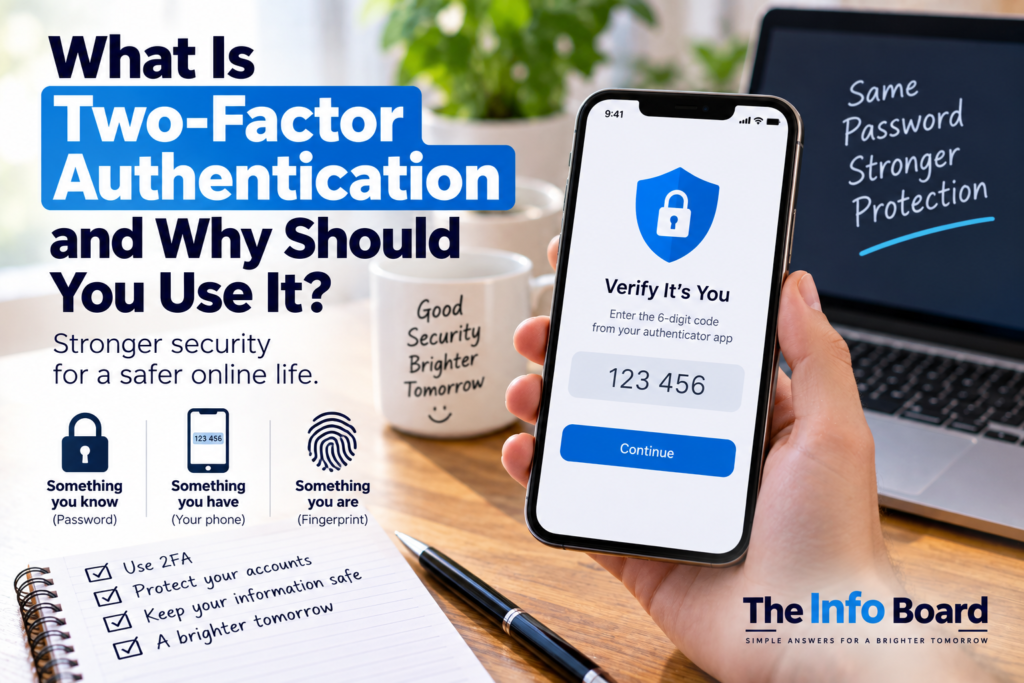
What Is Two-Factor Authentication and Why Should You Use It?
What Is Two-Factor Authentication?
Two-factor authentication is a security method that requires you to prove your identity in two different ways before accessing an account.
Normally, logging in requires something you know:
Your password.
With 2FA enabled, the service asks for another form of verification as well.
For example, you might enter your password and then approve the login using an authenticator app on your phone.
An attacker who knows only your password is therefore missing the second factor.
What Are the Different Authentication Factors?
Authentication methods are commonly divided into several categories.
Something You Know
This includes information stored in your memory, such as:
- a password
- a PIN
- a passphrase
Something You Have
This involves possessing a particular device or object, such as:
- your smartphone
- an authenticator app
- a physical security key
Something You Are
This involves biometric characteristics, such as:
- your fingerprint
- facial recognition
Using different types of authentication provides stronger protection than relying solely on a password.
How Does 2FA Work?
Imagine you’re logging into your email account.
First, you enter your email address and password.
Without 2FA, a correct password may be enough to access the account.
With 2FA enabled, you’re asked for another verification step.
This might be a temporary code generated by an authenticator app.
You enter the code and gain access.
Now imagine a criminal obtains your password through a phishing attack.
They attempt to log in.
The password works — but they’re then asked for the second authentication factor.
If they don’t have it, the stolen password alone may not be enough.
That’s the central benefit of two-factor authentication.
What Is an Authenticator App?
An authenticator app generates temporary login codes.
After connecting the app to an account, it can generate a short code that changes regularly.
When logging in, you enter your password followed by the current code.
The code is only valid for a limited period.
This makes it very different from having a second permanent password.
Authenticator apps are supported by many email providers, social networks, financial services and other online accounts.
What About Codes Sent by Text Message?
Some websites send a verification code to your phone by SMS.
This is also a form of two-step verification and can provide additional protection compared with using only a password.
However, SMS has security limitations.
Phone numbers can sometimes be targeted through attacks such as SIM swapping, where a criminal attempts to take control of someone’s mobile number.
For that reason, where a service offers stronger alternatives such as an authenticator app or security key, those options may be preferable.
But if SMS is the only additional authentication method available, it can still provide an extra barrier compared with password-only access.
What Is a Security Key?
A security key is a physical device used to authenticate your identity.
Depending on the device and service, you might insert it into a computer, connect it wirelessly or tap it against a compatible phone.
Security keys can provide very strong protection, particularly against phishing attacks.
They’re especially useful for people who require higher levels of account security, although most everyday users will find authenticator apps convenient and effective.
Read:iPhone 18 Pro: What’s New and What Has Changed?
Is Face ID or a Fingerprint 2FA?
Not automatically.
Using a fingerprint to unlock your phone involves biometric authentication, but that doesn’t necessarily mean every account on the phone is protected by two-factor authentication.
Whether something qualifies as 2FA depends on how the particular service combines its authentication factors.
A biometric check can form part of a multi-factor authentication system, but simply unlocking a device with your face or fingerprint shouldn’t be assumed to mean every website you visit is using 2FA.
Why Isn’t a Strong Password Enough?
A strong password is still extremely important.
But even an excellent password can potentially be stolen.
Imagine you use a long, completely unique password for your email account.
You then receive a convincing phishing message directing you to a fake login page.
If you enter the password, the attacker may receive it.
Two-factor authentication creates another obstacle.
Instead of having everything necessary to access the account, the attacker has only one part.
That’s why strong passwords and 2FA work best together.
You can read our guide on how to create a strong password you can actually remember for more information about password security.
Why Is Your Email Account Particularly Important?
Your email account can be one of your most valuable digital accounts.
Think about how many websites use email for password resets.
If somebody gains control of your email, they may be able to request password-reset messages for other services you use.
That makes protecting your main email account particularly important.
If your email provider supports two-factor authentication, enabling it should be a high priority.
Which Accounts Should Have 2FA?
Ideally, enable it wherever it’s available, particularly on important accounts.
Prioritise accounts such as:
Email — often connected to password resets for other services.
Banking and financial accounts — where supported and according to the provider’s security system.
Social media — compromised accounts can be used for scams and impersonation.
Cloud storage — may contain photographs, documents and personal information.
Shopping accounts — may contain saved addresses and payment details.
Work accounts — can contain sensitive business information.
You don’t have to enable everything in one afternoon.
Start with your most important accounts and work through the rest gradually.
Can Hackers Still Get Around 2FA?
Two-factor authentication significantly improves security, but no security measure makes an account completely invulnerable.
Attackers can attempt sophisticated phishing attacks designed to trick victims into entering both their password and a temporary authentication code.
Some criminals may also send repeated login approval requests hoping that the victim eventually presses Approve simply to make the notifications stop.
This is sometimes called MFA fatigue or push bombing.
The rule is simple:
Never approve a login request you didn’t initiate.
If unexpected authentication requests start appearing, change your password and investigate the account immediately.
Never Give Someone Your Authentication Code
A temporary verification code should be treated like a password.
A scammer might telephone or message you while pretending to represent a bank, technology company or other organisation.
They may claim that they need the code appearing on your phone to “verify your identity.”
In reality, they could be trying to log into your account themselves.
Never provide an authentication code simply because somebody asks for it.
What Are Backup Codes?
Many services provide backup or recovery codes when you enable 2FA.
These codes can help you regain access if you lose your phone or cannot use your normal authentication method.
Store them somewhere secure.
Don’t save your only copy somewhere that depends on access to the same account you’re trying to recover.
For example, keeping the only recovery code for your email account inside that email account would not be particularly helpful if you’re locked out.
What Happens If You Lose Your Phone?
This is one reason recovery preparation matters.
Depending on the service, you may be able to regain access using:
- a backup code
- another trusted device
- a security key
- an account-recovery process
- another authentication method you’ve previously configured
When enabling 2FA, spend a few extra minutes checking the recovery options.
That small amount of preparation can prevent a major problem later.
Is Two-Factor Authentication Annoying?
It adds an extra step, but usually not to every action you perform.
Many services recognise trusted devices and may only request additional authentication when something changes — for example, when you sign in on a new device or when a login appears unusual.
The small inconvenience is generally a reasonable trade-off for the additional protection.
Read:How to Create a Strong Password You Can Actually Remember
Is 2FA the Same as MFA?
The terms are closely related.
2FA means two-factor authentication: two different factors are required.
MFA means multi-factor authentication: two or more factors can be involved.
In everyday conversation, the terms are sometimes used interchangeably, although MFA is technically the broader concept.
What About Passkeys?
Passkeys are a newer approach to account authentication.
Instead of relying on a traditional password that can be typed into a fake website, passkeys use cryptographic technology tied to your device or password manager.
They can provide strong resistance to phishing and are increasingly supported by major online services.
However, passwords and 2FA remain extremely common, so understanding both is still important.
How to Start Using 2FA
You can usually find the option inside an account’s Security, Login, Privacy or Account Settings section.
Look for wording such as:
- Two-factor authentication
- Two-step verification
- Multi-factor authentication
- 2FA
- MFA
Choose the strongest convenient method the service offers, complete the setup process and save any recovery information securely.
Frequently Asked Questions
Is 2FA really necessary?
It is strongly recommended for important online accounts because it adds protection if your password becomes compromised.
Is an authenticator app better than SMS?
Authenticator apps generally avoid some of the weaknesses associated with SMS authentication. If a service offers an authenticator app or other stronger method, it is worth considering.
Can I use 2FA on Facebook?
Yes. Facebook provides two-factor authentication options through its security settings, including authentication apps and security keys.
Should I enable 2FA on my email first?
Your primary email account is an excellent place to start because email is frequently used to recover passwords for other accounts.
What should I do if I receive a 2FA request I didn’t make?
Do not approve it. Check the account’s security activity and change the password if you suspect somebody has obtained your login credentials.
The Bottom Line
A password is an important security barrier, but it shouldn’t always be the only one.
Two-factor authentication adds another layer of defence between an attacker and your account.
Start with your email, social media, cloud storage and other important accounts. Use an authenticator app or stronger authentication method when available, keep recovery codes secure and never approve login requests you didn’t initiate.
It only adds a small amount of effort to logging in, but it can make a stolen password considerably less useful to an attacker.
[…] Read:What Is Two-Factor Authentication and Why Should You Use It? […]