You’ve probably seen advertisements telling you that you need a VPN to stay safe online.
Some claim a VPN makes you anonymous. Others suggest it can protect everything you do on the internet.
The reality is more nuanced.
A VPN, or Virtual Private Network, can provide useful privacy and security benefits, particularly when you want to protect network traffic or connect securely to another network.
But a VPN is not an invisibility cloak.
It cannot stop every scam, prevent every hack or make unsafe behaviour automatically safe.
Understanding what a VPN actually does makes it much easier to decide whether you need one.
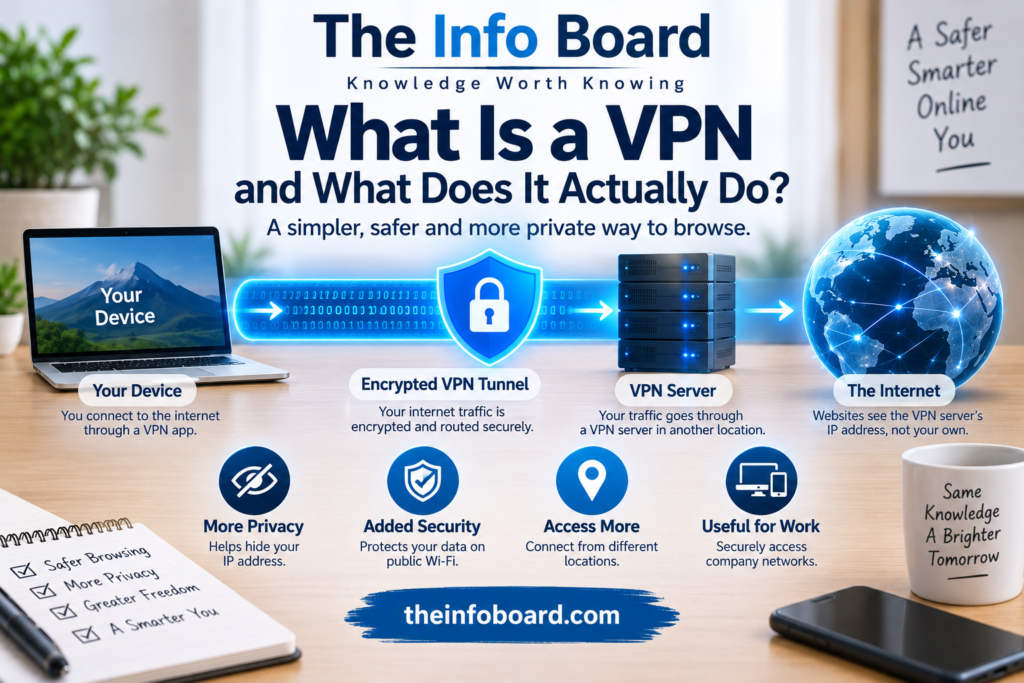
What Does VPN Mean?
VPN stands for:
Virtual Private Network
A VPN creates an encrypted connection between your device and a VPN server.
Normally, when you visit a website, your internet connection ultimately communicates with that website through your internet service provider and the wider internet.
When you use a VPN, your internet traffic is first routed through the VPN provider’s server.
The destination website then generally sees the VPN server’s public IP address rather than the public IP address assigned to your home or mobile connection.
What Happens When You Connect to a VPN?
A simplified version looks like this:
Your device → encrypted VPN connection → VPN server → website
Without the VPN:
Your device → internet connection → website
The VPN therefore introduces an intermediary between your device and the websites or online services you access.
Traffic between your device and the VPN server is encrypted by the VPN protocol.
From the VPN server onward, normal internet security still matters.
For example, HTTPS remains important when communicating with websites.
What Is an IP Address?
An IP address is an identifier used for communication across internet networks.
Your public IP address can reveal information such as the internet provider you’re using and an approximate geographic area.
It does not normally reveal your precise home address to an ordinary website visitor.
When you use a VPN, websites generally see the VPN server’s public IP address instead of the public IP address of your normal internet connection.
This is why a VPN can make your connection appear to originate from another location.
Does a VPN Hide Your IP Address?
From the websites and services you connect to through the VPN, generally yes — your normal public IP address is replaced by the VPN server’s address.
But this needs context.
Your VPN provider still has to receive your connection.
Your internet provider can generally tell that your connection is communicating with a VPN service, even though it may have less visibility into the destinations carried inside the encrypted VPN tunnel.
And websites may still recognise you through other methods.
Your IP address is only one piece of information used online.
Does a VPN Make You Anonymous?
No.
This is one of the biggest misconceptions about VPNs.
A VPN can improve privacy, but privacy and anonymity are not the same thing.
Imagine you connect to a VPN and then sign into your Google, Facebook or Amazon account.
Those services still know which account you’re using.
Cookies can also identify returning browsers.
Websites may use other technical information to distinguish users and devices.
So changing your visible IP address does not magically erase your online identity.
What Does VPN Encryption Protect?
The encrypted VPN tunnel protects traffic travelling between your device and the VPN server from straightforward inspection on the local network.
This can be particularly useful when you are using networks you don’t fully trust.
Someone monitoring the local connection should not simply be able to read the contents of traffic protected inside the VPN tunnel.
However, much of the modern web already uses HTTPS, which independently encrypts communication between your browser and HTTPS websites.
A VPN adds another layer and changes where some trust is placed.
Are Public Wi-Fi Networks Dangerous?
Public Wi-Fi deserves caution, although modern HTTPS has significantly improved web security compared with the early days of public wireless networking.
A VPN can provide additional protection for network traffic when you’re using a network you don’t control, such as Wi-Fi in a hotel, airport or café.
But using a VPN does not mean you can ignore every other security precaution.
You should still keep your device updated, use HTTPS services, avoid suspicious downloads and pay attention to security warnings.
Can the Wi-Fi Owner See What You’re Doing?
Without a VPN, the network operator can potentially see certain information about your connections, although HTTPS prevents them from simply reading the contents of properly encrypted web pages.
With a VPN, much of your internet traffic is carried through an encrypted tunnel to the VPN server.
The local network can see that your device is exchanging data with the VPN service, but it has less direct visibility into the traffic carried inside that tunnel.
Can Your Internet Provider See Through a VPN?
A VPN changes what your internet service provider can easily observe.
Your provider still knows that you’re connected to the internet and can see your connection to the VPN server.
But properly encrypted VPN traffic prevents the provider from simply inspecting everything carried through that tunnel.
There is an important trade-off, though:
You are shifting some trust from your internet provider to your VPN provider.
That makes the choice of VPN provider important.
Can the VPN Provider See Your Activity?
Potentially, the VPN provider occupies a privileged position because your traffic passes through its infrastructure.
Exactly what the provider can observe depends on the VPN architecture, protocols, website encryption and the provider’s technical and logging practices.
This is why you shouldn’t choose a VPN solely because an advertisement says “no logs.”
Privacy claims deserve scrutiny.
Look for clear policies, credible technical information and a business model you understand.
Are Free VPNs Safe?
Some legitimate services offer limited free VPN plans.
But “free” does not automatically mean trustworthy.
Operating VPN servers costs money.
If a service charges you nothing, it is reasonable to ask how the company funds its infrastructure.
Possible business models include advertising, paid premium plans or other revenue sources.
Before installing an unfamiliar free VPN, investigate who operates it, what data it collects, what permissions the app requests and how the company makes money.
Can a VPN Stop Viruses?
Not by itself.
A traditional VPN primarily protects and routes network traffic.
It does not automatically stop you from downloading malicious software.
If you deliberately download and run a dangerous file, having a VPN connection does not magically make that file safe.
Some commercial VPN products bundle additional security features, but those are separate functions from the core VPN technology.
Can a VPN Stop Phishing?
No.
Suppose you receive a fake banking email and visit a convincing fraudulent website.
A VPN can encrypt the connection between you and the VPN server.
It cannot determine that you are voluntarily giving your password to a criminal.
This is why online security requires multiple layers.
Related: How to Tell If a Website Is Safe Before You Use It.
Can a VPN Protect Your Passwords?
A VPN is not a replacement for good password security.
You should still use unique passwords, protect important accounts with two-factor authentication and be cautious about where you enter login credentials.
A VPN protects network traffic.
A password manager protects credentials in a completely different way.
Related: How to Create a Strong Password You Can Actually Remember.
What Is a VPN Useful For?
VPNs have several legitimate uses.
One major use is secure remote access.
Businesses often use VPN technology to allow employees to connect securely to internal company systems while working away from the office.
Consumers may use VPN services to add privacy when using networks they don’t control or to route internet traffic through a particular server.
VPNs are also widely used by organisations to connect separate networks securely.
Why Do Companies Use VPNs?
Imagine an employee working from home needs access to a system that should not be exposed openly to the internet.
A corporate VPN can create an encrypted connection between the employee’s device and the company’s network.
Once authenticated, the employee can access authorised internal resources as though they were connected more directly to the organisation.
This has been one of the major practical uses of VPN technology for many years.
Can a VPN Change Your Apparent Location?
Yes, to an extent.
If you connect to a VPN server in another country, websites may infer your location from the VPN server’s IP address.
For example, connecting through a server in France may cause some websites to interpret the connection as originating from France.
But IP-based location is not the only way websites and apps determine location.
A device may also provide GPS information, account settings or other location signals.
Does a VPN Make Your Internet Faster?
Usually, you should not expect a VPN to increase your maximum connection speed.
VPN traffic has to be encrypted and routed through an additional server.
That introduces overhead and can increase latency.
However, real-world performance depends on many factors, including the VPN server’s location, server load, protocol, your internet provider and the route traffic would otherwise take.
A good VPN can feel very fast, but speed improvement is not its fundamental purpose.
Why Can a VPN Make the Internet Slower?
Suppose you’re in London but connect to a VPN server thousands of kilometres away.
Your traffic may have to travel much farther before reaching its final destination.
That additional distance can increase latency.
Encryption also requires processing.
Modern devices and VPN protocols can handle encryption efficiently, but the extra work and routing still mean some performance overhead is normal.
What Is a VPN Protocol?
A VPN protocol defines how the encrypted connection is established and how data travels through it.
Examples include technologies such as:
WireGuard
OpenVPN
IKEv2/IPsec
Different protocols have different designs and trade-offs involving performance, compatibility and security.
Most ordinary users don’t need to understand every technical detail, but reputable VPN applications generally use established, modern protocols rather than mysterious proprietary technology with no documentation.
Read:What Is Two-Factor Authentication and Why Should You Use It?
What Is a VPN Kill Switch?
Some VPN applications include a feature called a kill switch.
Its purpose is to prevent your device from automatically sending traffic through the normal internet connection if the VPN unexpectedly disconnects.
Without such protection, a connection failure could cause traffic to revert to your ordinary network route.
Whether you need this feature depends on why you’re using the VPN and how sensitive continuity of VPN protection is for your situation.
What Is Split Tunnelling?
Split tunnelling allows some traffic to use the VPN while other traffic uses the normal internet connection.
For example, you might route work applications through a corporate VPN while allowing an unrelated service to use your ordinary connection.
This can improve flexibility and performance, although it also makes the configuration more complex.
Should You Leave a VPN On All the Time?
There is no universal rule.
Some people prefer continuous VPN protection, particularly on mobile devices that frequently connect to different networks.
Others activate a VPN only when they have a particular reason to use it.
Leaving it connected continuously can affect battery consumption, connection speed, website behaviour and access to certain services.
The right choice depends on what you’re trying to protect against.
Why Do Some Websites Dislike VPNs?
Many people can share the same VPN server.
That means hundreds or thousands of users may appear to websites under the same public IP address.
If some users generate suspicious traffic, websites may become cautious about that IP.
This can lead to extra CAPTCHAs, login verification or temporary blocking.
Some services also restrict connections from known VPN infrastructure for licensing, fraud-prevention or security reasons.
Do You Need a VPN at Home?
Not necessarily.
Your home Wi-Fi should already be protected with appropriate wireless security, and HTTPS encrypts communication with properly configured websites.
A VPN can still provide privacy benefits or serve particular use cases, but advertisements sometimes exaggerate the idea that everyone is dangerously exposed whenever they browse without one.
Security decisions should be based on your actual needs rather than fear.
A VPN Doesn’t Replace HTTPS
This distinction is important.
VPN encryption protects the connection between your device and the VPN server.
HTTPS protects communication between your browser and the website.
They solve overlapping but different problems.
When using a VPN, you should still expect legitimate websites handling sensitive information to use HTTPS.
Related: How to Tell If a Website Is Safe Before You Use It.
A VPN Doesn’t Replace Software Updates Either
Security vulnerabilities in your operating system, browser or applications are not repaired by connecting to a VPN.
Keeping software updated remains essential.
Related: Why Are Software Updates So Important?
How Should You Choose a VPN?
Don’t choose solely based on flashy advertisements or enormous discount countdowns.
Consider:
the company’s reputation, privacy policy, ownership, technical documentation, supported protocols, security history, independent audits where available, pricing and whether you genuinely need the service.
Also be cautious about granting a VPN app extensive permissions without understanding why they’re required.
Because VPN software handles network traffic, trust matters.
Do You Actually Need One?
Ask yourself what problem you’re trying to solve.
If your answer is:
“I regularly use networks I don’t control and want an additional privacy layer”
a VPN may be useful.
If your answer is:
“I need secure remote access to my employer’s network”
your organisation may provide a VPN specifically for that purpose.
But if your answer is:
“An advertisement told me hackers can see everything I do unless I buy this VPN immediately”
the situation is probably being oversimplified.
Read:What Is an IP Address and What Can It Reveal About You?
The Bottom Line
A VPN creates an encrypted connection between your device and a VPN server and routes internet traffic through that server.
This can hide your normal public IP address from destination websites and reduce what the local network or internet provider can directly observe about traffic carried inside the VPN tunnel.
But a VPN does not make you completely anonymous.
It does not automatically stop viruses.
It does not prevent phishing.
It does not replace strong passwords, two-factor authentication, HTTPS or software updates.
Think of a VPN as one privacy and networking tool, not a complete cybersecurity solution.
Understanding that distinction is far more useful than simply switching one on and assuming you’re protected from everything.
Frequently Asked Questions
What does VPN stand for?
VPN stands for Virtual Private Network.
What does a VPN actually do?
It creates an encrypted connection between your device and a VPN server and routes internet traffic through that server.
Does a VPN hide my IP address?
Websites you access through the VPN generally see the VPN server’s public IP address rather than your normal public IP address.
Does a VPN make me anonymous?
No. Accounts, cookies and other identifying information can still reveal who you are.
Does a VPN protect against hackers?
A VPN can protect network traffic in certain situations, but it is not comprehensive protection against hacking, malware, phishing or account theft.
Is a free VPN safe?
Some reputable companies provide limited free services, but free VPNs should be evaluated carefully. Investigate the provider’s ownership, privacy practices and business model before trusting it with your traffic.
Will a VPN make my internet faster?
Usually not. VPNs introduce additional routing and encryption overhead, although actual performance varies considerably between services and network conditions.
Should I use a VPN on public Wi-Fi?
A VPN can provide an additional layer of protection on networks you don’t control. You should still use HTTPS, keep software updated and follow normal security precautions.
External source:
UK National Cyber Security Centre — Virtual private networks guidance
Leave a Comment