Open your refrigerator door and cold air immediately spills into the kitchen.
It seems obvious that a fridge’s job is to make things cold. But technically, that’s not quite what it does.
A refrigerator doesn’t create cold in the same way that a heater creates heat.
Instead, it uses a clever system to move heat from inside the refrigerator to the room outside.
That’s why the back or sides of a fridge can feel warm even though the food inside is cold.
So how does this everyday appliance actually work?
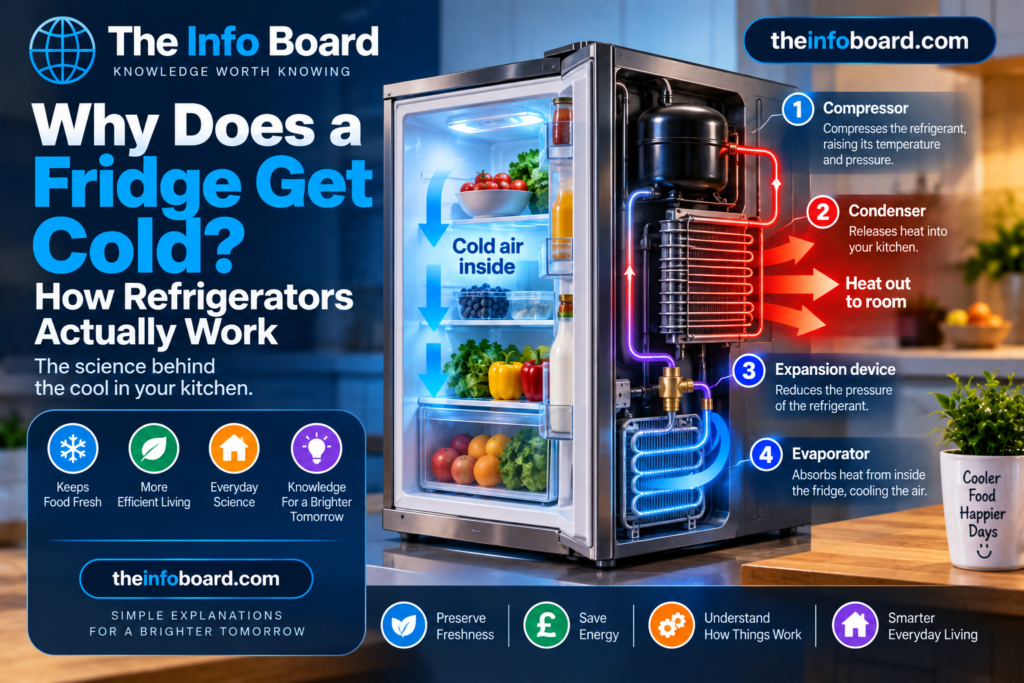
Why Does a Fridge Get Cold? How Refrigerators Actually Work
A Refrigerator Doesn’t Really “Make Cold”
The easiest way to understand a refrigerator is to think about heat rather than cold.
Heat naturally moves from warmer areas toward cooler ones.
But your refrigerator needs to do something different: it needs to take heat from a cool compartment and move it into a warmer kitchen.
Doing that requires energy.
The refrigerator uses electricity to operate a system that continuously transfers heat from inside the appliance to the surrounding room.
As heat is removed, the temperature inside falls.
The Refrigeration Cycle
Most household refrigerators use a process called the vapour-compression refrigeration cycle.
The main components are:
- Refrigerant
- Compressor
- Condenser
- Expansion device
- Evaporator
These components work together in a repeating loop.
Once you understand that loop, the mystery of how a fridge gets cold becomes much easier to understand.
What Is Refrigerant?
Refrigerant is a substance that circulates through the refrigerator’s sealed cooling system.
Its physical properties allow it to change between liquid and gas under different pressures and temperatures.
Those changes allow the system to absorb heat in one location and release it somewhere else.
The refrigerant doesn’t normally get used up during everyday operation.
Instead, it continuously circulates through a closed system.
If refrigerant escapes, that usually indicates a fault or leak requiring professional attention.
Step 1: The Compressor Compresses the Refrigerant
The compressor is one of the most important parts of the refrigerator.
It is powered by electricity and compresses refrigerant vapour.
Compressing the refrigerant raises its pressure and temperature.
The refrigerant leaving the compressor is therefore a hot, high-pressure gas.
It then travels toward the condenser.
You may sometimes hear your refrigerator humming when the compressor is operating.
Step 2: The Refrigerator Releases Heat Into Your Kitchen
The hot refrigerant travels through the condenser.
The condenser allows heat to move from the refrigerant into the surrounding air.
As the refrigerant loses heat, it condenses from a gas into a liquid.
This explains something that can initially seem strange:
A refrigerator makes your kitchen slightly warmer.
The appliance is moving heat out of its interior and releasing that heat into the room. The electrical energy used by the refrigerator ultimately contributes additional heat as well.
Why Is the Back of a Fridge Warm?
Older refrigerators often have clearly visible condenser coils at the back.
Many modern designs position parts of the condenser differently, sometimes within the appliance’s outer structure.
Wherever the condenser is located, it needs to release heat.
That’s why parts of a refrigerator can feel warm during normal operation.
Warmth isn’t automatically a sign that something is wrong.
However, unusual overheating, burning smells or other signs of an electrical problem should be investigated appropriately.
Step 3: The Refrigerant Passes Through an Expansion Device
After leaving the condenser, the high-pressure liquid refrigerant reaches an expansion device, such as a capillary tube or expansion valve depending on the system.
This restricts the flow of refrigerant and causes its pressure to drop.
The lower pressure prepares the refrigerant for the next crucial part of the cycle.
Step 4: The Refrigerant Absorbs Heat Inside the Fridge
The refrigerant then enters the evaporator.
Here, it absorbs heat from the air and contents inside the refrigerator.
As the refrigerant absorbs heat, it evaporates.
This is the part of the cycle responsible for cooling the refrigerator compartment.
The refrigerant isn’t adding “cold.”
It is taking heat away.
The refrigerant eventually returns toward the compressor, and the cycle begins again.
The Whole Process in Simple Terms
Think of the refrigeration cycle like a heat-moving loop:
Inside fridge → refrigerant absorbs heat → compressor → condenser releases heat into kitchen → refrigerant returns inside → repeat.
As long as the refrigerator keeps removing heat faster than heat enters, the inside remains cold.
Why Doesn’t the Compressor Run Constantly?
A refrigerator usually doesn’t need its compressor operating continuously.
A temperature sensor or thermostat monitors conditions inside.
When the temperature rises above the desired range, the cooling system operates.
Once the compartment becomes sufficiently cold, the compressor can switch off.
Later, as heat gradually enters the refrigerator, the temperature rises again and another cooling cycle begins.
This repeated starting and stopping is normal.
How Does Heat Get Into a Closed Fridge?
Even with the door shut, some heat eventually enters.
Refrigerators use insulation to slow heat transfer, but insulation cannot prevent it completely.
Heat can enter through the refrigerator’s walls, door seals and other parts of its structure.
Every time you open the door, warmer room air also enters.
The refrigerator then has to remove that additional heat.
Why Does Leaving the Fridge Door Open Waste Energy?
When you open the door, some cold air leaves and warmer air enters.
The cooling system must then work to remove the additional heat.
Repeatedly opening the refrigerator—or leaving the door open longer than necessary—can therefore increase the amount of work the appliance needs to do.
There’s another interesting consequence.
If you left a refrigerator door open indefinitely in a sealed room, it wouldn’t cool the room.
The refrigerator would remove some heat from the air entering its compartment, but then release that heat—plus heat resulting from the electrical energy it consumes—back into the same room.
Overall, the room would become slightly warmer.
Why Is There a Light but No Cold Air Blowing Sometimes?
The light and cooling system are separate.
The interior light usually comes on when the door opens, but the compressor doesn’t necessarily operate at that exact moment.
Depending on the design, fans may also stop when the door opens.
So hearing silence when you open the refrigerator doesn’t mean it isn’t working.
The cooling system operates according to temperature and the appliance’s control system.
Why Do Some Fridges Have Fans?
Many modern refrigerators use fans to circulate cold air.
Air circulation helps distribute cooling more evenly throughout the compartments.
Without adequate circulation, some areas could become considerably colder or warmer than others.
This is also why completely blocking internal vents with food can sometimes affect temperature distribution.
Why Is the Freezer Colder Than the Fridge?
A refrigerator typically keeps fresh food cool without freezing it, while the freezer operates at a much lower temperature.
In many fridge-freezer designs, cooling is produced around the freezer or evaporator area and controlled airflow distributes cold air between compartments.
Other designs may use separate cooling systems or evaporators.
The exact arrangement depends on the appliance.
For food safety, UK guidance generally recommends keeping your fridge at 5°C or below.
Why Does Ice Form Inside a Freezer?
Air contains water vapour.
When moist air enters a very cold freezer, some of that moisture can condense and freeze onto cold surfaces.
Over time this can create frost.
Opening the freezer door frequently allows additional humid room air inside, which can increase frost formation.
A damaged or poorly sealing door gasket can have a similar effect.
What Is a Frost-Free Freezer?
Many modern fridge-freezers are described as frost-free.
They don’t prevent water from existing in the air.
Instead, they periodically manage frost that forms around the evaporator using an automatic defrost system.
During a defrost cycle, accumulated ice is melted and the resulting water is directed away, commonly into a drainage system where it can eventually evaporate.
This reduces the need for manual defrosting.
Why Does Food Freeze at the Back of My Fridge?
The temperature isn’t always identical everywhere inside a refrigerator.
Some locations may be closer to cooling surfaces or cold-air outlets.
If food touches an especially cold rear surface, it may become cold enough to partially freeze.
Incorrect temperature settings, poor airflow or certain faults can also contribute.
If food regularly freezes when the refrigerator is set correctly, checking the manufacturer’s guidance or having the appliance assessed may be appropriate.
Why Does a Fridge Make Strange Noises?
Refrigerators aren’t silent machines.
Normal sounds can include:
Humming from the compressor.
Whirring from fans.
Clicking when components switch on or off.
Gurgling or bubbling as refrigerant moves through the system.
Cracking or popping caused by temperature changes and materials expanding or contracting.
A new or unusually loud sound doesn’t necessarily indicate a problem, but a significant change in normal operation may be worth investigating.
Read:Why Do LED Lights Use Less Electricity?
Why Is There Water at the Bottom of My Fridge?
Small amounts of condensation can occur inside refrigerators.
Many appliances have drainage systems designed to carry condensation or defrost water away.
If a drain becomes blocked, water may collect inside the appliance.
Other possibilities include damaged door seals, food positioning, excessive moisture or a fault.
The manufacturer’s troubleshooting instructions are the best starting point for a specific refrigerator model.
Does Putting Hot Food in the Fridge Make It Work Harder?
Hot food contains more thermal energy than cooled food.
When placed in the refrigerator, that heat must eventually be removed.
So yes, adding something hot increases the cooling load.
However, food safety is more important than trying to save a tiny amount of electricity.
Perishable cooked food shouldn’t simply be left at room temperature for excessive periods in an attempt to avoid making the refrigerator work.
Follow appropriate food-storage guidance.
Does a Full Fridge Use Less Electricity?
The answer is more complicated than the common claim that “a full fridge is always more efficient.”
Stored food and drinks provide thermal mass, which can help temperatures remain stable when the door opens.
But packing a refrigerator too tightly can restrict airflow.
A sensible approach is to use the refrigerator normally while allowing air to circulate according to the manufacturer’s instructions.
Why Are Fridge Door Seals Important?
The flexible seal around the door helps prevent warm room air from continually entering.
If the seal becomes damaged, dirty or unable to close properly, the refrigerator may need to run more often to maintain its temperature.
A poor seal can therefore increase energy consumption and contribute to temperature problems.
Keeping the seal clean and checking that the door closes properly are simple maintenance steps.
Why Does Dust Behind a Fridge Matter?
Where condenser coils or ventilation areas are accessible, accumulated dust can interfere with heat transfer and airflow.
That can make the refrigerator work harder.
Maintenance requirements vary by model, so follow the manufacturer’s instructions before cleaning around components.
Always disconnect an appliance from the electricity supply when the manufacturer’s safety instructions require it.
What Temperature Should a Refrigerator Be?
In the UK, the Food Standards Agency recommends keeping a refrigerator at 5°C or below.
A fridge thermometer can help you check the actual temperature rather than relying only on the numbered dial.
The numbers on many refrigerator controls don’t necessarily represent degrees Celsius.
They may simply indicate progressively stronger or weaker cooling settings.
Does Turning the Dial to Maximum Cool Food Faster?
A colder setting generally tells the refrigerator to aim for a lower temperature.
It doesn’t necessarily make the refrigeration system itself suddenly operate with dramatically greater cooling power.
Leaving the appliance unnecessarily cold can also waste energy and may cause some foods to freeze.
Use an appropriate setting and check the actual temperature.
Why Do Refrigerators Use Electricity?
The main refrigeration cycle requires mechanical work.
Electricity powers the compressor, which maintains the pressure differences necessary for the refrigerant to circulate and transfer heat.
Electricity may also power:
- Fans
- Lights
- Electronic controls
- Displays
- Automatic defrost heaters
- Ice makers or water systems on some models
The compressor is typically one of the major energy-consuming components.
Why Are Modern Fridges More Energy Efficient?
Modern refrigerators can reduce energy consumption through improvements such as:
Better insulation
More efficient compressors
Improved door seals
Electronic temperature controls
More efficient fans
Improved heat exchangers
Some models also use variable-speed or inverter-driven compressors that can adjust their output rather than simply operating at full power whenever cooling is required.
Refrigerator vs Air Conditioner
A refrigerator and an air conditioner operate on remarkably similar principles.
Both use refrigeration cycles to move heat.
The major difference is where the heat is being moved from and to.
A refrigerator removes heat from a small insulated cabinet and releases it into the room.
An air conditioner removes heat from the indoor environment and releases it outside the building.
In both cases, cooling is fundamentally about moving heat somewhere else.
Final Thoughts
A refrigerator seems to produce cold, but the science is really about heat transfer.
Refrigerant absorbs heat inside the appliance.
The compressor helps move that refrigerant through the system.
The condenser then releases the heat into your kitchen.
The cycle repeats whenever necessary to maintain the desired temperature.
So the next time you hear your fridge humming, remember what’s happening:
It isn’t making cold—it is continuously moving heat out of your food and into the room around you.
Frequently Asked Questions
How does a refrigerator work in simple terms?
A refrigerator uses refrigerant and a compressor-driven cooling cycle to absorb heat from inside the appliance and release that heat into the surrounding room.
Why is the back of my fridge warm?
The refrigeration system needs to release the heat it removes from inside. Depending on the design, this can make the back, sides or other exterior areas feel warm.
Why does my fridge keep turning on and off?
The cooling system responds to temperature. Once the refrigerator reaches the required temperature, the compressor can stop and restart later when additional cooling is needed.
What temperature should a fridge be?
UK food-safety guidance recommends keeping your fridge at 5°C or below.
Why does my fridge make a gurgling noise?
Movement of refrigerant through the cooling system can create bubbling or gurgling sounds, which may be normal.
Would leaving a fridge door open cool a room?
No. Because the refrigerator releases the removed heat plus energy from its electrical operation back into the room, leaving its door open would ultimately add heat to the room.
Safety note
Do not attempt to open, puncture or repair a refrigerator’s sealed refrigerant system yourself. Electrical or refrigeration-system faults should be handled according to the manufacturer’s instructions and, where necessary, by a qualified professional.
Leave a Comment