Replacing an old 60-watt incandescent light bulb with a modern 9-watt LED can provide roughly the same amount of visible light while using 85% less electrical power. The reason is not that the LED is dimmer: it generates light in a more efficient way.
Understanding the difference between watts, lumens and electricity use can help you choose a suitable bulb and estimate the potential savings on your UK household energy bill.
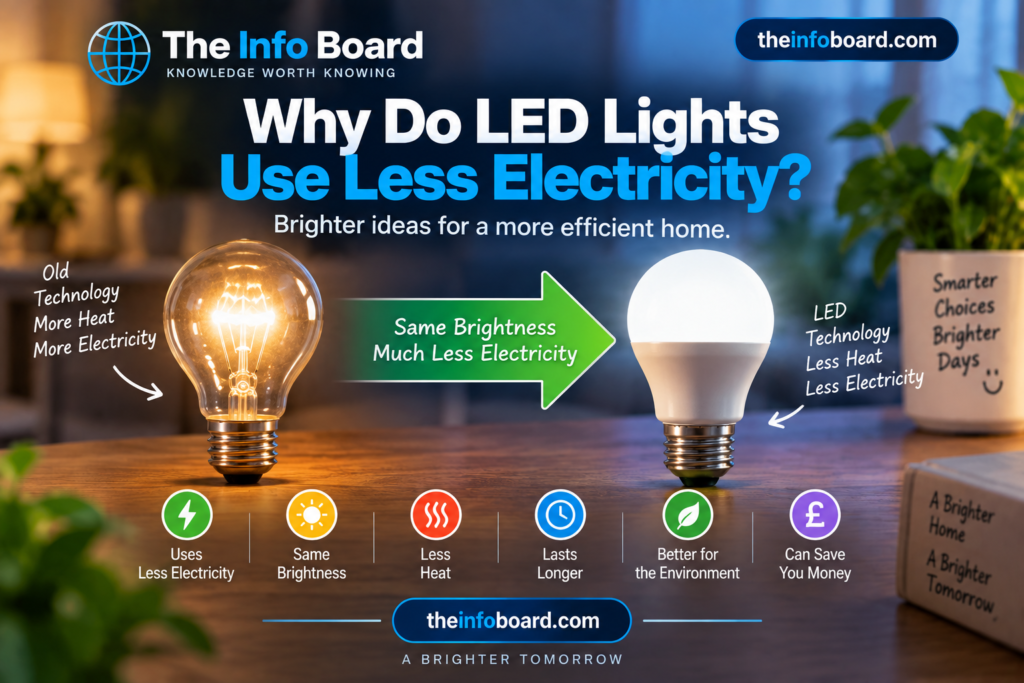
Why do LEDs use less electricity?
LED stands for light-emitting diode. Inside the diode, an electrical current passes through semiconductor materials, releasing energy as light. The process is called electroluminescence.
Traditional incandescent bulbs work differently. Their electricity heats a tungsten filament until it glows. Because much of the energy becomes heat rather than useful visible light, an incandescent bulb needs substantially more electrical power to illuminate a room to a similar level.
LEDs are not heat-free: their chips and electronic drivers generate heat, and well-designed bulbs dissipate it through their housings. But for comparable light output, they typically waste much less energy than filament bulbs.
Watts vs lumens: what should you look for?
Watts (W) measure electrical power consumption. Lumens (lm) measure visible light output. When selecting a replacement bulb, first choose the brightness in lumens and then compare how many watts different bulbs need to produce it.
| Approximate brightness | Traditional incandescent reference | What to look for on an LED |
|---|---|---|
| 470 lumens | 40W | A bulb labelled around 470 lm |
| 800 lumens | 60W | A bulb labelled around 800 lm |
| 1,050 lumens | 75W | A bulb labelled around 1,050 lm |
| 1,520 lumens | 100W | A bulb labelled around 1,520 lm |
These are approximate historical equivalents provided by the Energy Saving Trust’s lighting guide. Actual LED wattage varies by manufacturer and efficiency; use the package’s lumen figure to check brightness.
What does lumens per watt mean?
Luminous efficacy measures how many lumens are produced per watt. An 800-lumen incandescent bulb using 60W delivers about 13.3 lm/W. An 800-lumen LED using 9W delivers about 88.9 lm/W. The LED produces much more useful light per watt in this illustrative comparison.
How much money can one LED bulb save?
Here is a transparent example using two bulbs of approximately equal brightness. Assume they run for three hours each day and electricity costs an illustrative 25p per kilowatt-hour (kWh). This is an example rate, not a claim about today’s energy tariff.
| Annual calculation | 60W incandescent | 9W LED |
|---|---|---|
| Hours used | 1,095 | 1,095 |
| Electricity consumed | 65.70 kWh | 9.855 kWh |
| Electricity cost at 25p/kWh | £16.43 | £2.46 |
Estimated saving: £13.96 per bulb per year, rounded to the nearest penny using unrounded underlying figures. For five comparable bulbs used this often, the illustrative electricity saving is around £69.81 a year.
Calculate your own running cost using: (bulb watts ÷ 1,000) × hours used × electricity unit rate (£/kWh). For example, a 9W LED running for 1,095 hours consumes 9.855 kWh. Check the unit rate on your own bill; standing charges are not reduced simply by changing a bulb.
Real savings depend on the bulb you replace, brightness, actual usage and tariff. Purchase costs are excluded. Replacing an existing efficient LED with another LED typically saves much less than replacing an incandescent bulb.
Do LED bulbs last longer?
Usually. LEDs do not have a fragile incandescent filament, and their rated lifetimes can be much longer. However, the driver electronics, heat, enclosed fittings and manufacturing quality all affect how long an LED actually lasts. Some LEDs gradually dim before failing altogether.
When comparing products, look at the rated lifetime and warranty, but do not interpret a lifetime claim as a guarantee that the bulb will run for that exact number of hours.
How to choose the right LED bulb in a UK shop
- Check the fitting. Match the cap or base type (for example, B22 bayonet, E27 Edison screw or GU10) and follow the fitting’s instructions.
- Match the lumens. Choose the level of brightness you actually need, rather than choosing by watts.
- Choose the light colour. Around 2700K is a warmer, yellowish white; around 4000K looks more neutral; higher numbers tend to look cooler.
- Compare electricity use. For similarly bright bulbs, a lower wattage generally means lower running costs. Check the product’s energy-efficiency information.
- Check compatibility. If you use a dimmer, choose a dimmable LED and a compatible dimmer. Also check whether the bulb is approved for enclosed or specialist fittings.
- Consider useful life and quality. Look at warranty, manufacturer instructions and colour rendering as well as the purchase price.
The Energy Saving Trust has UK-specific guidance on choosing bulb brightness, colour and fittings.
Why might an LED flicker or get hot?
An LED needs electronic components, commonly including a driver, to regulate power. A mismatched dimmer, unsuitable driver or failing bulb may cause visible flicker, buzzing or poor dimming performance. Excessive heat can shorten component life; many bulbs include a heat-dissipating base for this reason.
If several lights suddenly flicker, a switch or socket feels unusually hot, or you notice burning smells or other signs of an electrical fault, stop using the affected equipment and consult a qualified electrician. Do not attempt wiring repairs unless competent and authorised to do so.
Do LEDs help the environment?
Using less electricity can reduce the energy required for household lighting. Longer service life may also mean fewer replacement bulbs, although manufacturing, the electricity supply and disposal still matter.
LED bulbs contain electronic components. Check your local council’s recycling guidance or an electrical retailer’s collection scheme rather than putting them automatically in ordinary household rubbish.
Common questions about LED lighting
Is a 9W LED as bright as a 60W bulb?
It can be. Compare the lumens: an LED around 800 lumens is commonly used as an alternative to a traditional 60W incandescent bulb, although the exact wattage of the LED varies.
Do LED lights still use electricity when switched off?
An ordinary bulb controlled by a physical switch usually consumes no power when the switch disconnects it. Smart bulbs or lighting systems can draw a small amount of standby power when they remain connected for remote control.
Are LED bulbs suitable for dimmer switches?
Only when the bulb is designed to be dimmed and the dimmer is compatible. Check both products’ specifications before using them together.
Will changing bulbs reduce my standing charge?
No. Using less electricity reduces the energy portion of your bill, not a fixed daily standing charge.
Should I replace a working LED to save energy?
Not automatically. Compare the two bulbs’ wattage at similar brightness and estimate the saving against the cost of replacement. Often the largest savings come from replacing older incandescent or halogen lights.
The bottom line
LEDs save electricity because they produce visible light more efficiently than bulbs that heat a filament. For a similar amount of light, they need fewer watts. When shopping, check lumens for brightness, watts for power consumption and kelvins for colour.
For broader energy-saving guidance, see Energy Saving Trust: lighting. If you’re comparing how different household costs change over time, see our guide to inflation and rising prices.
Figures in this article are illustrative, not personalised savings estimates or a current electricity-tariff quotation.