You take a photo on your phone and a few moments later it appears on your tablet.
You create a document on your laptop, then open the same document from another computer.
Even if your phone is lost or damaged, many of your photos may still be recoverable.
All of this is possible because of something we now use almost every day: cloud storage.
Despite the name, your files aren’t floating somewhere in the sky. They’re stored on real computers in real buildings.
So what exactly is cloud storage, where do your files go, and how can several devices access the same information?
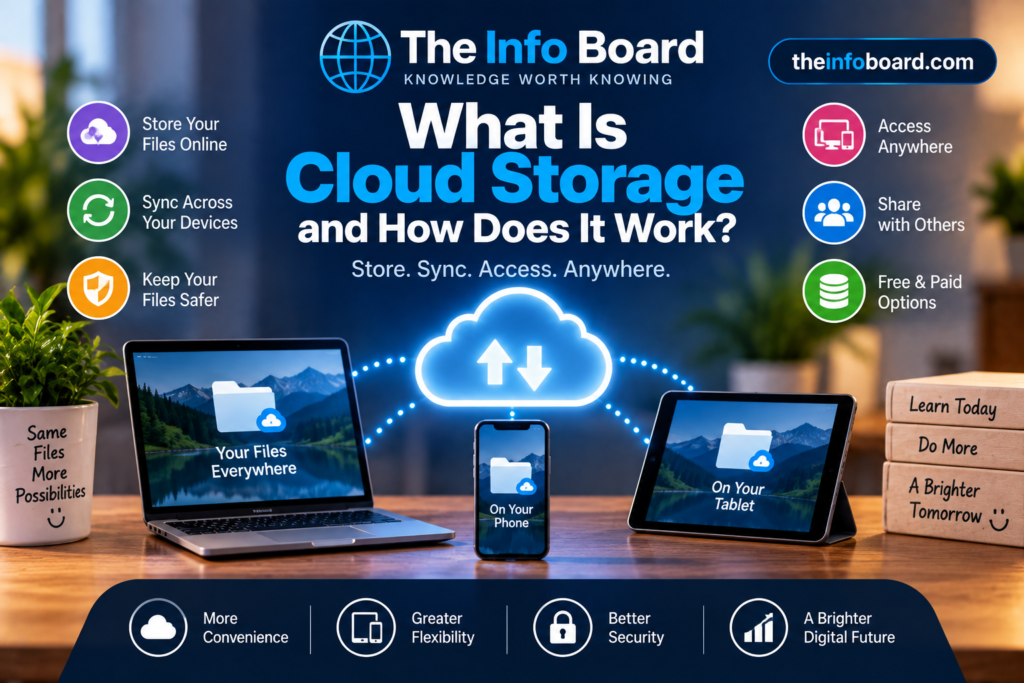
What Is Cloud Storage and How Does It Work?
What Is Cloud Storage?
Cloud storage is a way of storing digital information on remote computer systems that you access through a network, usually the internet.
Instead of keeping a file only on the storage inside your phone or computer, a copy can be sent to servers operated by a cloud provider.
These servers may store things such as:
- Photos and videos
- Documents
- Emails and attachments
- Device backups
- Music
- Application data
- Business files
When you need the information again, your device communicates with the cloud service and retrieves or synchronizes it.
Why Is It Called “The Cloud”?
The word cloud can make the technology sound mysterious.
It isn’t.
In computing diagrams, engineers historically used a cloud symbol to represent a network whose internal details weren’t important to the particular diagram.
Over time, “the cloud” became a convenient term for computing resources provided remotely over networks.
When someone says a photograph is “in the cloud,” the photograph is still physically represented by data stored on computer hardware somewhere.
The important difference is that the storage hardware isn’t sitting inside your own phone or laptop.
Where Are Cloud Files Actually Stored?
Cloud files are typically stored on servers housed in data centres.
A data centre is a facility containing large numbers of computer systems and supporting infrastructure.
These facilities require far more than rows of computers.
They can include:
Networking equipment to move data.
Cooling systems to control temperature.
Power infrastructure to keep equipment operating.
Backup power systems to deal with interruptions.
Physical security to restrict access.
A large cloud provider may operate data centres in multiple geographic regions rather than keeping everything in one building.
What Is a Server?
A server is essentially a computer designed to provide resources or services to other computers.
Your laptop might request a photograph.
A remote server receives the request and sends the necessary data back.
Servers can be designed differently from ordinary home computers because they’re often expected to operate continuously, handle many simultaneous requests and work as part of much larger systems.
Cloud storage services may use enormous numbers of servers working together.
What Happens When You Upload a File?
Suppose you upload a photograph from your phone to a cloud storage service.
The process can be simplified into several stages.
1. Your device reads the file.
Your phone accesses the digital data making up the photograph.
2. The data travels across the network.
The file is transmitted through your internet connection toward the cloud provider’s infrastructure.
3. The provider receives the data.
Its systems process the upload and associate it with your account.
4. The data is stored.
The information is written to storage systems controlled by the provider.
5. Your account records the file.
The service keeps track of information such as the filename, location and other metadata necessary to manage it.
Later, when you request the photograph, the process works broadly in reverse.
Does Cloud Storage Use Your Internet Connection?
Yes.
Uploading files requires data to travel from your device to the cloud provider.
Downloading requires data to travel back.
The speed of these operations therefore depends partly on your internet connection.
A very large video may take considerably longer to upload than a small text document.
Internet connections can also have different upload and download speeds.
That’s why transferring a large backup to the cloud can sometimes take much longer than downloading a single file from it.
What Is Cloud Syncing?
Cloud storage becomes particularly useful when combined with synchronization, commonly called syncing.
Suppose you have the same cloud account connected to a laptop and phone.
You edit a document on your laptop.
The updated version is uploaded to the cloud.
Your phone can then receive the updated information.
The goal is to keep the relevant versions synchronized across devices.
This is why a change made on one device can appear automatically on another.
Read:Why Do LED Lights Use Less Electricity?
Is Syncing the Same as Backup?
Not necessarily.
This distinction is important.
Synchronization aims to keep files or information consistent across locations.
Backup aims to preserve another copy of information so that it can be recovered if something goes wrong.
Imagine you accidentally delete a synchronized file.
Depending on how the service works, that deletion might also synchronize to your other devices.
A proper backup system may retain an earlier copy that can still be restored.
Some cloud services provide both syncing and backup features, but you shouldn’t automatically assume they’re the same thing.
Why Do Companies Store Multiple Copies?
Storage hardware can fail.
Hard drives and solid-state storage devices don’t last forever.
Cloud providers therefore design systems to reduce the risk that a single hardware failure causes customers to lose their files.
One approach is redundancy.
Instead of relying on one physical copy, systems may store data redundantly across multiple devices or locations.
The exact architecture varies considerably between providers and services.
Redundancy doesn’t mean data loss is impossible, but it helps remove individual pieces of hardware as single points of failure.
What Happens If a Cloud Server Breaks?
Ideally, very little from the user’s perspective.
Large cloud systems are designed with hardware failure in mind.
If one storage device or server fails, another part of the system may continue providing access to the data.
The failed hardware can then be repaired or replaced.
This is one reason cloud infrastructure is built using large distributed systems rather than depending on one extremely powerful computer.
Is Cloud Storage Safe?
Cloud storage can provide strong security, but no system is completely risk-free.
Reputable cloud providers typically use multiple layers of protection.
These can include:
Encryption
Account authentication
Access controls
Monitoring
Physical data-centre security
Redundant infrastructure
However, the provider’s infrastructure is only part of the security picture.
Your own account security matters too.
If someone obtains your password and successfully logs into your account, sophisticated data-centre security may not stop them from accessing files that your account is authorized to view.
That’s why strong account protection is important.
What Is Encryption?
Encryption transforms readable data into a form that cannot easily be understood without the appropriate cryptographic key.
Cloud services commonly use encryption while data is being transmitted.
This helps protect information as it travels between your device and the provider.
Services may also encrypt stored data.
However, encryption arrangements differ between providers.
In some systems, the provider manages the encryption keys and can technically access data under certain circumstances.
Other services offer forms of end-to-end encryption, where the provider has much less ability—or potentially no practical ability—to read the protected content.
Always check the specific service’s security design if privacy requirements are particularly important.
What Is Two-Factor Authentication?
Two-factor authentication adds another security check when signing into an account.
Instead of relying only on a password, the service may require something else, such as:
- An authenticator-app code
- A security key
- Approval from a trusted device
- Another supported verification method
This can help protect your cloud files if someone discovers your password.
It connects directly with something we’ve already covered on The Info Board: creating strong passwords and protecting online accounts.
That’s a good place for an internal link to our password article.
What Happens If You Lose Your Phone?
One of cloud storage’s biggest advantages becomes obvious when a device is lost, stolen or damaged.
If your photographs and documents existed only on the phone, losing the device could mean losing the files too.
If those files were successfully backed up or synchronized to cloud storage, you may be able to sign into your account on another device and retrieve them.
However, this only works for information that was actually uploaded.
Files waiting to synchronize when a phone is lost may not exist in the cloud yet.
Can You Access Cloud Files Without Internet?
Sometimes.
Many cloud services allow selected files to be stored locally on your device for offline access.
You can then open those files without an active internet connection.
Changes may synchronize with the cloud the next time the device connects.
Other files may exist primarily online and need to be downloaded before you can use them.
The exact behaviour depends on the application and its settings.
Does Cloud Storage Save Space on Your Phone?
It can.
Some services can keep full-resolution originals in the cloud while storing smaller versions—or only recently used files—on your device.
When you need the full file, the device downloads it.
This can reduce local storage usage.
However, cloud storage doesn’t automatically mean that nothing is stored on your device.
Applications often keep temporary files, thumbnails or downloaded copies locally to improve performance.
Free vs Paid Cloud Storage
Many cloud services provide a limited amount of storage with an account.
If you need more space, you may have to pay for a larger storage plan.
The amount required depends heavily on what you’re storing.
Text documents use relatively little space.
High-resolution photographs use considerably more.
Video—particularly high-resolution video—can consume storage very quickly.
Before paying for additional storage, it can be useful to review what’s actually using the available space.
What Happens If You Stop Paying?
This depends entirely on the provider.
A service might prevent new uploads, reduce functionality, ask you to reduce your stored data or eventually take other action according to its terms.
You shouldn’t assume that files will remain stored forever after a paid subscription ends.
Important information should therefore be managed with a clear understanding of the provider’s policies.
Is Cloud Storage Private?
Cloud storage is not automatically the same thing as completely private storage.
Your privacy depends on factors including:
The provider’s policies
How the service encrypts data
Who controls the encryption keys
Your sharing settings
Which applications have account access
Whether anyone else can access your devices
Cloud storage can be secure without necessarily being designed so that only you can technically decrypt every file.
If highly sensitive information is involved, understanding the service’s privacy and encryption model becomes especially important.
What Is a Shared Cloud Folder?
Cloud services can allow you to share files or folders with other people.
Instead of emailing a large file, you can send someone access to the cloud-hosted version.
Permissions may allow another person to:
View
Download
Comment
Edit
depending on the settings you choose.
This is extremely useful for collaboration.
But it also means you should check sharing permissions carefully.
A file intended for one person shouldn’t accidentally be made publicly accessible.
Advantages of Cloud Storage
Cloud storage has become popular because it solves several practical problems.
It can provide:
Access from multiple devices
Automatic synchronization
Off-site copies of files
Easy sharing
Expandable storage
Protection against some local hardware failures
For someone using a phone, tablet and computer, having the same information available across all three can be particularly convenient.
Disadvantages of Cloud Storage
There are trade-offs too.
Potential disadvantages include:
Dependence on internet connectivity
Ongoing subscription costs
Privacy considerations
Dependence on the provider
Account-security risks
Service outages
Potential synchronization mistakes
This is why important information shouldn’t necessarily depend on one storage method alone.
Should Important Files Exist in More Than One Place?
For genuinely important files, having multiple copies is sensible.
A commonly discussed backup principle is the 3-2-1 approach:
Keep three copies of your data, using two different types of storage, with one copy stored off-site.
Cloud storage can help provide the off-site component.
The exact backup strategy you need depends on how valuable the information is and how difficult it would be to replace.
Family photographs, important documents and business files may deserve more protection than easily replaceable downloads.
Read:What Is a Credit Score and Why Does It Matter?
Cloud Storage vs an External Hard Drive
Neither is automatically better.
An external drive provides local storage that you control physically and can access without the internet.
Cloud storage provides remote access and protects against certain local disasters, such as theft or damage affecting both your computer and nearby equipment.
Using both can provide advantages.
For example:
Computer → external backup → cloud backup
creates multiple layers of protection.
Is Email Cloud Storage?
In many cases, yes, broadly speaking.
Web-based email services store messages and attachments on remote servers.
That’s why you can log into your email from a completely different computer and still see your messages.
The same general idea applies to online calendars, contacts, photo libraries and many modern applications.
Much of what people call “the cloud” is simply remote computing infrastructure delivered over a network.
Final Thoughts
Cloud storage sounds more mysterious than it really is.
Your files don’t disappear into an invisible digital cloud.
They’re transmitted over networks and stored on real computer systems inside real data centres.
The cloud simply allows those storage systems to be managed remotely and accessed from different devices.
Its biggest advantages are convenience, synchronization and protection against certain types of local data loss.
But cloud storage isn’t automatically a perfect backup, and it isn’t automatically private.
The safest approach is to understand what is being stored, where copies exist, how your account is protected, and what would happen if either your device or cloud account became unavailable.
Once you understand those basics, “the cloud” stops seeming mysterious at all.
Frequently Asked Questions
What is cloud storage in simple terms?
Cloud storage means keeping digital files on remote computer systems that you access through a network rather than storing them only on your own device.
Where are cloud files physically stored?
They’re stored on physical storage hardware in data centres operated by or on behalf of cloud-service providers.
Can cloud storage lose my files?
No storage system can guarantee that data loss will never occur. Large providers use redundancy and other safeguards, but important files should still have an appropriate backup strategy.
Does cloud storage work without Wi-Fi?
Cloud services need a network connection to transfer data, although some applications allow selected files to be stored locally for offline use.
Is cloud storage the same as backup?
Not always. Synchronizing files with the cloud and creating a recoverable backup are different processes, although some services provide both.
Can someone see my cloud files?
Access depends on your account security, sharing settings and the provider’s security and encryption model. Strong passwords and additional authentication can help protect your account.
Leave a Comment