Leave a steel tool outside in the rain and, given enough time, its shiny surface may begin turning reddish-brown.
An old bicycle chain develops rough orange patches. A neglected garden gate starts flaking. A scratch on a car can eventually become a rusty spot.
We commonly call this process rusting.
It may look as though metal simply becomes old and begins falling apart, but rust is actually the visible result of a series of chemical reactions.
Iron reacts with substances in its environment, particularly oxygen and water, and gradually changes into new chemical compounds.
So what exactly is rust? Why does water make it happen? Why does salt make rusting faster? And why can aluminium survive outdoors without developing the familiar reddish-brown coating?
Let’s examine the chemistry.
What Is Rust?
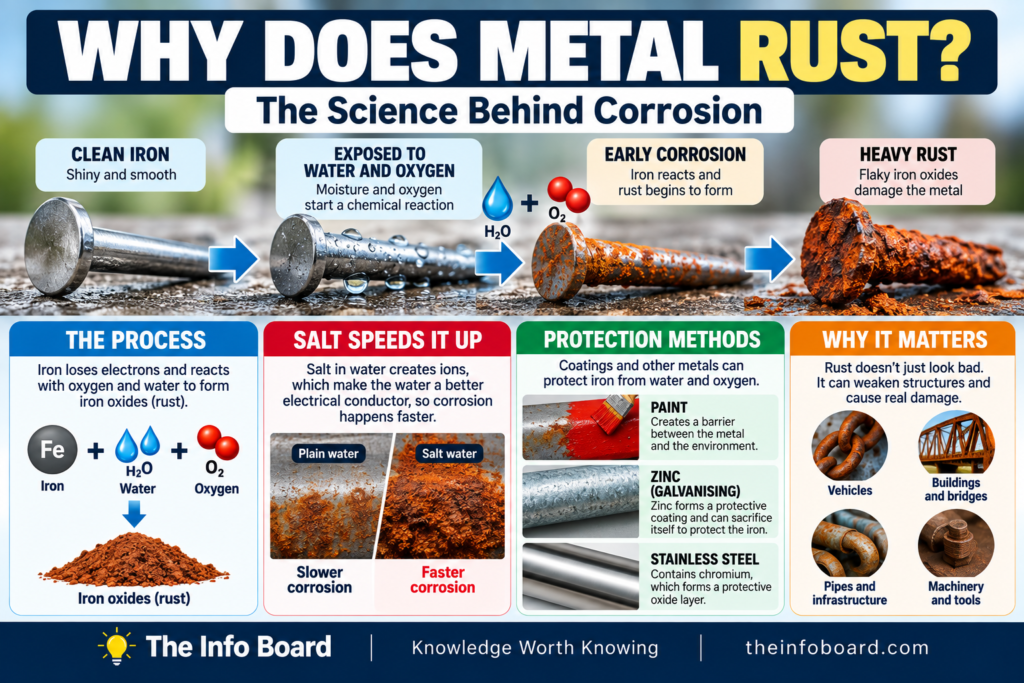
Rust is the common name given to a mixture of iron oxides and related compounds that form when iron corrodes.
This distinction matters:
Rust specifically involves iron.
Other metals can corrode, but the products they form aren’t technically rust.
Copper, for example, can develop a green patina.
Silver can tarnish.
Aluminium can develop a thin oxide layer.
All are examples of metals reacting with their environment, but they’re not all rusting.
What Is Corrosion?
Corrosion is the gradual deterioration of a material, particularly a metal, through chemical or electrochemical reactions with its surroundings.
Rusting is therefore one particular form of corrosion.
When iron rusts, atoms in the original metal participate in reactions that produce new compounds.
The material isn’t merely becoming dirty.
Its chemistry is changing.
What Does Iron Need to Rust?
Under ordinary conditions, two important ingredients encourage iron to rust:
oxygen
and
water.
Iron exposed to dry air doesn’t generally rust as rapidly as iron repeatedly exposed to moisture.
Similarly, water with very little available oxygen doesn’t necessarily produce the same rate of corrosion as conditions where both water and oxygen are readily available.
The combination creates an environment in which electrochemical corrosion can occur.
Rusting Is an Electrochemical Process
Rust formation is more complicated than a single reaction such as:
iron + oxygen = rust
Different areas on a piece of iron can behave like tiny electrochemical regions.
At some locations, iron atoms lose electrons.
In simplified form:
Fe → Fe²⁺ + 2e⁻
This is an oxidation reaction.
The iron atom becomes an iron ion and releases electrons.
Those electrons can then participate in reactions involving oxygen and water elsewhere on the metal surface.
What Does Oxidation Mean?
In chemistry, oxidation involves the loss of electrons.
The name historically became associated with reactions involving oxygen, but the modern chemical definition is broader.
During iron corrosion, iron atoms lose electrons.
That’s why rusting is described as an oxidation process.
But oxidation doesn’t happen alone.
Another substance must accept the electrons.
That accompanying process is called reduction.
Together, they’re known as redox reactions — reduction and oxidation.
What Happens to the Electrons?
The electrons released by iron can travel through the metal.
In the presence of water and dissolved oxygen, oxygen can participate in a reduction reaction.
A simplified reaction under many ordinary conditions can be represented as:
O₂ + 2H₂O + 4e⁻ → 4OH⁻
This produces hydroxide ions.
These can then react with iron ions and eventually contribute to the formation of hydrated iron oxides and other corrosion products.
The chemistry involves several stages rather than one instantaneous transformation.
Why Is Rust Reddish-Brown?
The familiar orange, red and brown colors come from iron-containing corrosion products.
Rust isn’t necessarily one perfectly uniform chemical substance.
It can contain various iron oxides and iron oxyhydroxides, sometimes associated with water.
Different conditions can therefore produce slightly different:
- colors,
- textures,
- structures,
- and corrosion patterns.
That’s why one rusty object may appear bright orange while another is dark reddish-brown.
Why Does Water Make Iron Rust?
Water helps create the environment necessary for electrochemical reactions.
Pure water isn’t an especially good electrical conductor, but ordinary water usually contains dissolved ions.
These ions allow charge to move through the liquid more effectively.
A thin film of moisture on metal can therefore act as an electrolyte.
This allows different electrochemical reactions to occur at different locations on the surface.
That’s one reason persistent dampness is such a problem for iron and steel.
Why Does Salt Make Rusting Faster?
This is especially important for cars, bridges, ships and coastal structures.
Salt dissolved in water produces ions.
Those ions make the water a better electrolyte, allowing electrochemical processes involved in corrosion to proceed more readily.
So:
water encourages rusting
but
salt water can accelerate it significantly.
This explains why metal objects exposed to seawater can suffer severe corrosion.
Why Do Cars Rust More in Areas That Use Road Salt?
In cold climates, salt may be spread on roads to help deal with ice.
Vehicles driving over those roads can become coated with salty water and spray.
This mixture can reach:
- wheel arches,
- suspension components,
- body panels,
- bolts,
- seams,
- and the underside of the vehicle.
Because salty water promotes corrosion, repeated winter exposure can create difficult conditions for unprotected steel.
Modern cars use coatings, galvanised materials and other corrosion-control techniques, but damage to those protective systems can still allow corrosion to begin.
Why Are Coastal Areas Tough on Metal?
Ocean air can carry tiny salt-containing droplets.
These can settle on exposed metal surfaces.
Add humidity and you have conditions that can encourage corrosion.
This is why outdoor metal structures near the sea often require careful material selection and protective maintenance.
The metal doesn’t necessarily need to be submerged in the ocean.
Salt carried through the atmosphere can also contribute.
Why Does a Scratch Make Rust More Likely?
Imagine a painted steel panel.
The paint creates a barrier between the steel and the environment.
As long as that barrier remains intact, water and oxygen have difficulty reaching the underlying metal.
Now scratch through the paint.
The exposed steel can come into direct contact with:
oxygen + moisture + dissolved ions.
Corrosion can begin at the damaged location.
If rust spreads underneath surrounding paint, the coating may begin bubbling or flaking.
That’s why small areas of coating damage shouldn’t always be ignored.
Why Doesn’t Paint Rust?
Because paint isn’t iron.
More importantly, paint can act as a physical barrier.
A good coating reduces contact between the underlying metal and the substances needed for corrosion.
Protective coatings are therefore one of the simplest methods of corrosion control.
They can include:
- paint,
- powder coatings,
- oils,
- greases,
- polymers,
- and specialised industrial coatings.
However, a coating is only effective while it remains sufficiently intact.
Can Oil Stop Rust?
Oil and grease can help protect metal by forming a water-resistant barrier over the surface.
This is useful for certain:
- tools,
- machinery,
- mechanical parts,
- and stored metal components.
The protective film reduces direct contact with moisture and oxygen.
But oils can wear away or become contaminated, so they may need to be reapplied.
They aren’t suitable for every application.
What Is Galvanising?
Galvanising is a widely used method for protecting steel by coating it with zinc.
You may have seen galvanised:
- fencing,
- roofing,
- screws,
- buckets,
- pipes,
- or structural components.
The zinc coating helps in two important ways.
First, it creates a physical barrier.
Second, zinc can provide sacrificial protection to the underlying steel.
That second property makes galvanising especially interesting.
Read:Why Do We See Lightning Before We Hear Thunder?
How Can Zinc Sacrifice Itself?
Zinc is more easily oxidised than iron under relevant electrochemical conditions.
If galvanised steel is damaged and a small area of iron becomes exposed, nearby zinc can preferentially corrode.
In effect, the zinc sacrifices itself to help protect the iron.
This is called sacrificial protection.
It’s an excellent example of engineers using electrochemistry rather than merely trying to prevent chemistry from happening.
What Is Cathodic Protection?
The same broad principle can be used on large metal structures.
Cathodic protection is a corrosion-control technique in which the metal being protected is made to behave as the cathodic part of an electrochemical system.
One method attaches a more reactive metal as a sacrificial anode.
The sacrificial material corrodes preferentially.
Cathodic protection is used in applications such as:
- pipelines,
- storage tanks,
- marine structures,
- and ships.
There are also impressed-current systems that use an external electrical power source.
Why Doesn’t Aluminium Rust Like Iron?
Aluminium certainly reacts with oxygen.
In fact, it reacts readily.
But the result is very different from ordinary iron rust.
Aluminium forms a thin, tightly adherent oxide layer on its surface.
This layer can protect the underlying metal from further reaction.
The process is known as passivation.
So aluminium isn’t surviving because it refuses to react with oxygen.
It survives remarkably well in many environments partly because the initial reaction creates a protective barrier.
Why Doesn’t Iron Rust Protect It in the Same Way?
This is one of the crucial differences.
The corrosion products formed on ordinary iron and steel are often:
- porous,
- brittle,
- flaky,
- or poorly adherent.
They don’t necessarily form a continuous, durable seal over the underlying metal.
Water and oxygen can continue reaching fresh iron beneath the rust.
Corrosion therefore continues.
This is why rust can progressively consume an iron object rather than simply forming a thin protective skin.
Why Does Stainless Steel Resist Rust?
Stainless steel contains enough chromium to develop a very thin chromium-rich passive oxide layer at its surface.
This layer helps protect the underlying metal.
If it is lightly damaged, it can often reform when sufficient oxygen is available.
That’s why stainless steel has excellent corrosion resistance in many environments.
But the name can be misleading.
Stainless steel isn’t completely corrosion-proof.
Certain chemicals, high salt concentrations, extreme temperatures or unsuitable environments can still cause corrosion.
Different stainless-steel grades are designed for different conditions.
Can Stainless Steel Rust?
Yes.
Stainless steel can suffer corrosion if its passive layer is compromised or environmental conditions become sufficiently aggressive.
For example, chloride-rich environments can contribute to pitting corrosion in some stainless steels.
This creates small localised holes rather than uniform rust across the entire surface.
Material selection therefore matters.
A stainless steel suitable for an indoor kitchen may not necessarily be the ideal alloy for a harsh marine environment.
Why Does Rust Spread?
Rust may appear to “infect” nearby metal, but it isn’t alive and doesn’t reproduce.
Instead, corrosion changes the local surface conditions.
Rust can:
- retain moisture,
- disrupt protective coatings,
- expose additional metal,
- and create complex electrochemical environments.
As corrosion products expand and coatings crack or lift, more metal becomes exposed.
The damaged region can therefore become progressively larger.
Does Rust Make Iron Heavier?
Here’s an interesting question.
When iron rusts, oxygen from the environment becomes chemically incorporated into corrosion products.
If you could collect the object and all of its rust without losing any flakes, the oxidised material contains atoms that weren’t originally part of the iron.
In that sense, oxidation adds oxygen mass.
However, real rusty objects frequently lose material as corrosion products flake away.
So an old, severely corroded object can eventually lose substantial mass and structural material.
Why Can Rust Cause Structures to Crack?
Rust occupies a different volume from the original metallic iron involved in its formation.
When steel embedded inside concrete corrodes, expanding corrosion products can place pressure on the surrounding concrete.
Eventually, the concrete may:
- crack,
- delaminate,
- or break away.
This is a serious engineering concern in reinforced concrete structures.
A small amount of hidden corrosion can therefore create damage that extends beyond the steel itself.
Why Is Rust Dangerous to Structures?
Rust isn’t merely cosmetic.
As corrosion removes usable metal, structural components can become thinner and weaker.
This can affect:
- bridges,
- vehicles,
- buildings,
- railways,
- pipelines,
- ships,
- industrial machinery,
- and reinforcing steel.
Engineers therefore consider corrosion throughout a structure’s life.
Inspection and maintenance aren’t just about appearance.
They’re part of ensuring continued structural integrity.
Can Rust Ever Be Useful?
Iron oxides themselves aren’t inherently useless.
Various iron oxide compounds have applications in:
- pigments,
- polishing materials,
- magnetic materials,
- industrial processes,
- and scientific research.
The problem with rust on a steel structure isn’t that iron oxide is a worthless substance.
The problem is that valuable structural metal is being converted into corrosion products, potentially weakening the object.
Can Rust Be Reversed?
Once iron atoms have been converted into corrosion products, simply drying the object doesn’t magically turn those compounds back into solid metallic iron.
Restoration normally involves:
removing or stabilising corrosion
and then
protecting the remaining metal.
Depending on the object, rust removal methods can include mechanical, chemical or electrochemical techniques.
Afterward, a protective coating may be applied to reduce future corrosion.
Does Removing Rust Stop It Forever?
No.
Removing existing rust doesn’t change the fact that exposed iron can react again.
If bare steel is cleaned perfectly and then left outdoors in damp conditions, new corrosion can begin.
Successful corrosion treatment therefore usually involves two stages:
deal with existing corrosion
and
protect the surface from future exposure.
Can Iron Rust Without Rain?
Yes.
Direct rainfall isn’t necessary.
Humidity can provide enough surface moisture for corrosion under suitable conditions.
Condensation can also create thin films of water.
For example, a cold metal object moved into warm, humid air may develop condensation on its surface.
That moisture can contribute to corrosion.
This is why even metal stored indoors can rust if storage conditions are damp enough.
Why Do Tools Rust in a Shed?
A shed may keep rain away while still experiencing significant humidity and temperature fluctuations.
Overnight cooling can encourage condensation.
If moisture forms on steel tools repeatedly, corrosion can develop.
Fingerprints can also leave behind moisture, salts and other substances that influence the metal surface.
For valuable steel tools, keeping them clean, dry and appropriately protected can significantly reduce corrosion.
Why Does Iron Rust Faster Than Some Other Metals?
Different metals have different chemical tendencies and produce different corrosion products.
Some metals form protective oxide layers.
Others are inherently less reactive under ordinary environmental conditions.
Iron has the unfortunate combination of being widely used while producing corrosion products that often don’t effectively protect the remaining metal.
Fortunately, iron’s disadvantages can be managed through engineering.
That’s one reason we commonly use steel plus corrosion protection rather than abandoning iron-based materials altogether.
Why Do We Still Use Steel If It Rusts?
Because steel has an extraordinary combination of useful properties.
Depending on its composition and treatment, it can be:
- strong,
- tough,
- relatively inexpensive,
- easily shaped,
- weldable,
- recyclable,
- and available in enormous quantities.
Engineers understand its corrosion problem and have developed numerous ways to manage it.
These include:
coatings
galvanising
alloying
cathodic protection
corrosion inhibitors
and
careful structural design.
Rust is a weakness of steel, but it’s a weakness we have learned to manage remarkably well.
Corrosion Is an Enormous Engineering Problem
Corrosion occurs quietly.
There may be no dramatic moment when a structure suddenly announces that chemical reactions have started.
Instead, deterioration can continue gradually for years.
That’s why engineers inspect structures before obvious failure occurs.
Corrosion management can involve:
- visual inspections,
- thickness measurements,
- sensors,
- coating maintenance,
- electrochemical testing,
- and replacement of sacrificial components.
Preventing corrosion is often far cheaper than replacing a severely damaged structure.
Read:Why Do Leaves Change Color in Autumn?
Rust Is Chemistry You Can See
One reason rust is scientifically fascinating is that it makes an invisible atomic process visible.
You can’t see individual iron atoms losing electrons.
You can’t watch electrons travelling through the metal with your eyes.
But you can see the consequences:
shiny grey metal → orange spots → rough brown corrosion → flaking material.
Behind that familiar transformation are oxidation, reduction, ions, electrolytes and electron transfer.
A rusty nail is effectively a small electrochemical system.
The Bottom Line
Rust forms when iron undergoes electrochemical corrosion, usually in the presence of oxygen and water.
Iron atoms lose electrons and eventually become part of iron-containing oxides and related corrosion products.
Moisture allows electrochemical reactions to occur, while dissolved salts can make the process faster by improving electrical conductivity through the water.
Unlike the protective oxide layer that forms on metals such as aluminium, ordinary iron rust is often porous and flaky.
That means it doesn’t completely isolate the remaining metal.
Corrosion can continue underneath.
That’s why engineers protect iron and steel with techniques such as:
paint, galvanising, alloying and cathodic protection.
So the next time you see an old rusty gate, you’re looking at much more than ageing metal.
You’re seeing electrochemistry happening in the real world.
Frequently Asked Questions
What causes metal to rust?
Iron rusts through electrochemical reactions involving iron, oxygen and water. Moisture provides an environment that allows the corrosion reactions to proceed.
Does all metal rust?
No. Rust specifically refers to corrosion products of iron. Other metals can corrode, tarnish or oxidise in different ways.
Why does salt water make iron rust faster?
Dissolved salts create ions that improve the conductivity of water, making the electrochemical corrosion process easier.
Can rust form without rain?
Yes. Humidity, condensation and other sources of moisture can provide enough water for iron corrosion.
Why doesn’t aluminium rust like iron?
Aluminium forms a thin, strongly adherent oxide layer that protects much of the underlying metal from further reaction.
Can stainless steel rust?
Yes. Stainless steel is highly corrosion resistant rather than completely corrosion-proof. Certain environments can damage its protective passive layer.
Does paint prevent rust?
Paint can help prevent rust by forming a barrier that limits contact between steel, oxygen and moisture. Damage to the coating can expose the underlying metal.
Leave a Comment