Every autumn, something remarkable happens to millions of trees.
Leaves that have been green throughout spring and summer begin turning yellow, orange, red, purple and brown. Entire forests can change appearance within a matter of weeks.
It may look as though cold weather simply “paints” the leaves different colors.
But that’s not really what’s happening.
Many of those colors were connected to chemicals already present in the leaf — or are produced as the leaf’s chemistry changes during autumn.
The transformation is part of a much larger process that helps certain trees prepare for winter.
So why are leaves green in the first place? What causes them to change color? Why are some leaves yellow while others become bright red? And why do trees eventually drop them?
Let’s look at the science behind one of nature’s most spectacular seasonal changes.
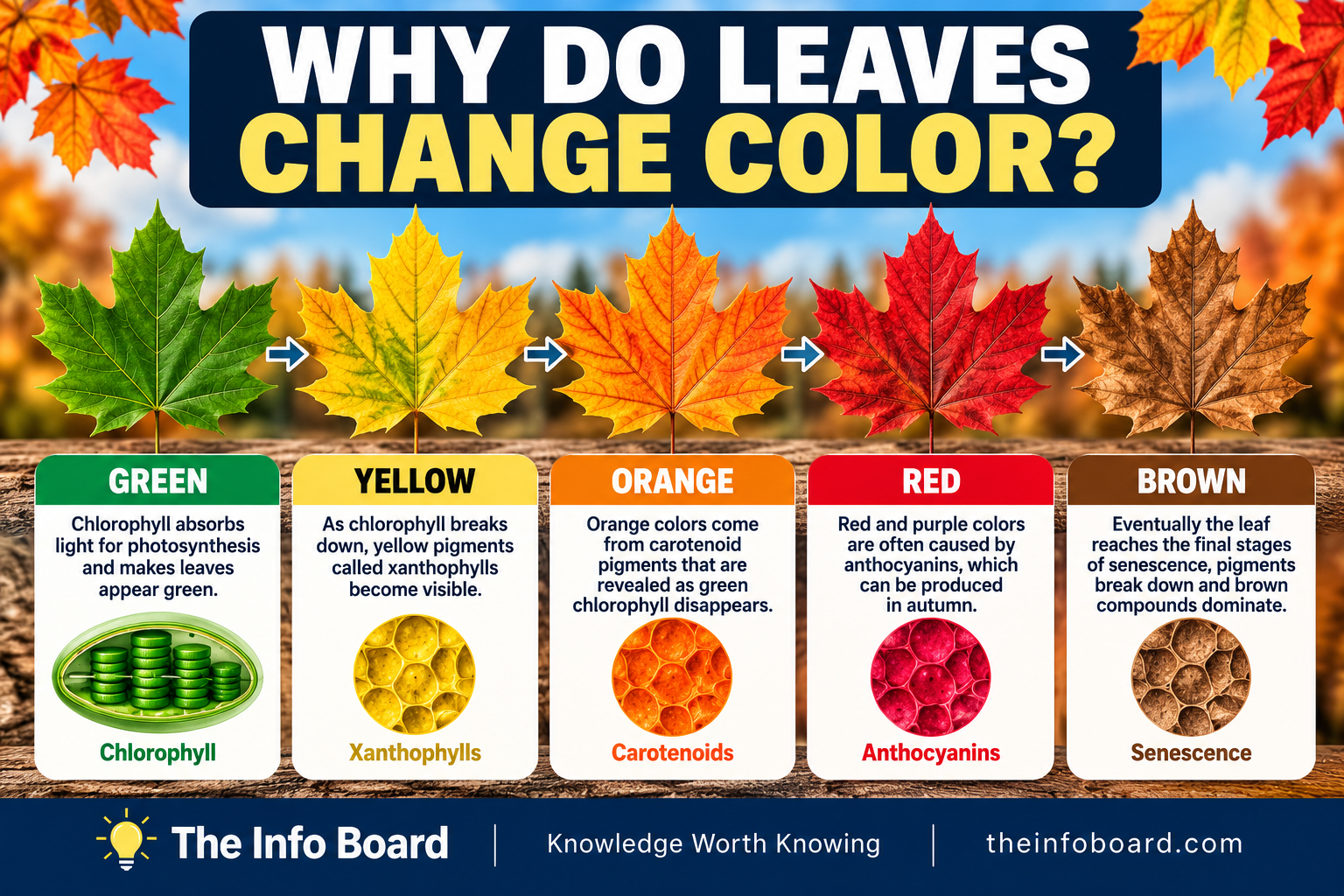
Why Are Leaves Green?
To understand autumn colors, we first need to understand why most leaves appear green during the growing season.
The answer involves a pigment called chlorophyll.
Chlorophyll absorbs light energy that plants use during photosynthesis.
Photosynthesis allows plants to use light energy to help convert carbon dioxide and water into energy-rich sugars.
These sugars provide chemical energy and raw material that plants can use for growth and other biological processes.
Chlorophyll absorbs certain wavelengths of visible light more strongly than others.
Green wavelengths are reflected or transmitted more than many other wavelengths.
That’s why leaves containing large amounts of chlorophyll usually appear green to us.
What Happens When Autumn Approaches?
For many deciduous trees, autumn brings major environmental changes.
Days become shorter.
Temperatures generally begin falling.
The amount of useful daylight available for photosynthesis decreases.
For trees adapted to seasonal climates, these changes provide signals that winter is approaching.
Maintaining a large collection of delicate leaves through winter would not always be advantageous.
So the tree begins preparing to shed them.
As part of this process, chlorophyll production declines and existing chlorophyll begins to break down.
And that’s when other colors become much easier to see.
The Colors Were Not All Created at Once
A green leaf doesn’t necessarily suddenly manufacture every autumn color from nothing.
Some pigments were present while the leaf was still green but were visually overwhelmed by the abundance of chlorophyll.
When chlorophyll breaks down, those pigments become more apparent.
Two important groups are:
carotenoids
and
xanthophylls.
These pigments contribute yellow and orange colors.
They are related to pigments responsible for colors in many familiar foods and plants.
Why Do Some Leaves Turn Yellow?
Yellow autumn leaves are strongly associated with pigments called xanthophylls, which are members of the broader carotenoid family.
During summer, the leaf contains so much green chlorophyll that yellow pigments can be difficult to notice.
As chlorophyll disappears in autumn, the yellow becomes visible.
In simplified terms, it can be thought of like removing a green layer that was visually dominating the other pigments.
The yellow wasn’t necessarily absent.
You simply couldn’t see it clearly before.
Why Do Some Leaves Turn Orange?
Orange coloration can result from carotenoid pigments becoming visible as chlorophyll declines.
Carotenoids occur widely in plants.
They don’t exist merely to make autumn leaves attractive.
They participate in important biological functions, including helping plants manage light energy.
When the dominant green pigment disappears, their warmer colors can become much more obvious.
But Where Does the Red Come From?
Red autumn leaves involve a somewhat different process.
Many red and purple colors are associated with pigments called anthocyanins.
Unlike carotenoids that may already be present in the leaf, substantial anthocyanin production can occur during autumn in some species.
These pigments can create:
- red,
- crimson,
- purple,
- and related shades.
This helps explain why autumn isn’t simply a matter of uncovering colors that were hidden underneath chlorophyll.
Some autumn coloration also involves new chemical changes within the leaf.
Why Do Trees Produce Anthocyanins?
Scientists have investigated several possible functions of autumn anthocyanins.
One idea is that they may help protect leaf tissues from excessive light while the tree is recovering valuable nutrients from the leaf.
Think about what’s happening.
The leaf is gradually being dismantled.
Chlorophyll is disappearing.
Yet sunlight is still reaching the leaf.
Anthocyanins may provide some photoprotection during this transitional period, potentially helping the tree recover nutrients more effectively before the leaf is discarded.
The complete evolutionary story is complex, and different species may benefit in different ways.
Why Don’t All Trees Turn the Same Color?
Different tree species have different leaf chemistry.
They contain different combinations and concentrations of pigments and respond differently to environmental conditions.
As a result, one species may characteristically become bright yellow while another turns orange or deep red.
Even trees growing beside each other can display dramatically different autumn colors.
Genetics plays a major role.
But environmental conditions matter too.
Weather Can Affect Autumn Colors
Autumn color isn’t identical every year.
Weather conditions can influence the timing, intensity and duration of the display.
Factors can include:
- temperature,
- sunlight,
- rainfall,
- drought,
- frost,
- and the conditions experienced during the growing season.
This is why the same forest can look spectacular one autumn and comparatively muted another.
Why Can Sunny Days and Cool Nights Produce Strong Red Colors?
Anthocyanin production can be influenced by light and temperature.
Bright autumn days can support sugar production within leaves while cool nights slow certain processes.
Under suitable conditions, sugars can accumulate in leaves and contribute to conditions associated with anthocyanin formation.
This can enhance red coloration in species capable of producing these pigments.
However, weather isn’t the only factor.
The tree species must have the appropriate biological machinery in the first place.
You can’t make every yellow-leaved species turn brilliant red simply by giving it the “perfect” weather.
What Does Drought Do to Autumn Leaves?
Drought can alter autumn coloration significantly.
If a tree experiences severe water stress, leaves may:
- change color earlier,
- turn brown,
- dry out,
- or fall before developing strong coloration.
Moderate environmental differences may influence the display, but severe stress can shorten it.
A tree struggling to maintain its leaves may simply shed them rather than investing resources in keeping them functioning.
Read:Why Does Your Voice Sound Different in a Recording?
What Happens After Chlorophyll Breaks Down?
A tree doesn’t simply destroy everything in a leaf and throw it away.
Before the leaf falls, the tree can recover valuable materials.
Some nutrients and chemical components are transported out of the leaf and retained elsewhere in the plant.
They can later contribute to new growth.
In that sense, autumn leaf fall is partly a recycling operation.
The tree is dismantling temporary solar-collecting structures and recovering useful resources before winter.
Why Do Trees Drop Their Leaves?
Leaves are extremely useful during the growing season.
But in cold seasonal climates, they can become liabilities during winter.
Broad leaves expose a large surface area to the environment.
Keeping them functioning requires water.
Winter conditions can make water harder for roots to obtain, particularly when soil is frozen.
Leaves can also be damaged by:
- freezing temperatures,
- strong winds,
- ice,
- and snow.
For many deciduous species, shedding leaves is an effective survival strategy.
What Does “Deciduous” Mean?
A deciduous plant sheds leaves as part of a regular biological cycle.
Many familiar broadleaf trees in temperate regions are deciduous.
Examples include various species of:
- maple,
- oak,
- birch,
- beech,
- and aspen.
The exact timing and coloration differ between species and locations.
How Does a Leaf Actually Fall Off?
A leaf doesn’t simply become so dry that the wind eventually tears it from the branch.
Trees actively prepare for leaf separation.
Near the base of the leaf stalk, a specialised region known as the abscission zone develops.
Cells in this area change in ways that weaken the connection between the leaf and the tree.
Eventually, the leaf detaches.
The tree also forms protective tissue around the separation point.
That’s the small scar you can see where a fallen leaf was previously attached.
What Is Abscission?
Abscission is the biological process through which plants deliberately shed structures such as leaves, flowers or fruits.
In autumn leaves, the process is carefully regulated by plant hormones and environmental signals.
This means leaf fall isn’t merely accidental damage caused by cold weather.
The tree is actively controlling the process.
Why Don’t Evergreen Trees Lose All Their Leaves?
Evergreen trees use a different strategy.
Many conifers retain their needles for several years rather than replacing the entire canopy every autumn.
Their leaves are adapted to survive harsher conditions.
Conifer needles often have characteristics such as:
- small surface area,
- protective waxy coatings,
- and structural adaptations that reduce water loss.
These adaptations can make them better suited to remaining on the tree during winter.
But evergreen doesn’t mean a tree never loses leaves.
Evergreens still shed old needles or leaves.
They simply don’t usually lose their entire canopy at the same time.
Why Do Some Oak Leaves Stay on the Tree During Winter?
You may have noticed that some trees retain dead brown leaves long after autumn.
This phenomenon is called marcescence.
It is particularly noticeable in some young beech and oak trees.
Instead of dropping immediately, dead leaves remain attached for part or all of the winter.
Scientists have proposed several possible explanations for this behaviour, including protection of developing buds or effects on nutrient cycling.
The exact advantage may vary.
Why Do Leaves Eventually Turn Brown?
When a leaf reaches the final stages of senescence, its living tissues break down.
Bright pigments disappear or degrade.
Brown compounds and structural materials become dominant.
At this point, the leaf is no longer functioning as the active photosynthetic organ it was during summer.
Eventually, abscission separates it from the tree.
What Is Leaf Senescence?
Senescence is the controlled ageing process that occurs as a leaf approaches the end of its functional life.
This isn’t simply uncontrolled decay.
The plant regulates many aspects of the process.
During senescence:
- photosynthesis declines,
- chlorophyll breaks down,
- proteins are dismantled,
- nutrients are recovered,
- pigments change,
- and preparations for abscission begin.
The beautiful autumn display we see is therefore the visible result of a sophisticated biological transition.
Do Shorter Days or Cold Temperatures Trigger Autumn?
Both can matter, but decreasing day length is particularly important for many species.
Temperature fluctuates considerably from year to year.
Day length, by contrast, follows an extremely predictable seasonal pattern.
As autumn approaches, nights become longer regardless of whether a particular week happens to be unusually warm.
Plants can use these changing light cycles as reliable seasonal information.
Temperature then helps influence the timing and character of the response.
Why Does Autumn Start Earlier Farther North?
At higher latitudes, seasonal changes in daylight can be more pronounced.
Temperatures also generally begin declining earlier as summer ends.
As a result, autumn leaf changes often begin earlier in northern regions than in warmer southern areas.
Altitude can have a similar effect.
Trees at higher elevations may encounter cooler conditions earlier than trees in nearby valleys.
That’s why autumn color can appear to move gradually across a landscape over several weeks.
Can Climate Change Affect Autumn Leaf Timing?
Long-term changes in temperature and growing seasons can influence seasonal biological events.
Scientists study these events through phenology — the study of recurring biological events and their relationship with seasonal and climatic conditions.
Examples include:
- flowering,
- bird migration,
- bud burst,
- fruit development,
- and autumn leaf coloration.
Warmer conditions can alter the timing of some of these events.
However, leaf senescence depends on multiple interacting signals, including daylight, temperature, drought and species-specific biology.
The response isn’t identical for every tree.
Why Are Autumn Colors More Dramatic in Some Parts of the World?
Some regions are particularly famous for spectacular autumn forests.
One reason is the diversity of deciduous tree species.
A forest containing many species capable of producing different pigments can display:
- yellow,
- gold,
- orange,
- scarlet,
- burgundy,
- and purple
at approximately the same time.
Climate also matters.
Regions with distinct seasonal transitions can provide conditions favourable to vivid autumn displays.
Why Are Fallen Leaves Important?
Once leaves reach the ground, their role isn’t necessarily finished.
Fallen leaves become part of the ecosystem.
Fungi, bacteria and small organisms gradually decompose them.
As decomposition occurs, nutrients can return to the soil.
Leaf litter also provides:
- habitat for small animals,
- insulation for soil,
- organic matter,
- and protection against some forms of erosion.
A forest floor covered in leaves may look messy, but ecologically it is extremely active.
Leaves Are Temporary Solar Panels
One useful way to think about deciduous leaves is as temporary biological solar collectors.
During spring and summer, a tree invests resources in producing a huge surface area of leaves.
Those leaves capture light and support photosynthesis.
As winter approaches, maintaining them becomes less beneficial.
The tree:
recovers useful materials → shuts down the leaves → seals their attachment points → drops them.
Then, when favourable conditions return, it grows a new set.
This annual cycle has evolved over enormous spans of time.
Why Doesn’t the Tree Keep Chlorophyll During Winter?
Producing and maintaining chlorophyll requires biological resources.
If cold temperatures, short days and limited water make photosynthesis inefficient, continuing to maintain a full summer canopy may provide little benefit.
Instead, deciduous trees enter a period of reduced activity.
They conserve resources until conditions improve.
When spring returns, new leaves develop and chlorophyll production increases again.
The tree becomes green once more.
Read:Why Can You Sometimes See the Moon During the Day?
Autumn Colors Are a Side Effect of Survival
Humans admire autumn leaves because they’re beautiful.
For the tree, however, the process isn’t about creating a colorful landscape.
It’s about surviving seasonal change efficiently.
The colors reveal what’s happening chemically inside the leaf:
Green — chlorophyll dominates
Yellow — carotenoid pigments become visible
Orange — carotenoid pigments become prominent
Red and purple — anthocyanins may accumulate
Brown — the leaf reaches the final stages of senescence
What looks like a simple color change is actually a complex transition involving pigments, nutrients, hormones, weather and seasonal biology.
The Bottom Line
Leaves change color in autumn because deciduous trees are preparing for winter.
As days shorten and environmental conditions change, trees reduce chlorophyll production and begin dismantling the machinery inside their leaves.
When green chlorophyll disappears, yellow and orange carotenoid pigments become easier to see.
Some trees also produce anthocyanins, creating brilliant red and purple colors.
Meanwhile, the tree recovers useful nutrients from the leaf and forms an abscission zone at its base.
Eventually, the leaf falls.
So autumn isn’t simply a season when leaves “die.”
It’s a carefully controlled process of recycling, preparation and survival.
And the spectacular colors we see are the visible chemistry of that process taking place.
Frequently Asked Questions
Why are leaves green in summer?
Leaves appear green primarily because they contain large amounts of chlorophyll, a pigment involved in capturing light energy for photosynthesis.
Why do leaves turn yellow in autumn?
As chlorophyll breaks down, yellow carotenoid pigments that were already present in the leaf become much more visible.
Why do some leaves turn red?
Red and purple autumn colors are often caused by anthocyanin pigments that can accumulate in certain leaves during autumn.
Does cold weather cause leaves to change color?
Temperature can influence autumn coloration, but decreasing day length and other environmental signals are also important. The process isn’t triggered by cold alone.
Why do trees lose their leaves?
For many deciduous trees, shedding leaves reduces water loss and avoids maintaining vulnerable foliage through unfavourable winter conditions.
Do evergreen trees ever lose their leaves?
Yes. Evergreens shed old needles or leaves, but they usually do so gradually rather than losing their entire canopy every autumn.
Why are autumn colors different every year?
Weather conditions, drought, temperature, sunlight and the timing of seasonal changes can influence the intensity and duration of autumn colors.
Leave a Comment