Disclaimer: This article is for general educational purposes only and does not constitute financial advice. Overdraft charges vary by bank and account. Check your bank’s current terms. Sources: FCA, MoneyHelper, HSBC, Nationwide, Starling Bank.
You check your bank account and see £40 available.
Then a £60 payment leaves the account.
Instead of the payment automatically being rejected, your balance might show:
−£20
That means you’ve spent £20 more than the money available in your account.
You are now using an overdraft.
An overdraft can provide useful short-term flexibility, but it is still a form of borrowing. Depending on your bank, account and circumstances, using one can cost money.
Understanding how overdrafts work — including the difference between arranged and unarranged overdrafts — can help you avoid unnecessary charges and make better decisions when your bank balance gets low.
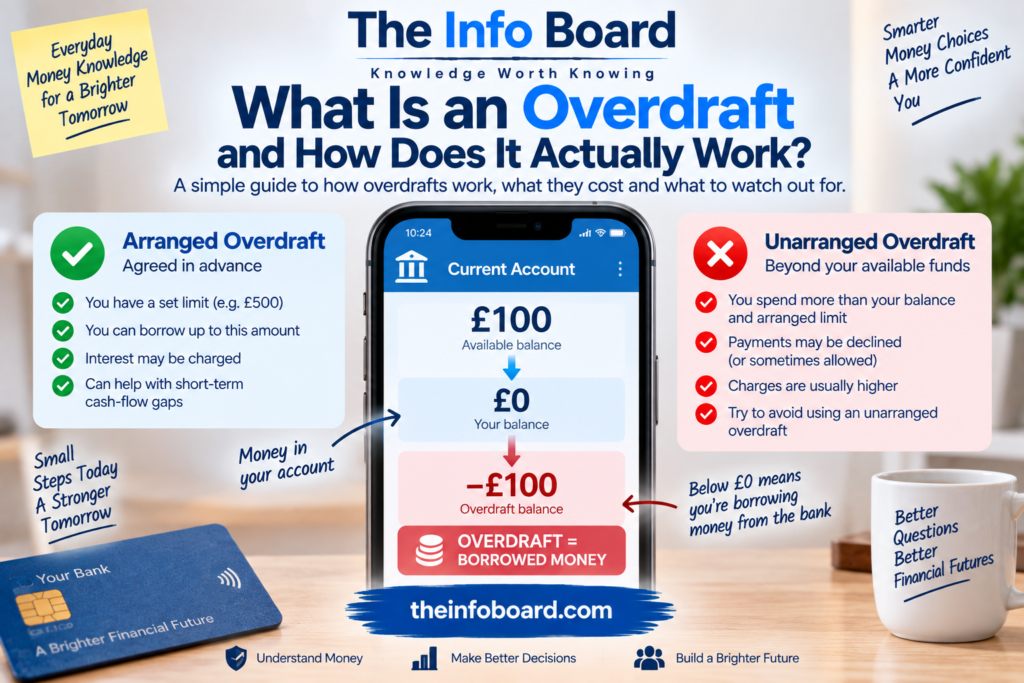
What Is an Overdraft?
An overdraft allows your current account balance to go below zero.
Normally, if you have £100 in your account and spend £30, you have £70 remaining.
But suppose you have £30 and make a £50 payment.
If your bank allows the transaction, your balance could become:
−£20
The £20 below zero isn’t your money.
You have effectively borrowed it from the bank.
Your account remains overdrawn until enough money enters the account to bring the balance back to zero or above.
Is an Overdraft a Loan?
An overdraft is a form of borrowing, but it works differently from a conventional personal loan.
With a typical loan, you borrow an agreed amount and repay it according to a repayment schedule.
An overdraft is attached to your current account.
You normally use it when outgoing transactions take your balance below zero, subject to the bank’s terms and any agreed limit.
This makes an overdraft flexible, but that flexibility doesn’t mean it is free.
Read:What Is Compound Interest and How Does It Work?
What Is an Arranged Overdraft?
An arranged overdraft is a borrowing facility agreed with your bank in advance.
For example, your bank might approve an overdraft limit of £500.
If your balance falls below zero, you could potentially borrow within that agreed limit.
Suppose your balance is £20 and a £100 payment leaves your account.
Your new balance would be:
−£80
You would be using £80 of your arranged overdraft.
The exact amount you can borrow, the interest charged and eligibility requirements depend on the bank and account.
What Is an Unarranged Overdraft?
An unarranged overdraft occurs when you attempt to spend more money than you have without having sufficient arranged overdraft available.
For example, perhaps you have:
Account balance: £10
Arranged overdraft limit: £100
Then a £150 transaction is attempted.
The payment would take you beyond the agreed limit.
What happens next depends on your bank and the type of transaction.
The bank might refuse the payment, or in some circumstances it may allow a transaction that takes the account beyond the arranged limit.
You should check your bank’s current terms rather than assuming a payment will automatically be accepted.
What Does “Overdraft Limit” Mean?
Your overdraft limit is the maximum arranged borrowing facility the bank has agreed to provide on the account.
Imagine your balance is £0 and your arranged overdraft limit is £500.
That does not mean you have £500 of savings.
It means the bank has agreed that you may be able to borrow up to £500 through the overdraft, subject to its terms.
If your balance shows:
−£300
you have used £300 of that borrowing facility.
You don’t have £200 left in your bank account. You have another £200 of your agreed overdraft facility potentially available to borrow.
You potentially have another £200 of agreed borrowing available.
That distinction matters.
How Do You Repay an Overdraft?
An overdraft is generally repaid when money enters your current account.
Suppose your balance is:
−£200
Your salary of £1,500 is then paid into the account.
Ignoring any other transactions, your new balance becomes:
£1,300
The first £200 effectively clears the negative balance.
Unlike many loans, there may not be a separate fixed monthly repayment for the overdraft itself.
Money entering the account automatically reduces the amount overdrawn.
Why Can This Become a Problem?
Because it can create a cycle.
Imagine you’re £500 overdrawn immediately before payday.
Then £2,000 salary arrives.
Your balance becomes approximately £1,500 before other transactions.
You haven’t really gained access to the full £2,000 for that month’s spending because £500 was needed to clear the previous month’s overdraft.
If your normal expenses then consume the £1,500, you may enter the overdraft again before the next payday.
The pattern can repeat:
payday → overdraft cleared → spending → overdraft again → payday
This is sometimes described informally as living in your overdraft.
Do Banks Charge Interest on Overdrafts?
They can.
Typical UK arranged overdraft charges (as of October 2026 — variable, check your bank):
| Bank | Typical rate | Interest-free buffer |
| HSBC | 39.9% EAR variable | £25 |
| Nationwide | 39.9% EAR variable | £50 |
| First Direct | 39.9% EAR variable | £250 |
| Starling Bank | 15%, 25% or 35% EAR based on credit score | £0 |
Rates are variable and depend on your account. Sources: Official bank overdraft pages and MoneyHelper.
The exact cost depends on your bank, account type, overdraft arrangement and applicable rules.
Some accounts may provide a small interest-free overdraft or other concessions.
Others charge interest on the amount borrowed.
For example, if you remain £300 overdrawn for a period of time, the cost generally depends on factors such as:
the amount borrowed, the applicable interest rate and how long you remain overdrawn.
Always check the actual terms of your account because overdraft pricing can change.
Wondering if you pay interest? See our guide: are overdrafts subject to interest?
What Does EAR Mean?
In the UK, you may see overdraft interest expressed using EAR, meaning Equivalent Annual Rate.
EAR provides a standardised way of expressing an annual interest rate while taking compounding into account.
It can help compare overdraft rates.
However, you should not assume that the percentage shown means you will literally pay that percentage of your overdraft balance immediately.
The actual amount of interest depends on how much you borrow and how long you borrow it.
Does a 40% Overdraft Rate Mean £40 Every Month on £100?
No.
This is a common misunderstanding of annual interest rates.
An annual rate is not the same thing as a monthly charge equal to that percentage.
If an overdraft advertises an annual rate around 40%, borrowing £100 for a few days would not mean paying £40 for those few days.
The actual interest would depend on the product’s calculation method and how long the balance remained overdrawn.
This is why annual rates are useful for comparison but shouldn’t be interpreted as a one-time fee.
Why Can Overdrafts Still Be Expensive?
Because the rate can be high and people sometimes remain overdrawn for long periods.
Using £50 temporarily for a very short period is different from remaining hundreds of pounds overdrawn month after month.
The longer borrowing continues, the more interest can accumulate.
An overdraft may therefore be convenient for occasional short-term cash-flow problems but potentially expensive as persistent borrowing.
Read:What Is a Direct Debit and How Does It Work?
What Happens When a Payment Would Take You Over Your Limit?
The bank may decline it.
Suppose you have £5 available and no usable overdraft.
A £50 card transaction is attempted.
The bank can refuse authorisation because there isn’t enough money available.
With other types of payments, the process can differ.
For example, direct debits, standing orders, card payments and cash withdrawals don’t necessarily behave identically.
Banks also have their own policies.
The important point is that an overdraft does not guarantee every payment will go through.
What Happens to a Direct Debit If There Isn’t Enough Money?
A direct debit may be rejected or returned if there are insufficient funds and the bank doesn’t allow the account to become sufficiently overdrawn.
This can matter because the company expecting the payment may then treat it as missed.
Depending on the agreement, that could potentially result in:
another collection attempt, a late-payment issue or other consequences.
If you know an important payment is due and your balance is insufficient, dealing with the situation before the payment date is generally better than simply waiting to see what happens.
Can an Overdraft Affect Your Credit Score?
Potentially.
The precise effect depends on how the overdraft is used and how credit-reference agencies and lenders assess the information available to them.
Applying for an overdraft can involve a credit assessment.
Persistent borrowing or exceeding agreed limits may also be viewed differently from occasional responsible use.
But there is no universal rule that says simply entering an arranged overdraft automatically destroys your credit score.
Lenders assess creditworthiness using multiple factors.
Is an Overdraft Guaranteed Forever?
No.
An arranged overdraft should not be thought of as permanent money belonging to you.
Banks can review overdraft facilities and may change or withdraw them according to their terms and applicable requirements.
This is an important difference between:
having £500 in savings
and
having a £500 overdraft facility.
The first is your money.
The second is access to borrowing.
Why Does My Banking App Show an “Available Balance” Higher Than My Actual Balance?
Some banking apps may include an arranged overdraft when displaying money available to spend.
For example:
Account balance: £100
Arranged overdraft: £500
A bank might indicate that considerably more than £100 is technically available for transactions.
But this can create a misleading psychological effect.
Anything beyond your positive account balance may represent borrowing, not money you own.
Always distinguish between your actual balance and available credit.
Should You Treat Your Overdraft as Extra Income?
No.
An overdraft can make it feel as though you have more spending money than you really do.
If your salary is £2,000 and you also have a £1,000 overdraft, your monthly income has not become £3,000.
The £1,000 is borrowed money.
Using it increases your financial obligations rather than your income.
This sounds obvious, but treating credit as spending money is one of the easiest ways to develop persistent debt.
When Can an Overdraft Be Useful?
Overdrafts can provide flexibility for short-term timing problems.
Imagine an essential bill is due today but your salary arrives tomorrow.
An arranged overdraft may allow the payment to be made rather than rejected.
That convenience can be valuable.
But whether it is financially sensible depends on the cost and circumstances.
A useful distinction is:
temporary cash-flow bridge versus long-term source of spending money.
The second is generally much more concerning.
What Is a Cash-Flow Problem?
Cash flow is about when money enters and leaves your account.
You could theoretically earn enough money to cover your monthly expenses but still run into trouble because payments happen at inconvenient times.
For example:
Salary arrives: 30th
Rent leaves: 1st
Energy bill leaves: 2nd
Insurance leaves: 3rd
If other spending depleted your previous salary before the 30th, those first few days can become difficult.
An overdraft can bridge timing gaps, but changing payment dates or building a cash buffer may provide a more durable solution where possible.
What Is a Financial Buffer?
A financial buffer is money kept available to absorb small unexpected expenses or timing differences.
For example, instead of allowing your current account to repeatedly approach £0, you might aim eventually to keep an extra amount untouched.
Then a slightly larger electricity bill or unexpected household expense doesn’t immediately force you into borrowing.
A buffer isn’t exactly the same as a full emergency fund.
Think of it as a smaller first layer of protection against everyday financial variation.
Is an Overdraft Better Than a Credit Card?
There is no universal answer.
Both are forms of borrowing, but their costs, repayment structures and protections differ.
An overdraft may be convenient because it is integrated directly into your current account.
A credit card may offer an interest-free purchase period or other features depending on the product and how it is used.
But either can become expensive if debt persists.
The sensible comparison is based on:
total cost, repayment terms, borrowing period and your ability to repay.
Not simply which product feels easier to use.
Is an Overdraft Better Than a Payday Loan?
High-cost short-term credit can be extremely expensive, so comparing alternatives matters.
But an overdraft shouldn’t automatically be described as “cheap” simply because another borrowing option may cost more.
The correct question is:
How much will this borrowing cost me in my specific situation, and how quickly can I repay it?
If borrowing is becoming necessary for ordinary essentials every month, the underlying budget problem deserves attention regardless of the credit product being used.
How Can You Get Out of an Overdraft?
Start by finding the exact amount you are overdrawn and the interest rate you’re paying.
Then look at your monthly cash flow.
If possible, aim to reduce the negative balance gradually rather than treating the full overdraft limit as your normal zero.
For example, suppose you’re routinely reaching:
−£600
You might first aim to stop going below:
−£550
Then:
−£500
Then:
−£450
Progress may be gradual, but each reduction decreases your reliance on borrowed money.
Should You Reduce Your Overdraft Limit While Paying It Off?
Possibly, but be careful.
Reducing the limit can help prevent you from borrowing the money again after you’ve repaid part of it.
However, lowering the limit too aggressively could create problems if upcoming payments require more money than is available.
Before changing the facility, consider scheduled bills and the bank’s terms.
The objective is to reduce dependence on the overdraft without accidentally causing essential payments to fail.
What If You Can’t Escape the Overdraft Cycle?
If your income regularly disappears into an overdraft immediately after payday and you cannot make progress, the problem may require more than small budgeting adjustments.
Review:
essential expenses, discretionary spending, debt repayments, subscriptions and other recurring commitments.
If you are struggling with debts or essential bills, consider contacting your bank and an appropriate free debt-advice organisation in your country.
Seeking help early can provide more options than waiting until payments are repeatedly missed.
Should You Use Savings to Clear an Overdraft?
It depends on your circumstances.
Mathematically, if you’re paying a high rate on an overdraft while earning a much lower rate on savings, using some savings to reduce expensive borrowing may appear sensible.
But liquidity matters.
Using every penny of your savings could leave you without money for an emergency, potentially forcing you to borrow again.
The decision therefore involves more than comparing two interest rates.
You need to consider the purpose of your savings, your emergency needs and how likely you are to return to the overdraft.
Can Bank Alerts Help?
Yes.
Many banking apps allow you to receive notifications when:
your balance falls below a chosen amount, you enter your overdraft, a payment leaves the account or your balance changes significantly.
These alerts can be surprisingly useful.
An overdraft is easier to manage when you know you’re approaching it before transactions begin failing or interest starts accumulating.
Automation can turn account monitoring from something you remember occasionally into something happening continuously in the background.
Read:What Is Compound Interest and How Does It Actually Work?
What’s the Difference Between £0 and Your Overdraft Limit?
Psychologically, this may be the most important distinction in the entire article.
If you have a £1,000 arranged overdraft, it can be tempting to think:
−£1,000 is my real zero.
It isn’t.
£0 is zero.
Everything below it is borrowed money.
Treating the overdraft limit as your normal spending boundary can make persistent borrowing feel ordinary and make it harder to recognise how much debt you are actually carrying.
A Simple Example
Imagine your account starts with:
£300
You spend:
Rent contribution: £150
Groceries: £80
Transport: £40
Other spending: £60
Total spending:
£330
Your balance becomes:
−£30
You are now £30 overdrawn.
Two days later, £100 enters the account.
Your new balance becomes:
£70
The first £30 cleared the overdraft.
The remaining £70 is your positive balance.
This is the basic mechanism behind an overdraft.
The Bottom Line
An overdraft lets your current account go below zero, effectively allowing you to borrow money from your bank through the account.
An arranged overdraft has been agreed in advance and normally has a defined limit.
An unarranged overdraft involves spending beyond your available balance without sufficient arranged borrowing available.
Overdrafts can be useful for short-term cash-flow problems, but they should not be mistaken for extra income.
If you repeatedly reach payday with a negative balance, the overdraft can become a cycle in which part of every new salary is immediately used to repay last month’s borrowing.
The most useful number to remember is therefore not your overdraft limit.
It is:
£0.
Above zero, you’re spending money in your account.
Below zero, you’re borrowing.
Frequently Asked Questions
What is an overdraft in simple terms?
An overdraft is a form of borrowing that allows your bank-account balance to fall below zero.
What is an arranged overdraft?
It is an overdraft facility that your bank has agreed with you in advance, usually up to a specified limit.
What is an unarranged overdraft?
It occurs when you attempt to spend beyond your available money without enough arranged overdraft to cover the transaction.
Do you pay interest on an overdraft?
You may. The rate and terms depend on your bank and account, so check the current conditions of your particular overdraft.
How is an overdraft repaid?
Money entering your account automatically reduces the negative balance. Once enough money has entered to cover the overdraft, your balance returns to zero and then becomes positive.
Is an overdraft free money?
No. An overdraft is borrowing, not income or savings.
Can an overdraft affect your credit?
Potentially. The impact depends on factors including how the facility is used and how lenders assess your overall credit history.
Is it bad to use an overdraft?
Occasional arranged use is different from relying on an overdraft continuously. Persistent overdraft borrowing can become expensive and may indicate an ongoing cash-flow problem.