Walk through almost any supermarket or hardware shop today and most of the household light bulbs on the shelves will be LEDs.
They can produce plenty of light while using surprisingly little electricity.
A traditional incandescent bulb might have used around 60 watts to produce a familiar level of brightness, while an LED designed to provide a similar amount of light may use only a fraction of that power.
So how can an LED produce similar brightness while consuming much less electricity?
The answer is largely about how efficiently electrical energy is converted into visible light rather than unwanted heat.
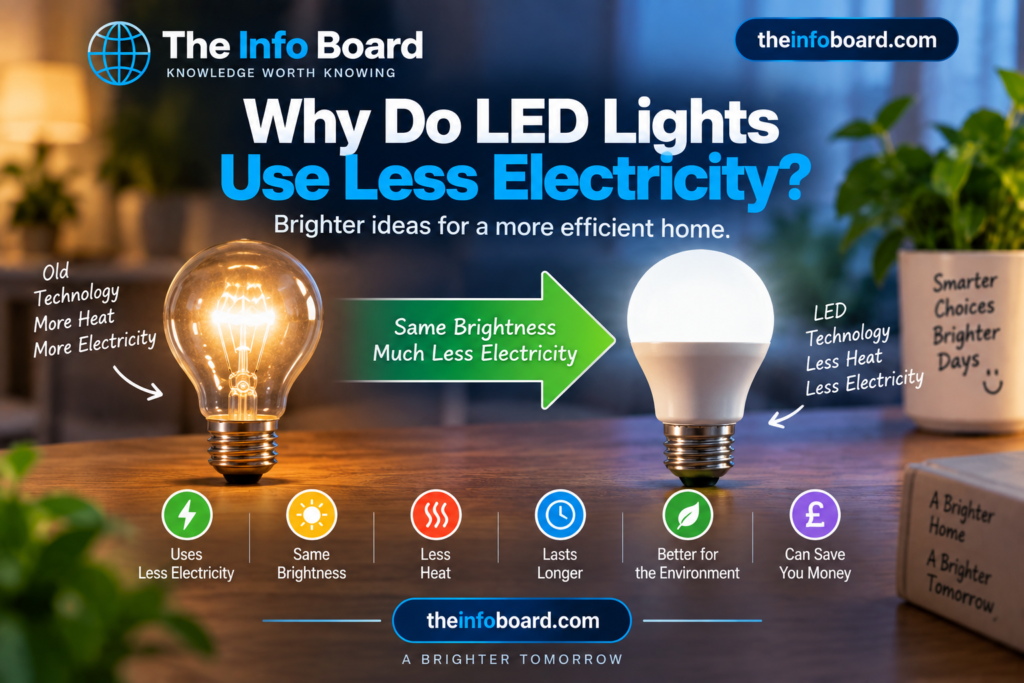
Why Do LED Lights Use Less Electricity?
What Does LED Mean?
LED stands for light-emitting diode.
A diode is a semiconductor device that allows electrical current to behave in particular ways.
When electrical current passes through the semiconductor material inside an LED, electrons interact in a process that releases energy as particles of light called photons.
This phenomenon is known as electroluminescence.
In simple terms:
Electricity enters the LED → the semiconductor converts some of that energy into light.
This is fundamentally different from the way an old-fashioned incandescent bulb produces light.
How Does an Incandescent Light Bulb Work?
Traditional incandescent bulbs use a thin metal filament, usually made from tungsten.
Electricity flows through the filament and heats it to an extremely high temperature.
Once the filament becomes hot enough, it glows and produces visible light.
The problem is that producing light this way also produces a great deal of heat.
In fact, much of the electrical energy consumed by an incandescent bulb ultimately becomes heat rather than useful visible light.
That’s why an incandescent bulb can become extremely hot during operation.
Why Are LEDs More Efficient?
LEDs don’t need to heat a filament until it glows.
Instead, they produce light through semiconductor physics.
That allows a larger proportion of their electrical input to be converted into useful visible light and less to be wasted as unwanted heat compared with incandescent lighting.
LEDs still produce heat—they aren’t perfectly efficient.
But they generally produce much less waste heat for a given amount of useful illumination.
This improved efficiency means they can deliver similar brightness while drawing substantially less electrical power.
Watts Don’t Tell You How Bright a Bulb Is
For many years, people became accustomed to buying bulbs according to their wattage.
You might remember thinking:
40W = dimmer
60W = normal
100W = bright
But watts don’t actually measure brightness.
A watt (W) measures power—the rate at which electrical energy is being used.
The old association between watts and brightness worked reasonably well when most household bulbs used essentially the same incandescent technology.
With LEDs, that shortcut no longer works well.
An LED can produce comparable visible light while consuming far fewer watts.
What Are Lumens?
Brightness is better compared using lumens.
A lumen is a measure of the amount of visible light emitted by a source.
When shopping for LED bulbs, looking at lumens makes it easier to compare brightness across different technologies.
For example, a bulb producing around 800 lumens is roughly in the brightness range historically associated with a common 60-watt incandescent household bulb.
An LED producing a similar number of lumens may require considerably less electrical power.
Exact performance varies between products, so the packaging is the best place to check both lumens and wattage.
What Does Lumens per Watt Mean?
One useful way to compare lighting efficiency is lumens per watt (lm/W).
This tells you how much visible light a source produces for each watt of electrical power it consumes.
Suppose one bulb produces:
800 lumens using 60 watts
and another produces:
800 lumens using 9 watts
The second bulb produces approximately the same measured light output while requiring much less electrical power.
Its luminous efficacy—its lumens per watt—is therefore much higher.
Modern LEDs generally achieve far higher luminous efficacy than traditional incandescent bulbs.
How Much Electricity Can an LED Save?
Let’s use a simplified example.
Imagine replacing a 60-watt incandescent bulb with a 9-watt LED providing broadly comparable light output.
The difference is:
60W − 9W = 51W
Now imagine the light is used for five hours every day.
The incandescent bulb would use:
60W × 5 hours = 300 watt-hours per day
The LED would use:
9W × 5 hours = 45 watt-hours per day
Over many days and across multiple bulbs, that difference can become significant.
The exact financial saving depends on your electricity tariff, the bulbs involved and how long they’re used.
Do LEDs Really Last Longer?
Generally, yes.
LED lighting products are typically designed for much longer operating lifetimes than traditional incandescent bulbs.
An incandescent filament operates at an extremely high temperature and gradually deteriorates until it breaks.
LEDs don’t rely on a glowing filament.
However, LEDs don’t last forever.
Their electronic components and semiconductor materials gradually degrade, and heat can accelerate this process.
Rather than suddenly burning out in exactly the same way as a filament bulb, an LED may gradually become dimmer over time.
Manufacturers often describe LED lifetime in terms of rated operating hours.
Actual lifespan depends on product quality, operating conditions and thermal management.
Read:What Is a Credit Score and Why Does It Matter?
If LEDs Are Efficient, Why Do They Get Hot?
LED bulbs still produce heat.
No electrical device converts 100% of its input energy into useful output.
The difference is that LEDs generally waste much less energy as heat than incandescent bulbs for a similar amount of visible light.
Many LED bulbs have heat sinks or specially designed housings that move heat away from sensitive electronic components.
Effective heat management is important because excessive temperature can shorten the life of an LED.
Why Do Some LED Bulbs Have Metal Bases?
Those metal or heat-dissipating sections aren’t just decorative.
They can form part of the bulb’s thermal management system.
Heat generated by the LED chips and electronics needs somewhere to go.
A heat sink helps transfer that heat away from sensitive components and into the surrounding environment.
This helps the LED operate within an appropriate temperature range.
What Is Colour Temperature?
Not all white light looks the same.
LED packaging often includes a colour temperature, measured in kelvins (K).
Common household options include approximately:
2700K — warm white
3000K — warm/soft white
4000K — neutral or cool white
5000K–6500K — daylight-like/cooler appearance
Lower colour temperatures generally appear warmer and more yellowish.
Higher colour temperatures generally appear cooler and more bluish-white.
Colour temperature doesn’t tell you how bright the bulb is—that’s what lumens are for.
Why Do Some LEDs Look Different From Traditional Bulbs?
LED technology gives manufacturers considerable control over the colour and direction of emitted light.
An incandescent filament naturally radiates light in many directions.
Individual LEDs are more directional, so bulb manufacturers use diffusers, multiple LED chips and optical designs to distribute light around a room.
That’s why some LED bulbs have frosted plastic domes or unusual internal arrangements.
They’re designed to spread the light more evenly.
Are LED Bulbs Always the Most Efficient Choice?
For ordinary household lighting, modern LEDs are generally among the most energy-efficient widely available options.
However, not every LED bulb performs identically.
Efficiency, colour quality, lifespan and reliability can vary significantly between products.
A very cheap, poorly designed LED may not last as long as expected.
When comparing bulbs, useful specifications include:
Lumens
Watts
Colour temperature
Energy-efficiency information
Rated lifetime
Whether the bulb is dimmable
Can You Use an LED With a Dimmer Switch?
Sometimes—but you need the right bulb and compatible equipment.
Not every LED bulb is designed to be dimmed.
Using a non-dimmable LED with a dimmer can result in problems such as:
Flickering
Buzzing
Poor dimming performance
Reduced lifespan
Even dimmable LEDs may not work perfectly with older dimmer switches originally designed for higher-wattage incandescent bulbs.
Check the bulb and dimmer specifications before combining them.
Why Do Some LED Lights Flicker?
LED flicker can have several causes.
Possible reasons include:
An incompatible dimmer
A poor-quality LED driver
Voltage fluctuations
A failing bulb
Electrical installation problems
Some flicker is obvious to the human eye, while higher-frequency variations may be less noticeable.
If multiple lights unexpectedly begin flickering or there are other signs of an electrical problem, it may be sensible to have the electrical system checked by a suitably qualified professional.
Do LEDs Save Money?
Using less electricity means an LED generally costs less to operate than a substantially higher-wattage incandescent bulb producing similar light output.
The actual saving depends on:
- Electricity price
- Bulb wattage
- Daily usage
- Number of bulbs
- Purchase price
- How long the bulb lasts
An LED may cost more upfront than older bulb technologies, although LED prices have fallen considerably over time.
Lower energy consumption and longer service life can compensate for that initial cost.
A Simple Cost Example
Suppose an LED uses 9 watts and operates for five hours each day.
Its annual energy consumption would be approximately:
9W × 5 × 365 = 16,425Wh
That’s approximately:
16.4 kWh per year
A 60-watt incandescent bulb used for the same amount of time would consume approximately:
109.5 kWh per year
The difference would be about:
93 kWh per year for that single bulb.
Multiply that across several frequently used lights and the reduction in electricity consumption becomes much more noticeable.
The monetary saving depends on the price you’re paying per kilowatt-hour.
Are LEDs Better for the Environment?
Lower electricity consumption can reduce the energy required to provide lighting.
The overall environmental impact depends on many factors, including how electricity is generated, how products are manufactured, their lifespan and how they’re disposed of.
Longer-lasting bulbs can also mean fewer replacement products are required over time.
However, LEDs contain electronic components and should be disposed of according to appropriate local recycling and waste guidance rather than automatically treated like ordinary household rubbish.
Why Did Governments Phase Out Many Incandescent Bulbs?
Many countries introduced energy-efficiency standards that traditional incandescent bulbs could not meet.
The goal was to reduce unnecessary electricity consumption by encouraging more efficient lighting technologies.
In the UK, lighting efficiency requirements have evolved over time, and inefficient traditional bulbs have largely disappeared from normal retail shelves.
LEDs have consequently become the standard choice for many household applications.
Final Thoughts
LED lights use less electricity because they produce light in a fundamentally different way from traditional incandescent bulbs.
An incandescent bulb creates visible light by heating a filament until it glows, which means a large amount of energy ends up as heat.
An LED uses semiconductor technology to produce light much more efficiently.
The result is simple:
More useful light from less electrical power.
When choosing an LED, don’t rely on watts to judge brightness.
Look at lumens for brightness, watts for electricity consumption, and colour temperature for the appearance of the light.
Those three numbers can tell you much more about the bulb you’re actually buying.
Frequently Asked Questions
Why do LED lights use less electricity?
LEDs use semiconductor technology to convert electrical energy into light more efficiently than incandescent bulbs, which generate light by heating a filament.
Does a lower-watt LED mean less brightness?
Not necessarily. Wattage measures electricity use, not brightness. Compare lumens when choosing bulbs of similar brightness.
What LED replaces a 60W incandescent bulb?
Look primarily for a similar lumen output rather than a particular wattage. Around 800 lumens is commonly associated with the light output of a traditional 60W incandescent bulb, while the LED wattage can vary by product.
Do LEDs get hot?
Yes. LEDs generate heat, but generally much less waste heat than incandescent bulbs for comparable useful light output.
Do LED bulbs really save money?
They can reduce electricity costs because they require less power for comparable illumination. Actual savings depend on electricity prices and usage.
Why do LED bulbs last longer?
LEDs don’t rely on a fragile filament heated to extremely high temperatures. Their lifespan still depends on component quality, heat management and operating conditions.
Safety note: Readers should use bulbs appropriate for their fittings and follow manufacturer instructions. Electrical faults or installation work should be assessed by a suitably qualified professional.
[…] Read:Why Do LED Lights Use Less Electricity? […]
[…] Read:Why Do LED Lights Use Less Electricity? […]