Sleep is not a period when your brain simply switches off. While you rest, your brain moves through changing patterns of activity and your body continues to regulate important functions. Sleep supports attention, memory, mood and physical health — which is why regularly getting too little can affect how you feel and function the next day.
In brief: A typical night includes several cycles of non-rapid eye movement (NREM) and rapid eye movement (REM) sleep. The stages are different, but there is no single “best” stage that replaces the need for a full night’s sleep.
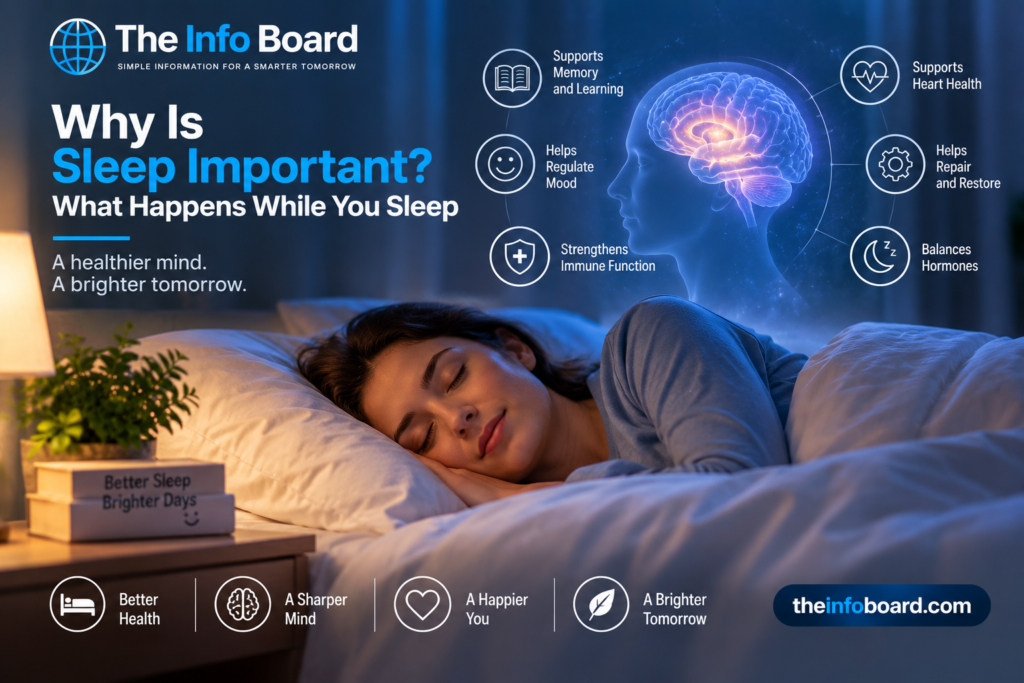
Why Is Sleep Important? What Happens While You Sleep
What happens while you sleep?
Sleep follows a changing pattern rather than remaining at one level all night. The National Institutes of Health (NIH) describes three stages of NREM sleep followed by REM sleep. People generally cycle through these stages several times, although the timing and amount of each stage vary. Source: NIH — Sleep phases and stages.
| Stage | What happens | What to know |
|---|---|---|
| NREM stage 1 | Transition from wakefulness into sleep | Light sleep; you may wake easily |
| NREM stage 2 | Body settles further into sleep as patterns of brain activity change | A substantial part of an ordinary night’s sleep |
| NREM stage 3 | Slow-wave or deep sleep | Often more prominent earlier in the night; waking can be difficult |
| REM | Active brain patterns, rapid eye movements and reduced movement of many muscles | Vivid dreaming is common, although dreams can occur in other stages |
These are general descriptions, not a way to diagnose sleep quality from a smartwatch. Consumer trackers estimate stages rather than measuring them as a clinical sleep study would.
Why sleep matters for your brain
Memory and learning
Good sleep helps you stay attentive when learning something new. Sleep also contributes to memory consolidation — the processes that help stabilise newly acquired information. Studying for longer while severely sleep-deprived may therefore be less useful than it first appears.
Concentration, decisions and safety
Insufficient sleep can impair attention, reaction time, judgment and problem-solving. You may feel only mildly tired yet still make more mistakes. If you are struggling to stay awake, do not drive or operate machinery: feeling able to push through is not a reliable measure of alertness.
Emotions and mood
Poor sleep may make irritability and emotional regulation more difficult. Stress, in turn, can interfere with sleep, creating a difficult cycle. This does not mean every mood problem is caused by poor sleep, but sleep is an important part of the wider picture.
What does sleep do for the body?
Sleep is connected with normal immune activity, metabolism, hormone regulation and cardiovascular function. Researchers study how inadequate sleep contributes to longer-term health risks, but these relationships are complex: sleep is one factor among many, not a cure or a substitute for medical care.
Deep NREM sleep is often described as restorative, but it would be misleading to claim that only deep sleep benefits the body. Both NREM and REM sleep are parts of healthy sleep architecture.
Does your brain clear waste while you sleep?
You may have read that the brain “washes itself” during sleep. Research on the glymphatic system investigates how fluid movement and waste transport work in and around brain tissue. It is an active research area, particularly in humans. A 2026 review of human studies found intriguing associations but emphasised that much of the evidence uses indirect measures and cannot yet establish simple cause-and-effect rules. Source: 2026 scientific review indexed by PubMed.
In other words, this research is interesting, but claims that a particular bedtime routine will “flush toxins from the brain” go beyond what the human evidence currently supports.
Why do we feel sleepy at particular times?
Two important processes influence sleep timing:
- Circadian rhythm: Your internal daily timing system responds strongly to light and helps regulate when you feel awake or sleepy.
- Sleep pressure: The tendency to sleep generally grows the longer you have been awake.
Irregular schedules, shift work and late-night light exposure can make it harder to align sleep with these processes. This is one reason regularity can matter alongside total sleep duration.
How much sleep do adults need?
The NHS says most adults need around 7–9 hours of sleep per night, although individual needs vary. Children and teenagers usually need more. The number alone is not the whole story: uninterrupted rest, health conditions and how you function during the day matter too. Source: NHS — Insomnia and sleep needs.
For example, someone who spends eight hours in bed but wakes repeatedly may still feel unrefreshed. Someone who consistently sleeps five hours may underestimate the effect on attention and performance.
If your main question is why you feel exhausted despite apparently sleeping long enough, see our separate guide: Why do you wake up tired after eight hours of sleep? That article focuses on possible reasons for unrefreshing sleep rather than repeating the science here.
Can you catch up on lost sleep at the weekend?
Extra sleep after a short night may help reduce sleepiness, but that does not make an ongoing cycle of severe sleep restriction harmless. The practical goal is a sustainable routine that gives you enough sleep most nights, rather than relying on a perfect mathematical repayment of every missed hour.
Seven habits that may support better sleep
- Keep a reasonably consistent wake-up time. A repeatable schedule helps your body establish a rhythm.
- Get daylight during the day. Natural light helps signal daytime to your body clock.
- Make the room comfortable. Reduce unwanted noise and light and choose a comfortable temperature.
- Notice your caffeine timing. If caffeine interferes with sleep, have it earlier.
- Limit alcohol near bedtime. Alcohol can disrupt sleep even if it initially makes you drowsy.
- Build a wind-down routine. Choose calming activities you can realistically repeat.
- Address persistent problems rather than forcing more sleep. If you are regularly unable to sleep or stay refreshed, seek advice.
These steps are consistent with general NHS sleep advice, but they are not a treatment plan for every sleep disorder.
When should you speak to a GP?
Seek medical advice if tiredness continues for several weeks, affects daily life or comes with other concerning symptoms. The NHS tiredness and fatigue guide explains when to seek assessment.
In particular, loud snoring, witnessed pauses in breathing, or gasping or choking during sleep can be symptoms of sleep apnoea. This condition requires proper assessment; simply trying more sleep tips is not enough. See the NHS sleep apnoea guidance.
Quick questions about sleep
Is REM sleep more important than deep sleep?
They have different characteristics and are both parts of a normal sleep pattern. There is no sound reason to optimise one stage at the expense of getting sufficient sleep overall.
Can you dream outside REM sleep?
Yes. Vivid dreams are strongly associated with REM sleep, but dreaming can also happen during NREM sleep.
Does everyone need exactly eight hours?
No. Eight hours is a useful rule of thumb, while NHS guidance describes about 7–9 hours for most adults. Your circumstances and daytime functioning matter.
What if I still feel tired after a full night?
Consider whether sleep is repeatedly interrupted and whether the tiredness persists. Our guide to waking up tired explains common possibilities; a GP can investigate persistent or concerning symptoms.
The bottom line
Sleep is active, structured and essential for healthy daytime functioning. It supports learning, concentration, mood and many bodily processes. The most useful target is not a perfect tracker score or a fashionable sleep “hack”, but enough good-quality sleep on a reasonably consistent schedule — and professional help when symptoms suggest a problem that habits alone cannot solve.
Editorial note: This article provides general educational information, not an individual diagnosis or treatment recommendation. The linked NHS and NIH resources were consulted for this revision in October 2026. Scientific understanding continues to develop.