An overdraft can be useful when you are temporarily short of money, but many people worry about what using one could do to their credit score.
The simple answer is that having or occasionally using an arranged overdraft does not automatically damage your credit score. However, regularly relying on an overdraft, exceeding your agreed limit or struggling to repay what you owe can potentially affect how lenders view your finances.
Here is how overdrafts and credit records work in the UK.
What Is an Overdraft?
An overdraft allows you to spend more money than you currently have in your current account.
For example, imagine you have £50 in your bank account and an arranged overdraft limit of £500. If you spend £150, your balance could become -£100.
That £100 is borrowed money and will normally need to be repaid with interest.
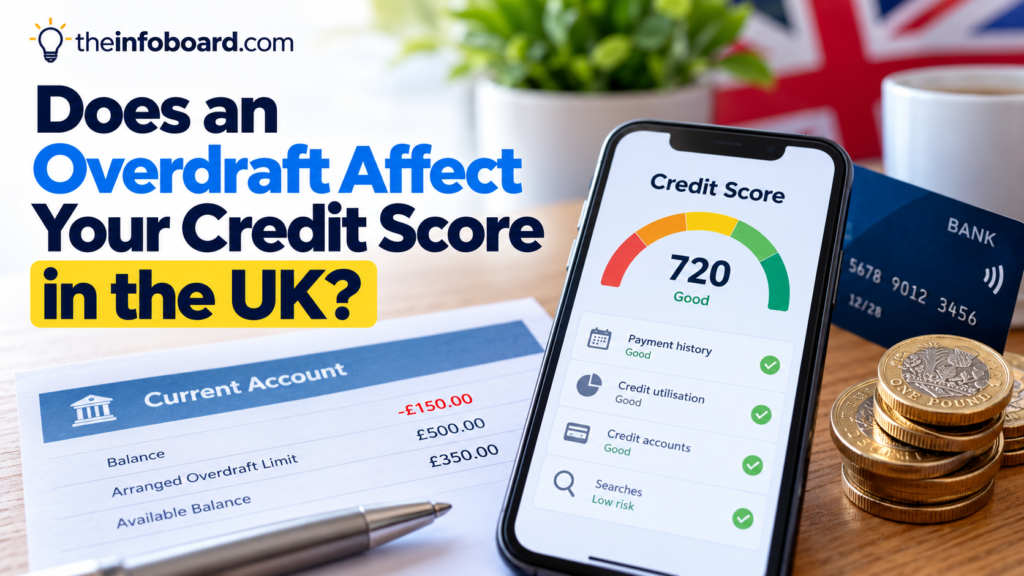
There are generally two situations you might encounter:
Arranged overdraft: Your bank has agreed in advance that you can borrow up to a particular limit.
Unarranged overdraft: You attempt to spend more than the money available without having sufficient arranged overdraft available.
An overdraft is therefore a form of borrowing rather than extra money in your account.
Does an Arranged Overdraft Affect Your Credit Score?
Simply having an arranged overdraft does not necessarily mean your credit score will fall.
If you occasionally use your overdraft, remain within your agreed limit and repay it, this is very different from constantly being heavily overdrawn.
Problems are more likely to arise when your overdraft starts showing signs of financial difficulty.
MoneyHelper advises that staying within your agreed limit and regularly paying off an overdraft are important when managing this type of credit. MaPS
When Can an Overdraft Become a Problem?
There is an important difference between occasionally using £50 of an overdraft before payday and spending months close to a £2,000 overdraft limit.
Potential warning signs include:
- remaining overdrawn for long periods
- repeatedly reaching your overdraft limit
- exceeding your agreed limit
- having little or no money left after income enters your account
- struggling to reduce the amount you owe
- increasingly depending on the overdraft for normal living costs
These patterns can indicate that the overdraft is no longer being used as short-term borrowing.
Can Lenders See Your Overdraft?
When you apply for credit, lenders may examine information contained in your credit report as part of their assessment.
However, lenders do not make decisions based purely on one number called your “credit score”.
They can consider several factors, including your existing debts, repayment history, income and their own lending criteria.
Therefore, someone being approved by one lender does not guarantee that another lender will make the same decision.
Read:What Is an Overdraft and How Does It Actually Work?
Does Going Into Your Overdraft Once Hurt Your Credit Score?
Normally, simply dipping into an agreed overdraft occasionally should not be treated the same way as serious financial difficulty.
Imagine your balance falls to -£80 shortly before payday.
Your salary arrives a few days later and returns the account to a positive balance.
That is very different from remaining £1,500 overdrawn for months while repeatedly approaching the account’s borrowing limit.
The overall way you manage borrowing matters more than simply asking whether your account has ever been overdrawn.
What Happens If You Exceed Your Overdraft Limit?
Going beyond your agreed borrowing limit can be more problematic.
A bank might refuse payments if there is insufficient money available, which could cause Direct Debits or other payments to fail.
A failed payment can then create separate problems if it means you miss an important bill.
MoneyHelper notes that when there is insufficient money in an account, a bank may reject a payment, and the company awaiting payment could potentially impose consequences for late payment.
This is one reason it is useful to set low-balance notifications through your banking app.
Can an Overdraft Affect a Mortgage Application?
Potentially, yes — but simply having an overdraft does not automatically prevent you from obtaining a mortgage.
Mortgage lenders examine your broader financial circumstances.
Heavy or persistent overdraft use could attract attention because it may suggest that your normal income is not consistently covering your expenditure.
Someone who occasionally uses a small arranged overdraft and quickly repays it presents a different financial picture from someone who spends every month close to a large overdraft limit.
If you are preparing for a mortgage application, reducing persistent reliance on short-term borrowing can generally put your finances in a stronger position.
How Much Does an Overdraft Cost?
This is another reason overdrafts deserve attention.
Overdraft interest can be expensive.
MoneyHelper says overdraft interest rates offered by banks and building societies can range from around 19% to 40% or more, and describes overdrafts as primarily suitable for emergencies or short-term borrowing.
For example, suppose you remain £1,000 overdrawn for an extended period.
Even if you can comfortably make your everyday payments, the interest charged on that borrowing can make it harder to return the account permanently to a positive balance.
Always check the actual overdraft rate offered by your bank because rates and account terms vary.
Is an Overdraft Better Than a Credit Card?
Neither is automatically better.
The appropriate form of borrowing depends on the amount you need, how long you need it for and your individual financial circumstances.
An overdraft can offer flexibility for very short-term borrowing because money becomes available directly through your current account.
However, persistent overdraft borrowing can be expensive.
Credit cards can also charge significant interest, particularly when balances are carried from month to month.
The important principle is to compare the total cost of borrowing, not simply the borrowing limit available to you.
How to Reduce Your Overdraft Reliance
If you regularly finish the month overdrawn, reducing the balance gradually may be more realistic than trying to eliminate it immediately.
Start by finding out exactly how much of your income is being absorbed by the overdraft.
For example, if your salary arrives and your balance moves from -£800 to £1,000, you effectively have less available money than the £1,000 balance initially suggests.
You could then establish a manageable monthly target.
Reducing an £800 overdraft by £50 each month may feel slow, but it gradually decreases the amount of borrowed money supporting your everyday spending.
Setting balance alerts can also help you notice when spending is approaching your limit.
Should You Use Savings to Clear an Overdraft?
Sometimes this can make financial sense.
If your savings earn considerably less interest than your overdraft costs, holding substantial savings while paying expensive overdraft interest may be inefficient.
MoneyHelper suggests that people who have savings alongside an overdraft consider using savings to repay the overdraft, while recognising that they may then need to rebuild their emergency savings.
However, you should consider your own circumstances and the need to retain enough accessible money for genuine emergencies.
Read:Arranged vs Unarranged Overdrafts: What’s the Difference in the UK?
What If You Cannot Get Out of Your Overdraft?
Contact your bank early rather than waiting for the situation to become unmanageable.
Banks may have support options available for customers experiencing financial difficulty.
You can also obtain free, impartial guidance from MoneyHelper.
MoneyHelper — Overdrafts explained
Avoid automatically taking additional borrowing simply to cover an existing overdraft without understanding the total costs involved. Moving debt around does not necessarily solve the underlying problem.
Frequently Asked Questions
Does having an overdraft lower your credit score?
Not automatically. How you use and manage the overdraft is more important than simply having an overdraft facility available.
Is it bad to use an overdraft every month?
Regularly depending on an overdraft can indicate that your expenditure is exceeding your available income. It can also become expensive because overdraft interest may be high.
Does an unused overdraft affect your credit score?
Having an available overdraft limit is not the same as borrowing the entire amount. Lenders assess multiple aspects of your credit history and financial circumstances.
Should I remove my overdraft before applying for a mortgage?
There is no universal requirement that everyone must remove an overdraft before applying. However, persistent or heavy overdraft usage could be relevant to a lender’s affordability assessment.
Can my bank reduce my overdraft?
Yes. An overdraft is not necessarily permanent. Banks can review overdraft facilities and may reduce or withdraw a limit. MoneyHelper specifically warns that overdraft facilities can be withdrawn.
Final Thoughts
An overdraft can be a useful financial safety net when it is used occasionally and repaid quickly.
The greater concern is persistent dependence on it.
If your account remains overdrawn month after month, the interest cost can accumulate and your borrowing pattern may indicate financial pressure.
Treat an overdraft as borrowing rather than as part of your normal income, monitor your balance and aim to bring the account back into credit regularly.
Related: Read our guide “What Is an Overdraft and How Does It Actually Work?” for a complete explanation of arranged overdrafts, limits and charges.
This article provides general information and is not personal financial advice. Credit decisions vary between lenders and individual circumstances.
Leave a Comment