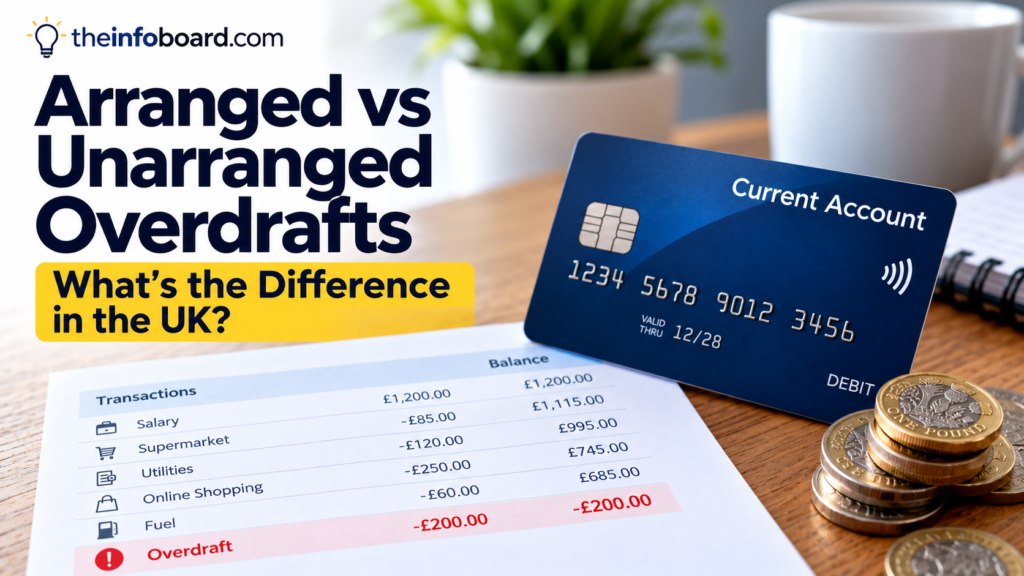
An overdraft can be useful when your current account balance runs low, but not all overdrafts work in exactly the same way. In the UK, you will commonly hear two terms: arranged overdraft and unarranged overdraft.
The main difference is straightforward. An arranged overdraft is agreed with your bank in advance and normally comes with a set borrowing limit. An unarranged overdraft happens when you spend beyond your available balance without an agreed overdraft, or when you go beyond your arranged overdraft limit.
Understanding the difference can help you avoid unexpected problems and make better decisions when using your current account.
What Is an Arranged Overdraft?
An arranged overdraft, sometimes called an authorised overdraft, is a borrowing facility agreed between you and your bank or building society.
For example, imagine you have £50 in your current account and an arranged overdraft limit of £500. If a £150 payment leaves your account, your balance could fall to -£100. You would then be using £100 of your arranged overdraft.
You haven’t necessarily done anything wrong by entering the overdraft because the bank has already agreed that you can borrow up to the specified limit.
However, an overdraft is still borrowing, rather than extra money belonging to you. Interest may apply while you are using it. MoneyHelper recommends treating overdrafts as short-term borrowing or something for emergencies rather than relying on them as a long-term source of money.
If you’re unfamiliar with overdrafts generally, read our guide “What Is an Overdraft and How Does It Actually Work?” before continuing.
What Is an Unarranged Overdraft?
An unarranged overdraft — sometimes called an unauthorised or unplanned overdraft — occurs when you spend more money than is available without having sufficient overdraft borrowing agreed beforehand.
It can also happen when you exceed an existing arranged overdraft limit.
For example:
You have £20 in your account and no arranged overdraft. A transaction takes the account to -£30.
Alternatively, you have an arranged overdraft limit of £500 but a transaction would take the balance to -£550.
In either situation, you may be attempting to use money beyond your agreed available funds.
Importantly, a bank doesn’t necessarily have to allow every payment that would take you into an unarranged overdraft. A transaction could instead be declined or returned, depending on the circumstances and your bank’s terms.
Read:What Is an Overdraft and How Does It Actually Work?
Arranged vs Unarranged Overdraft: Key Differences
The easiest way to understand the distinction is to compare them directly.
| Arranged overdraft | Unarranged overdraft | |
|---|---|---|
| Agreed beforehand? | Yes | No |
| Usually has an agreed limit? | Yes | No separate agreed limit |
| Can occur after exceeding an arranged limit? | No | Yes |
| Is it borrowing? | Yes | Yes |
| Can interest apply? | Yes | Yes |
| Are payments guaranteed? | No | No |
The most important distinction is therefore whether the borrowing has been agreed with your bank beforehand.
Are Unarranged Overdrafts More Expensive?
This is where outdated information online can cause confusion.
Historically, UK customers could face substantially higher charges for using an unarranged overdraft. The rules changed in April 2020.
FCA rules require overdraft charging structures to be simpler and prohibit firms from requiring a customer to pay a higher interest rate for an unarranged overdraft than the relevant arranged overdraft rate. Overdraft charges covered by these rules are structured as annual interest rates rather than the old system of separate daily or monthly overdraft fees. FCA Handbook
That doesn’t mean every overdraft is cheap.
The interest rate and exact conditions depend on the bank, account and customer circumstances. Always check your own bank’s current overdraft information rather than assuming that one bank’s rate applies everywhere.
What Happens If You Exceed Your Arranged Overdraft Limit?
Suppose your bank has given you a £500 arranged overdraft.
Your balance reaches -£490 and another £30 payment is requested.
That transaction would take you beyond your agreed £500 limit.
Your bank could refuse the transaction, or allowing it could result in unarranged overdraft borrowing, depending on the circumstances and account terms.
This is one reason it’s useful to monitor your balance when you’re close to your overdraft limit.
Many banking apps allow customers to set balance notifications or alerts. These can provide an early warning before the account runs short of available funds.
Can Using an Overdraft Affect Your Credit?
An overdraft is a form of borrowing, so it should be managed carefully.
Simply having an arranged overdraft doesn’t automatically mean that you are experiencing financial difficulty. But lenders assessing an application can consider information in your credit history and your wider financial circumstances.
Regularly depending on borrowing can also become expensive.
The FCA has specific rules concerning repeat overdraft use. Banks must have systems for identifying customers whose pattern of overdraft use could result in high cumulative costs or indicate actual or potential financial difficulty.
So rather than viewing an overdraft as part of your normal monthly income, it is generally better to think of it as a borrowing facility.
Is an Arranged Overdraft Better Than an Unarranged Overdraft?
If you know you may occasionally need an overdraft, having an agreed facility generally gives you more certainty because you know the borrowing limit that has been approved.
An unarranged overdraft is less predictable because you’re attempting to spend money outside your agreed available funds.
But an arranged overdraft shouldn’t automatically be considered a good long-term borrowing solution.
MoneyHelper advises that overdrafts are generally intended for short-term borrowing or emergencies, and notes that other forms of borrowing may sometimes be cheaper. MaPS
Before borrowing, compare the total cost and consider whether you can realistically repay the money.
What If You Keep Living in Your Overdraft?
Occasionally dipping into an overdraft and spending much of every month overdrawn are very different situations.
If your salary enters your account but most of it simply brings your balance back toward zero before you become overdrawn again, the overdraft may effectively have become persistent debt.
The FCA describes repeat use as a pattern where the frequency and depth of overdraft use can result in high cumulative charges or indicate that someone is experiencing, or risks experiencing, financial difficulties. Banks are required to monitor for these patterns and take appropriate steps with affected customers.
If you’re struggling to reduce an overdraft balance, consider speaking to your bank before the situation becomes harder to manage. Free debt guidance is also available through services such as MoneyHelper.
How to Reduce the Risk of an Unarranged Overdraft
A few simple habits can help:
- Check your available balance rather than only remembering what you think is in the account.
- Enable low-balance notifications if your bank offers them.
- Keep track of Direct Debits and recurring subscriptions.
- Know your arranged overdraft limit.
- Avoid treating your overdraft limit as money that needs to be spent.
- Contact your bank if you’re repeatedly relying on the overdraft.
Most importantly, act early if your overdraft is becoming difficult to repay.
Read:What Is Compound Interest and How Does It Actually Work?
Frequently Asked Questions
Is an arranged overdraft the same as an authorised overdraft?
Generally, yes. “Authorised overdraft” is an older/common term for borrowing that has been agreed with the bank beforehand. “Arranged overdraft” is now widely used.
What does unarranged overdraft mean?
It means you’ve attempted to borrow through your current account without sufficient overdraft being agreed beforehand. It can also occur when you exceed your arranged overdraft limit.
Can my bank refuse a payment?
Yes. Having insufficient available funds does not mean the bank must provide additional borrowing. Payments can be refused depending on the circumstances and account terms.
Is an unarranged overdraft always more expensive?
Not in the way it historically was. FCA rules prevent firms from charging a higher interest rate for an unarranged overdraft than the relevant arranged overdraft rate for that customer.
Should I use an overdraft every month?
Regular reliance on an overdraft can become expensive. The FCA specifically requires firms to identify and respond appropriately to patterns of repeat overdraft use.
Final Thoughts
The difference between arranged and unarranged overdrafts is relatively simple: an arranged overdraft has been agreed with your bank in advance, while an unarranged overdraft has not, or results from exceeding your agreed limit.
An arranged overdraft can provide a useful short-term buffer, but both types involve borrowing. If you regularly need an overdraft to cover everyday expenses, it’s worth looking at the underlying budget rather than treating the overdraft as additional income.
Leave a Comment