A baby sleeping bag can look like one of the simplest products in a nursery. It keeps a baby covered without using a loose blanket and is available in countless sizes, materials and designs.
But the UK’s product-safety regulator has issued an important warning: not every product sold as a baby sleeping bag is safe for unsupervised sleep.
On 1 October 2026, the Office for Product Safety and Standards (OPSS) issued a national Product Safety Alert covering baby sleeping bags that do not have armholes or that include a hood. The regulator warns that these designs can create risks of suffocation and overheating.
OPSS says it has published nearly 50 recalls or product-safety reports involving dangerous baby sleeping bags since 2023. GOV.UK
For parents and carers, the most important message is fortunately easy to remember:
Armholes: yes.
Hood: no.
The alert doesn’t mean every baby sleeping bag is dangerous. It means parents should check the design, fit and instructions rather than assuming a product is suitable simply because it is marketed for babies.
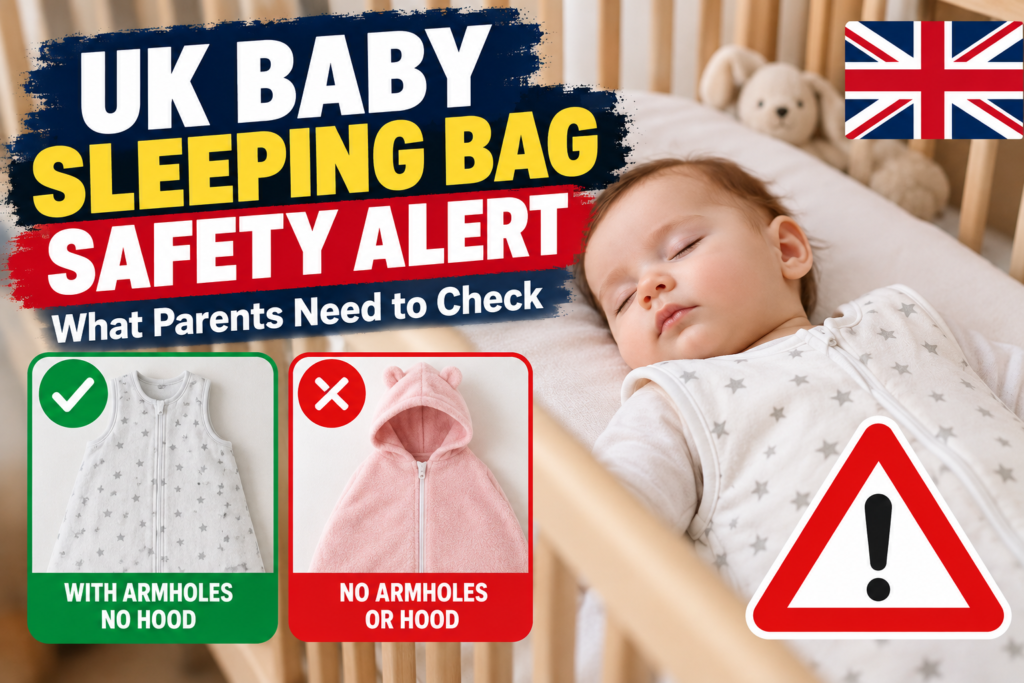
Which Baby Sleeping Bags Does the UK Alert Cover?
The alert applies to products marketed or intended as bags for babies to sleep in unsupervised in a cot or crib.
OPSS identifies two particular warning signs.
The first is a sleeping bag without armholes.
The second is a sleeping bag with a hood.
Products with either feature should not be bought or used for unsupervised baby sleep, according to the regulator. GOV.UK
There are some important exclusions.
The alert does not apply to products specifically designed to swaddle a baby. It also doesn’t cover items such as pramsuits or muffs designed to be worn in a pram. GOV.UK
That distinction matters because products can look similar online while being intended for very different purposes.
For example, a warm hooded item intended for a baby being pushed outdoors in a pram is not the same product as a sleeping bag designed for a baby to wear unattended overnight in a cot.
Parents therefore need to consider not only what a product looks like, but what it is actually designed and marketed to do.
Why Armholes and a Hood Make Such a Difference
A baby sleeping bag needs to keep the baby positioned safely.
Without armholes, a baby may be able to slip further down inside the sleeping bag. Material could then cover the nose or mouth, creating a risk of suffocation or asphyxiation.
A hood creates another potential hazard. Natural movement during sleep could cause it to cover the baby’s nose or mouth.
OPSS also warns about overheating. Materials that retain heat or enclose a baby’s head can prevent heat escaping effectively.
Think about the difference between an adult and a baby.
An adult who becomes uncomfortable inside bedding can usually move it away, sit up or get out.
A baby cannot reliably respond to a dangerous sleeping position in the same way.
That’s why something that looks soft, warm and comfortable in a product photograph isn’t necessarily safer.
For an unsupervised baby sleeping bag, a hood isn’t an added comfort feature. It’s specifically one of the design features UK product-safety officials are warning parents to avoid.
How to Check a Sleeping Bag You Already Own
Start with the simplest visual check.
Lay the sleeping bag out flat.
Does it have two proper armholes?
Does it have a hood?
If it has no armholes or includes a hood, OPSS advises that it should not be used for unsupervised baby sleep. GOV.UK
Next, check the fit.
A sleeping bag can have the correct basic design and still be inappropriate if it is too large for the baby wearing it.
Follow the manufacturer’s sizing guidance rather than deliberately buying a much larger size for the baby to “grow into”.
For example, if the upper opening is so large that the baby could slip down inside the bag, that deserves immediate attention.
Look at the product label too. Check the size information, care instructions and safety warnings.
Then inspect the physical condition of the bag.
Fasteners should work correctly. Seams shouldn’t be coming apart, and there shouldn’t be loose components or damage that could affect how the product fits.
If you’ve inherited or bought a second-hand sleeping bag, you may not have the original packaging. In that situation, the label and manufacturer’s information become particularly useful.
You can also search the exact brand and product name to see whether a safety notice or recall has been issued.
Be Careful When Buying Baby Sleep Products Online
Online shopping gives parents access to thousands of baby products, including products sold by businesses based outside the UK.
But a professional-looking product page isn’t evidence that an item is safe.
Neither is a high star rating.
Customer reviews can tell you whether buyers liked the material, delivery time or appearance. They cannot replace a proper product-safety assessment.
This is particularly important when the product is intended to be used while a baby is asleep and unsupervised.
Imagine two listings.
One sleeping bag has armholes, no hood, clear sizing information, identifiable manufacturer details and proper safety instructions.
Another is described simply as a “luxury cosy baby sleep sack”, has a large hood and provides almost no safety or manufacturer information.
The second product might look warmer and more attractive in photographs, but those marketing qualities don’t answer the important safety questions.
OPSS has been actively addressing unsafe baby products sold online. Its current alert follows nearly 50 recalls or product-safety reports concerning dangerous sleeping bags since 2023.
Before buying, check exactly who is selling the product, whether proper sizing and safety information is provided, and whether its design matches current UK safety advice.
A low price isn’t a worthwhile saving if the product isn’t appropriate for its intended use.
What to Do If Your Baby Sleeping Bag Matches the Warning
If you own a sleeping bag intended for unsupervised baby sleep that lacks armholes or has a hood, stop using it for that purpose.
Don’t try to redesign it yourself.
Cutting armholes into a product or removing a hood at home could create damaged seams, loose material or a fit that was never tested or intended by the manufacturer.
Instead, identify the retailer or business that supplied it.
OPSS advises consumers with affected products marketed for unsupervised baby sleep to contact the supplying business. The official alert says consumers may be entitled to redress.
Keep useful evidence such as your receipt or order confirmation, photographs of the product, photographs of its label and the seller’s details.
If you bought it through an online marketplace, check your account for any product-safety or recall messages associated with the order.
Most importantly, don’t continue using an affected product merely because your baby has previously slept in it without an incident.
A safety warning concerns the risk of something happening, not whether it has already happened to your particular product.
Keep the Rest of the Sleep Environment Simple Too
The sleeping bag is only one part of a baby’s sleep environment.
A correctly designed sleeping bag doesn’t make other unsuitable sleep products safe.
Parents can encounter products marketed as helping with sleep, comfort, positioning, reflux or soothing. Attractive advertising can make additional products seem necessary when they aren’t.
This is an area where official advice matters more than social-media trends.
For example, OPSS separately maintains safety alerts concerning certain baby sleep pillows because of suffocation and overheating risks.
The practical lesson is not to judge sleep products by how soft, padded or comfortable they appear.
When something is intended to be used around an unattended sleeping baby, check whether it is actually designed and considered safe for that purpose.
If you’re uncertain about safer sleep more generally, use current NHS guidance rather than relying on product marketing.
The Bottom Line
The October 2026 safety alert is not a warning against every baby sleeping bag.
It targets particular unsafe designs.
For a baby sleeping bag intended for unsupervised sleep, remember the simplest version of the official advice:
It should have armholes.
It should not have a hood.
The fit matters too. Follow the manufacturer’s sizing guidance and make sure the baby cannot slip down inside the bag.
If a product you already own lacks armholes or includes a hood and was marketed for unsupervised baby sleep, stop using it for that purpose and contact the business that supplied it.
And when buying online, don’t treat availability as proof of safety.
A product being listed for sale, having attractive photographs or receiving positive customer reviews does not replace proper safety information.
For something your baby may wear for hours while sleeping, those checks are worth making before the product ever reaches the cot.
Leave a Comment