Millions of households across Great Britain are about to see another change to their energy prices.
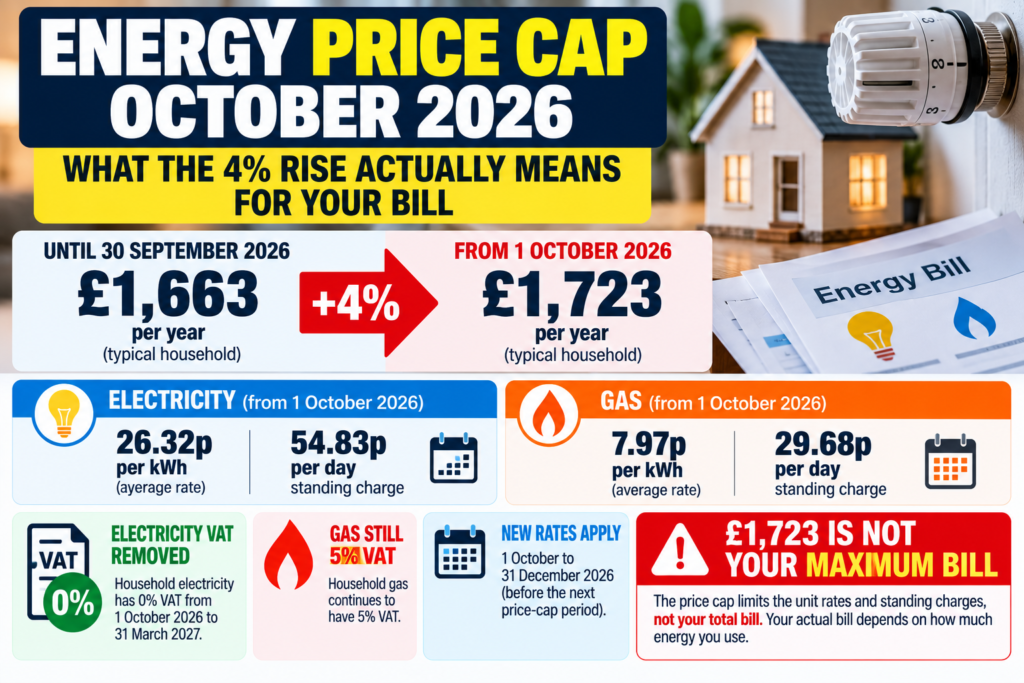
From 1 October 2026, Ofgem’s energy price cap will rise by around 4% for a typical household using gas and electricity and paying by Direct Debit.
The headline annual figure will increase from £1,663 to £1,723.
That works out at roughly £60 more per year, or about £5 per month, based on typical energy use and if those rates remained in place for a full year.
But there’s one extremely important point:
£1,723 is not the maximum amount your household can be charged.
You could pay considerably more.
You could also pay considerably less.
That’s because the energy price cap doesn’t put a fixed ceiling on your total energy bill.
So what exactly is being capped, who does the change affect, and what should you check before the new rates begin?
Let’s break it down.
What Is the Energy Price Cap?
The energy price cap is set by Ofgem, Great Britain’s energy regulator.
It limits how much suppliers can charge customers on default tariffs for certain elements of their energy supply, including:
- the unit rate for electricity,
- the unit rate for gas,
- and daily standing charges.
Ofgem normally reviews the cap every three months.
The important thing to understand is that the cap limits rates, rather than setting one maximum total bill for every household.
The widely reported £1,723 figure is based on a household with typical gas and electricity consumption.
Your actual bill depends on how much energy you use.
What Changes on 1 October 2026?
For a typical dual-fuel household paying by Direct Debit, the headline annualised figure changes from:
£1,663 → £1,723
That’s an increase of approximately:
£60 per year
or around:
£5 per month
based on typical consumption.
The new cap period runs from:
1 October to 31 December 2026
After that, another price-cap period begins.
The New Electricity Price
For customers on standard variable tariffs paying by Direct Debit, the average electricity unit rate from 1 October will be:
26.32p per kWh
The average electricity standing charge will be:
54.83p per day
These are average figures across England, Scotland and Wales.
The exact rates on your own bill can vary depending on your region, meter type and circumstances.
The New Gas Price
For gas, the average Direct Debit unit rate from 1 October will be:
7.97p per kWh
The average gas standing charge will be:
29.68p per day
Again, these are averages.
Your actual rates may be slightly different.
October 2026 Energy Prices at a Glance
For an average Direct Debit customer:
| Until 30 September | From 1 October | |
|---|---|---|
| Electricity unit rate | 26.11p/kWh | 26.32p/kWh |
| Electricity standing charge | 57.19p/day | 54.83p/day |
| Gas unit rate | 7.33p/kWh | 7.97p/kWh |
| Gas standing charge | 29.04p/day | 29.68p/day |
| Typical annualised bill | £1,663 | £1,723 |
There’s something interesting in those figures.
The average electricity standing charge actually falls, while the gas unit price increases.
Overall, however, the headline price-cap figure for a typical dual-fuel household still rises.
There’s Another Important Change: Electricity VAT
October 2026 also brings an important change to the tax applied to household electricity.
From 1 October 2026 until 31 March 2027, VAT is being removed from household electricity bills.
Gas will continue to carry 5% VAT.
The electricity VAT change is already reflected in the published October price-cap figures.
The measure is intended to reduce some of the pressure on household electricity costs.
Why Is the Price Cap Rising If Electricity VAT Is Being Removed?
This is an obvious question.
If VAT is being removed from household electricity, why is the overall headline cap still going up?
Because electricity taxation is only one component of an energy bill.
Wholesale energy costs, network costs, operating costs and other components also influence the price cap.
For the October 2026 period, higher wholesale gas costs are putting upward pressure on household energy prices.
The electricity VAT reduction offsets some of that pressure, but not enough to prevent the overall typical dual-fuel figure from increasing.
£1,723 Is NOT the Maximum You Can Pay
This is probably the single most important part of the article.
Suppose two households are on exactly the same capped tariff.
household a uses relatively little gas and electricity.
A household B has a larger home, more occupants and considerably higher energy consumption.
Household B will pay more.
Potentially much more.
The cap controls the rates charged for energy, not the total amount of energy you’re allowed to use.
A simple analogy is petrol.
Imagine petrol were capped at £1.50 per litre.
That wouldn’t mean every driver could spend no more than £1,500 per year.
Someone buying twice as much fuel would still spend roughly twice as much.
Household energy works in a similar way.
What Is a kWh?
Energy bills measure consumption using kilowatt-hours, abbreviated to kWh.
A kilowatt-hour is a unit of energy.
For example, a 1,000-watt appliance operating continuously for one hour would use approximately:
1 kWh
At an electricity unit rate of 26.32p/kWh, that amount of electricity would cost approximately:
26.32p
before considering the standing charge.
A 2,000-watt appliance operating for one hour would use approximately:
2 kWh
and would therefore cost roughly twice as much in electricity.
This is why both an appliance’s power consumption and how long you use it matter.
What Is a Standing Charge?
The standing charge is a daily amount you pay regardless of how much energy you actually use.
From 1 October, the average Direct Debit standing charges will be:
Electricity: 54.83p per day
Gas: 29.68p per day
Together, that’s approximately:
84.51p every day
before you’ve used any gas or electricity.
If those exact average rates applied for an entire 365-day year, that would be roughly £308 in standing charges alone.
However, remember that the October price-cap period itself lasts only three months and rates vary by region.
This is also why reducing your energy consumption cannot completely eliminate your energy bill.
Even if your consumption becomes extremely low, standing charges may still apply.
Why Does Your Location Matter?
Energy price-cap rates aren’t identical everywhere in Great Britain.
Unit rates and standing charges can vary by region.
This reflects differences in the costs associated with supplying and distributing energy across different areas.
So don’t be surprised if the electricity or gas rate shown on your own bill isn’t exactly the same as the national average reported in headlines.
The figures in this article are useful benchmarks.
Your own tariff details are what ultimately matter for your bill.
Read:What Is an Overdraft and How Does It Actually Work?
Who Is Protected by the Energy Price Cap?
The price cap applies to customers on default energy tariffs.
This can include eligible customers paying through methods such as:
- Direct Debit,
- standard credit,
- prepayment meters,
- and certain Economy 7 arrangements.
The exact cap level can differ depending on factors including:
- payment method,
- region,
- meter type,
- and energy usage.
What If You Have a Fixed Energy Tariff?
If you’ve switched to a fixed-rate tariff, the October price-cap rate change doesn’t simply replace the rates you’ve agreed with your supplier.
Your fixed tariff generally continues according to its own terms.
This is why one of the first things you should check is:
Am I on a fixed or variable tariff?
Look at your latest energy bill or online account.
You may see terms such as:
Fixed
Standard Variable
Flexible
or
Default Tariff.
Knowing which one you’re on makes it much easier to understand whether the October change directly affects your rates.
Should You Switch to a Fixed Tariff?
Don’t assume a fixed tariff is automatically cheaper.
A fixed tariff gives you more certainty about your unit rates for the agreed period.
But whether it’s a good deal depends on:
- the unit rates,
- standing charges,
- length of the fix,
- exit fees,
- your expected consumption,
- and what happens to future variable rates.
Some fixed deals may save money.
Others may not.
Instead of asking:
“Should I fix?”
ask:
“What would I actually pay under each tariff based on my own energy consumption?”
That’s a much more useful comparison.
Check Exit Fees Before Switching
Some fixed tariffs charge an exit fee if you leave before the agreed period ends.
That can completely change whether switching makes financial sense.
Suppose a different tariff could save you £70.
If leaving your existing tariff costs £150, switching may not be worthwhile.
Always look beyond the advertised monthly estimate.
Check:
- unit rates,
- standing charges,
- contract length,
- exit fees,
- and any other relevant conditions.
Don’t Compare Your Bill With Your Neighbour’s
Your neighbour paying £120 per month doesn’t necessarily mean you should also be paying £120.
Household energy consumption varies enormously.
Important factors include:
- property size,
- insulation,
- number of occupants,
- heating system,
- appliance efficiency,
- working from home,
- electric vehicles,
- and individual habits.
A much more useful comparison is based on your annual energy consumption in kWh.
You can usually find this information on your energy statement or online account.
Why Your Direct Debit Isn’t Necessarily Your Monthly Energy Cost
This causes a lot of confusion.
Suppose your Direct Debit is:
£140 per month
That doesn’t necessarily mean you used exactly £140 worth of energy that month.
Suppliers often estimate your annual consumption and spread the expected cost across the year.
During summer, you may use much less energy than the monthly payment.
During winter, you may use considerably more.
Your account balance helps smooth those seasonal differences.
That’s why it’s useful to look at:
actual energy use + meter readings + account balance
rather than judging everything from the Direct Debit amount alone.
Should You Submit a Meter Reading Before 1 October?
If you don’t have a smart meter that reliably sends readings automatically, taking an accurate meter reading around the time the prices change can be sensible.
It provides a clearer record of how much energy was consumed before and after the new rates began.
Follow your supplier’s instructions when submitting the reading.
You may also want to keep your own record of the figures.
If you have a working smart meter that is successfully sending readings automatically, manual readings may not be necessary.
Check Whether Your Smart Meter Is Actually Sending Readings
Having a smart meter installed doesn’t automatically mean every reading is successfully reaching your supplier.
Check your online energy account.
Look at your recent readings.
Are they shown as:
Smart
or
Actual
rather than:
Estimated?
If your supplier is repeatedly estimating your consumption despite having a smart meter, contact them.
Accurate readings help produce more accurate bills.
Your Smart Meter and In-Home Display Are Different Things
The small screen sitting in your kitchen isn’t usually the smart meter itself.
It’s an in-home display.
The actual smart meter measures your consumption and communicates with your supplier.
The display simply provides information to you.
If your in-home display stops working, it doesn’t automatically mean your smart meter has stopped recording energy use.
What Should You Do Before 1 October?
You don’t need to panic or make a rushed decision.
But this is an excellent time for a quick energy-account check.
1. Find Out Which Tariff You’re On
Determine whether your tariff is:
fixed
or
variable/default.
2. Check Your Current Rates
Find your electricity and gas:
unit rates
and
standing charges.
3. Find Your Annual Consumption
Look for your annual usage in kWh.
This is much more useful for comparing tariffs than simply looking at your monthly payment.
4. Check Your Meter Readings
Make sure your supplier has recent and accurate readings.
5. Look at Your Account Balance
Check whether you’re substantially in credit or debit.
If the balance looks unusually large, ask your supplier to explain it.
6. Compare Available Tariffs
Use your actual consumption where possible.
And remember to include exit fees and standing charges.
Don’t Automatically Reduce Your Direct Debit
If your account has built up credit during summer, it can be tempting to immediately reduce your monthly payment.
But remember that energy consumption typically increases during colder months.
Some summer credit may be intended to help cover higher winter usage.
Before changing your payment, look at:
- your annual consumption,
- expected winter use,
- account balance,
- and supplier forecast.
A large credit balance may deserve investigation, but a positive balance isn’t automatically evidence that your Direct Debit is wrong.
Focus on the Biggest Energy Users
When prices rise, people understandably look for ways to reduce consumption.
But not every energy-saving action has the same impact.
Switching off a tiny LED may technically save electricity.
However, larger household energy uses often deserve more attention.
Depending on the property, major energy consumption can include:
- space heating,
- water heating,
- tumble dryers,
- ovens,
- electric showers,
- large appliances,
- and electric vehicles.
The goal isn’t to become obsessed with every watt.
It’s to identify where substantial amounts of energy are actually being used.
Be Careful With “Energy-Saving” Gadgets
Higher energy prices often lead to renewed advertising for devices claiming they can dramatically reduce electricity bills.
Be sceptical of extraordinary claims.
A device that simply plugs into a socket cannot magically eliminate legitimate energy consumption throughout your home.
Before buying an energy-saving product, ask:
How exactly is this device supposed to reduce the number of kWh recorded by my electricity meter?
If the seller cannot provide a credible explanation, be cautious.
Reducing real energy consumption or paying a lower tariff are genuine ways to lower costs.
Marketing claims aren’t a substitute for physics.
Read:What Is Inflation and Why Does Your Money Buy Less Over Time?
If You Can’t Afford Your Energy Bill
Don’t simply ignore the problem.
Contact your energy supplier as early as possible.
Suppliers have obligations relating to customers who are struggling to pay.
Depending on your circumstances, options may include:
- an affordable repayment arrangement,
- changes to how debt is repaid,
- additional support,
- or other assistance.
The exact help available depends on your situation.
You can also seek independent debt and energy advice if you’re struggling.
The earlier you address an affordability problem, the more options you’re likely to have.
When Will the Energy Price Cap Change Again?
The October price cap isn’t permanent.
It covers:
1 October – 31 December 2026
A new cap period begins in January 2027.
Ofgem is expected to announce the January–March 2027 price cap in November 2026.
That means energy prices could change again only a few months after the October increase.
This is another reason to be cautious about assuming today’s cheapest tariff will automatically remain the cheapest option for a long period.
Five Things to Remember About the October Price Cap
If you remember nothing else from this article, remember these five points.
1. The headline figure rises to £1,723
That’s based on typical dual-fuel consumption for a Direct Debit customer.
2. £1,723 is NOT a maximum bill
Use more energy and you can pay more.
Use less and you can pay less.
3. The new rates start on 1 October 2026
They apply through 31 December 2026.
4. Fixed-tariff customers are different
Your fixed tariff continues according to its own terms.
5. Check your actual kWh consumption
Your real energy use is far more useful than simply comparing monthly Direct Debit amounts.
The Bottom Line
From 1 October 2026, the Ofgem energy price cap rises by approximately 4% for a typical household using electricity and gas and paying by Direct Debit.
The headline annualised figure increases from:
£1,663 to £1,723
For average Direct Debit customers, the new national rates are approximately:
Electricity
26.32p per kWh
plus
54.83p per day standing charge
Gas
7.97p per kWh
plus
29.68p per day standing charge
But the most important thing to understand is this:
Your total energy bill is not capped at £1,723.
The cap controls rates.
Your actual bill depends on your energy consumption and circumstances.
Before October begins, check your tariff, meter readings, annual kWh consumption, current rates and account balance.
And when comparing energy deals, don’t focus solely on an estimated monthly Direct Debit.
How much energy you use and how much you’re charged for each unit tell you much more about what you’re actually paying.
Frequently Asked Questions
What is the energy price cap from October 2026?
The headline figure for a typical dual-fuel household paying by Direct Debit rises to approximately £1,723 a year, based on typical consumption and annualised rates.
When does the new energy price cap start?
The new price-cap period starts on 1 October 2026 and runs until 31 December 2026.
Does the £1,723 cap mean I can’t pay more than £1,723?
No.
The price cap limits unit rates and standing charges rather than setting a maximum total household bill.
If you use more energy, you can pay more than £1,723.
What is the electricity rate from October?
The average Direct Debit electricity unit rate is approximately 26.32p per kWh, with an average standing charge of 54.83p per day.
What is the gas rate from October?
The average Direct Debit gas unit rate is approximately 7.97p per kWh, with an average standing charge of 29.68p per day.
Does the October price cap affect fixed tariffs?
Not in the same way.
If you’re on a fixed-rate tariff, your agreed tariff rates normally continue according to the terms of your contract.
Is VAT being removed from electricity?
Household electricity is set to have 0% VAT from 1 October 2026 until 31 March 2027, while household gas continues to carry 5% VAT.
Should I take a meter reading on 30 September?
If you don’t have a working smart meter that automatically sends accurate readings, taking and submitting a meter reading around the price-change date can help ensure your usage is allocated correctly.
Leave a Comment