If you look inside your kettle and notice a white, chalky coating around the heating element or base, you’re probably looking at limescale.
It can appear as a thin white film, hard crusty deposits or small flakes floating in the water. In hard-water areas, it can build up surprisingly quickly.
The good news is that ordinary kettle limescale is usually straightforward to remove.
You don’t need to scrape aggressively at the inside of the kettle, and you certainly shouldn’t use harsh cleaning chemicals without checking that they’re suitable for the appliance.
In many cases, a mild acidic solution such as white vinegar or citric acid can dissolve the mineral deposits.
Here’s how to descale a kettle properly, why limescale forms and how you can reduce how quickly it comes back.
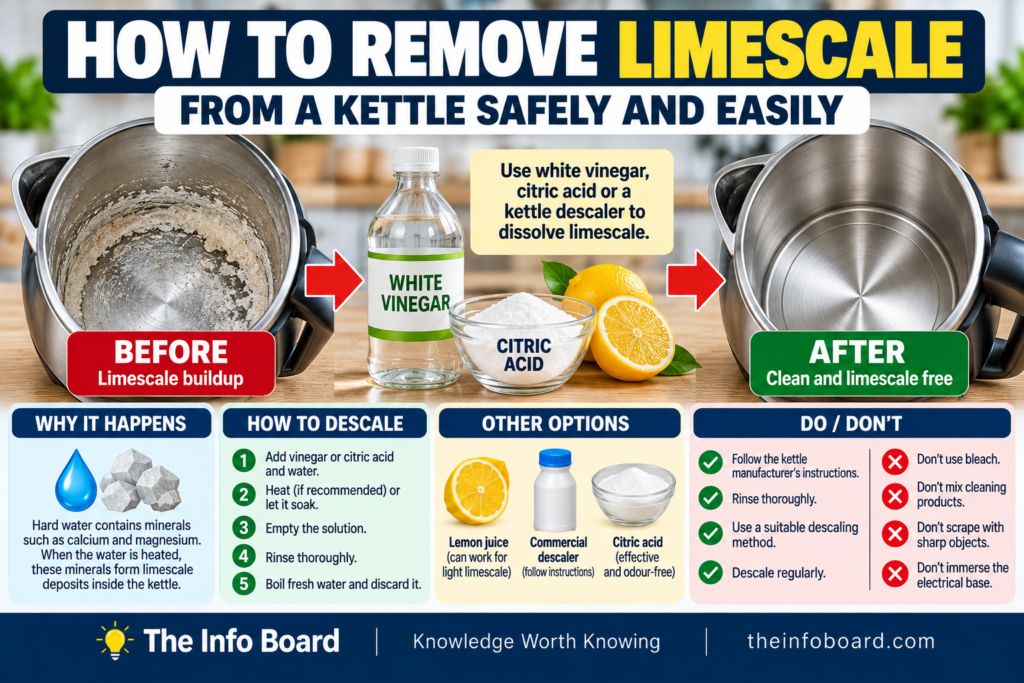
What Is Limescale?
Limescale is a hard mineral deposit that commonly forms when hard water is heated.
Hard water contains relatively high concentrations of dissolved minerals, particularly calcium and magnesium compounds.
These minerals aren’t normally visible while dissolved in the water.
But heating the water changes the chemistry.
Some dissolved compounds can form insoluble deposits, particularly calcium carbonate.
Over time, these deposits accumulate on surfaces inside appliances.
The result is the familiar:
white, grey or cream-colored crust known as limescale.
Why Does Limescale Build Up Inside a Kettle?
A kettle provides almost ideal conditions for limescale formation.
It repeatedly:
fills with hard water → heats the water → cools → fills again → reheats.
Each heating cycle can leave behind a tiny amount of mineral deposit.
One boil may make almost no noticeable difference.
Hundreds of boils can.
Eventually, a visible layer develops on the base, heating element or internal walls.
Is Limescale Dangerous?
The presence of ordinary limescale doesn’t automatically mean your kettle is unsafe.
Limescale is primarily a mineral deposit, not mould or dirt.
However, a heavy accumulation isn’t desirable.
It can:
- leave flakes in the water,
- affect the appearance of the kettle,
- make cleaning more difficult,
- build up around heating surfaces,
- and potentially reduce heating efficiency.
Regular descaling keeps the appliance cleaner and prevents deposits from becoming extremely thick.
Before You Start
First, check the manufacturer’s instructions for your kettle.
This is particularly important if you have:
- a kettle with unusual internal materials,
- a specialist temperature-controlled kettle,
- an expensive coffee or tea appliance,
- or a model with specific descaling requirements.
If the manufacturer recommends a particular descaling method or product, follow those instructions.
Never immerse the kettle’s electrical base, plug or electrical connections in water.
Method 1: How to Descale a Kettle With White Vinegar
White vinegar contains acetic acid, which can react with mineral deposits such as calcium carbonate.
That makes it useful for removing limescale.
Step 1 — Empty the Kettle
Pour away any remaining water.
If there are loose pieces of limescale inside, rinse them out.
Don’t aggressively scrape the heating element or interior with a knife or other sharp object.
You could damage the surface.
Step 2 — Add Vinegar and Water
If your kettle manufacturer permits vinegar cleaning, prepare a diluted solution of white vinegar and water.
A commonly used starting mixture is approximately equal parts vinegar and water.
You don’t necessarily need to fill the entire kettle.
Use enough solution to cover the affected areas while staying below the maximum-fill line.
Step 3 — Allow the Acid to Work
For light deposits, soaking may be sufficient.
For heavier deposits, some kettle instructions may permit gently heating or boiling the descaling solution.
However, check the manufacturer’s instructions before boiling vinegar in the appliance.
Vinegar produces a strong smell when heated, and not every manufacturer recommends exactly the same procedure.
Never leave the kettle unattended.
Step 4 — Let It Soak
After heating, if permitted, switch the kettle off and unplug it.
Allow the solution to sit while it works on the deposits.
You may notice the hard mineral layer beginning to loosen or dissolve.
Heavy limescale may require more time than a thin coating.
Step 5 — Empty the Kettle
Pour the vinegar solution away.
You may see pieces of loosened limescale coming out with it.
Avoid getting liquid onto electrical connections.
Step 6 — Rinse Thoroughly
Rinse the kettle several times with clean water.
This is important because vinegar has a strong taste and smell.
Step 7 — Boil Fresh Water
Fill the kettle with clean water to a safe level and boil it normally.
Discard that water.
If you can still smell or taste vinegar, rinse again and repeat with another batch of fresh water.
Once the kettle is thoroughly rinsed and no vinegar remains, it can return to normal use.
Method 2: How to Descale a Kettle With Citric Acid
Citric acid is another useful descaling agent.
It’s commonly sold as a powder and is also used in many commercial descaling products.
One advantage is that it doesn’t leave the strong vinegar smell.
Step 1 — Add Water
Fill the kettle with enough water to cover the limescale while remaining within its safe operating level.
Step 2 — Add Citric Acid
Follow the instructions provided with the citric-acid product or your kettle manufacturer.
The correct concentration can vary.
There’s little benefit in making an unnecessarily concentrated solution.
Step 3 — Allow It to React
Depending on the appliance instructions, the solution may be warmed or allowed to soak.
As with vinegar, check the kettle manufacturer’s guidance before heating any descaling solution.
Step 4 — Empty and Rinse
Pour away the solution and rinse the kettle thoroughly several times.
Step 5 — Boil Fresh Water
Boil a fresh kettle of water and discard it before making drinks.
This helps remove any remaining descaling solution.
Can You Use Lemon Juice?
Lemon juice contains citric acid, so it can sometimes help dissolve light mineral deposits.
However, it isn’t always the most practical descaler.
The concentration varies, and fresh lemon juice can contain:
- pulp,
- sugars,
- oils,
- and other organic material.
Pure citric-acid descaler or an approved commercial product is generally easier to measure and rinse clean.
For light limescale, lemon juice may work.
For a heavily scaled kettle, a purpose-made method is usually more predictable.
Why Does Vinegar Remove Limescale?
This is where the cleaning becomes chemistry.
A major component of limescale is often calcium carbonate.
Calcium carbonate doesn’t dissolve readily in ordinary water.
But acids react with carbonate compounds.
When an acid encounters calcium carbonate, the reaction produces more soluble substances along with water and carbon dioxide.
You may sometimes notice tiny bubbles during descaling.
Those bubbles can be carbon dioxide being released as the acid reacts with the carbonate deposit.
So vinegar isn’t simply “washing” the limescale away.
A chemical reaction is helping dissolve it.
Why Doesn’t Plain Water Remove It?
Limescale is difficult to remove with ordinary rinsing because the mineral deposit isn’t very soluble in plain water.
That’s why you can repeatedly boil and rinse a kettle while the white coating remains.
An appropriate mild acid changes the chemistry and helps convert the deposit into forms that are easier to remove.
Should You Scrape Limescale Off?
Avoid attacking the inside of your kettle with:
- knives,
- screwdrivers,
- metal scrapers,
- abrasive tools,
- or anything else likely to scratch it.
Scraping can damage:
- coatings,
- heating elements,
- seals,
- and internal surfaces.
Chemical descaling is generally preferable because it dissolves deposits rather than relying on force.
If a softened piece remains after descaling, follow the manufacturer’s cleaning instructions rather than aggressively scraping it.
Can You Use Baking Soda to Remove Limescale?
Baking soda is useful for many household cleaning jobs, but it isn’t the obvious choice for dissolving calcium-carbonate limescale.
Limescale responds well to acids.
Baking soda is alkaline.
It may help with certain residues or odours, but it doesn’t perform the same chemical role as vinegar or citric acid when dealing with mineral scale.
For descaling, use a method specifically intended for limescale.
Don’t Mix Cleaning Chemicals
This rule is important well beyond kettle cleaning:
Don’t casually mix household cleaning products.
Combining chemicals can produce unexpected reactions, irritating vapours or dangerous substances.
If you’re using a commercial descaler, follow its instructions.
Don’t add bleach, chlorine-based cleaner or another chemical because you think it will make the solution “stronger.”
More chemicals do not automatically mean better cleaning.
Never Put Bleach in Your Kettle
A kettle is a food-contact appliance used to prepare drinking water.
Bleach is not an appropriate routine kettle descaler.
Use a manufacturer-approved descaling method instead.
If you’ve accidentally introduced an unsuitable chemical into an appliance used for food or drink, consult the product manufacturer before using the appliance again.
What About Commercial Kettle Descalers?
Commercial descaling products can work very well.
Many contain acids specifically chosen to dissolve mineral deposits.
Their main advantage is that the concentration and instructions are designed for descaling.
If you use one:
read the label carefully
use the specified quantity
follow the stated contact time
rinse exactly as instructed
and
don’t mix it with another cleaning product.
Using twice as much doesn’t necessarily make it twice as effective.
How Often Should You Descale a Kettle?
There isn’t one schedule that works for everyone.
How quickly limescale develops depends largely on:
- local water hardness,
- how frequently you use the kettle,
- how much water you boil,
- and the kettle’s design.
In a hard-water area, visible deposits can develop relatively quickly.
In a soft-water area, buildup may be much slower.
Rather than relying only on a calendar, periodically look inside the kettle.
If a noticeable layer is developing, it’s probably time to descale.
What Is Hard Water?
Water naturally passes through rocks and soil before reaching homes.
During that journey, it can dissolve minerals.
Water containing relatively high levels of dissolved calcium and magnesium is described as hard water.
Hardness varies significantly between regions because local geology differs.
Areas with certain limestone and chalk geology commonly experience harder water.
Is Hard Water Bad for You?
Hard water and limescale shouldn’t automatically be treated as contamination.
The minerals associated with water hardness aren’t the same thing as harmful dirt building up in the kettle.
The practical problem is mainly what those minerals do to:
- kettles,
- heating elements,
- pipes,
- taps,
- shower screens,
- boilers,
- and other water-using equipment.
Limescale is therefore largely a maintenance problem.
Why Is Limescale Worse on Heating Elements?
Heating encourages mineral precipitation.
A heating element also creates a particularly hot surface.
This means deposits can accumulate directly where heat is being transferred into the water.
In kettles with exposed elements, the buildup can be particularly easy to see.
Modern flat-bottom kettles hide the heating element beneath the base, but scale can still accumulate on the heated surface.
Can Limescale Make a Kettle Less Efficient?
A heavy layer of scale can interfere with efficient heat transfer.
Mineral deposits act differently from the metal heating surface beneath them.
The appliance may need to transfer heat through the scale before efficiently heating the water.
The exact effect depends on the kettle and the amount of buildup, but preventing thick deposits is sensible for both cleanliness and appliance maintenance.
Why Are There White Flakes in My Kettle?
If you see small white or cream-colored flakes, they may be pieces of mineral scale that have broken away from the kettle’s interior.
This can happen naturally or after descaling begins loosening deposits.
Empty the kettle, rinse it and inspect the interior.
If you’re unsure whether the material is ordinary limescale — particularly if it looks unusual or appears to come from a deteriorating internal component — stop using the appliance and check with the manufacturer.
Why Does Limescale Keep Coming Back?
Because descaling removes the deposit, not the minerals from your incoming water supply.
If your tap water is hard, every new kettle of water introduces more dissolved minerals.
Heating that water repeatedly allows scale to begin accumulating again.
Descaling therefore isn’t usually a permanent treatment.
It’s routine maintenance.
Can You Prevent Limescale Completely?
If you continue using hard water, completely preventing mineral deposits can be difficult.
But you can reduce unnecessary buildup.
Don’t Leave Water Sitting in the Kettle for Long Periods
After use, you can empty excess water when practical rather than repeatedly reheating the same water.
Follow your appliance manufacturer’s care instructions.
Only Boil What You Need
This has two benefits.
You avoid unnecessarily heating a large volume of water, and you reduce the amount of water repeatedly passing through heating cycles.
Descale Before the Layer Becomes Thick
A thin deposit is generally easier to remove than months or years of hardened scale.
Regular light maintenance can be easier than occasional aggressive cleaning.
Does Filtered Water Stop Limescale?
It depends on the filtration system.
Not every water filter removes the minerals responsible for hardness.
Some filtration methods reduce certain hardness-related ions, while others mainly target:
- taste,
- odour,
- chlorine,
- particles,
- or other substances.
Don’t assume that “filtered” automatically means “softened.”
If preventing limescale is the goal, check what the particular filtration system actually removes.
What Is a Water Softener?
A traditional ion-exchange water softener reduces hardness by exchanging calcium and magnesium ions for other ions, commonly sodium.
This can dramatically reduce scale formation throughout a home.
However, installing and operating a water softener is a much bigger decision than simply descaling a kettle.
There can also be specific considerations regarding drinking-water supplies and installation.
For an ordinary kettle, regular descaling is often the simplest solution.
What About Kettles With Built-In Filters?
Some kettles include filters near the spout.
These can help stop loose particles from entering your cup.
But a mesh filter doesn’t necessarily prevent limescale from forming inside the kettle.
The dissolved minerals enter with the water before they become solid deposits.
The filter may catch some flakes later, but it doesn’t necessarily remove the underlying cause.
Don’t Forget the Spout Filter
If your kettle has a removable limescale filter, check the manufacturer’s instructions for cleaning it.
Mineral deposits can accumulate on the mesh.
Some filters can be:
- removed,
- soaked,
- rinsed,
- and replaced.
But designs vary, so don’t force the filter out if you aren’t sure it’s removable.
How to Clean the Outside of a Kettle
The exterior usually doesn’t need descaling in the same way as the interior.
First:
unplug the kettle and allow it to cool.
Then follow the manufacturer’s cleaning guidance.
A soft damp cloth is often sufficient for ordinary marks.
Avoid allowing water to enter:
- electrical connections,
- switches,
- the base,
- or other electrical components.
Never immerse an electric kettle or its powered base unless the manufacturer specifically states that a component is washable.
What If Limescale Is Extremely Thick?
If a kettle hasn’t been descaled for years, one treatment may not remove everything.
Don’t compensate by attacking the deposits with sharp tools or mixing stronger chemicals.
Instead, you may need to repeat an approved descaling treatment.
For severe deposits, follow the kettle manufacturer’s instructions or use an appropriate commercial descaler exactly as directed.
If the appliance itself is deteriorating, leaking or damaged, replacement may be safer than increasingly aggressive cleaning.
When Should You Replace the Kettle?
Limescale alone doesn’t necessarily mean you need a new kettle.
But stop using an electric kettle if you notice problems such as:
- electrical damage,
- a damaged power cord,
- leaking near electrical components,
- a malfunctioning switch,
- serious internal deterioration,
- damaged insulation,
- or another safety-related defect.
Descaling fixes mineral deposits.
It doesn’t repair electrical or structural damage.
A Simple Kettle-Descaling Routine
For most households, kettle maintenance doesn’t need to be complicated.
1. Inspect the inside periodically.
2. Descale when a noticeable deposit develops.
3. Use a manufacturer-approved method.
4. Choose an appropriate descaler such as vinegar, citric acid or a commercial product where permitted.
5. Allow the solution time to dissolve the mineral deposits.
6. Empty and rinse thoroughly.
7. Boil fresh water and discard it before making drinks.
8. Repeat later when scale begins returning.
That’s usually all that’s required.
Why Regular Cleaning Is Easier
Imagine a tiny layer of scale forming each week.
If you remove it periodically, the deposit remains relatively easy to manage.
Ignore it for a very long time and those layers accumulate into a much harder crust.
This is a common principle in household maintenance:
small, regular jobs often prevent much larger jobs later.
Your kettle is a perfect example.
The Bottom Line
Limescale forms when minerals present in hard water create solid deposits as the water is repeatedly heated.
In a kettle, those deposits commonly appear as a white, grey or cream-colored coating on the base, heating element or internal walls.
Fortunately, limescale can often be dissolved with an appropriate mild acid.
White vinegar, citric acid or a manufacturer-approved commercial descaler can all be suitable options depending on the kettle.
The key is to let chemistry do the work rather than aggressively scraping the appliance.
Check the manufacturer’s instructions, use an appropriate descaling solution, rinse thoroughly and never mix household cleaning chemicals.
And if you live in a hard-water area, don’t be surprised when the white coating eventually returns.
It doesn’t mean you cleaned the kettle incorrectly.
It simply means it’s time for another round of routine maintenance.
Frequently Asked Questions
What is the easiest way to remove limescale from a kettle?
An appropriate acidic descaling solution, such as diluted white vinegar, citric acid or a commercial kettle descaler, can dissolve mineral deposits. Always follow the kettle manufacturer’s instructions.
Can I use white vinegar to descale a kettle?
Many kettles can be descaled with diluted white vinegar, but check the manufacturer’s instructions first. Rinse the kettle thoroughly afterward and boil fresh water before using it for drinks.
Why does vinegar remove limescale?
Vinegar contains acetic acid, which reacts with carbonate mineral deposits such as calcium carbonate and helps dissolve them.
Can I use baking soda instead?
Baking soda is useful for many cleaning tasks, but acids such as vinegar or citric acid are generally more appropriate for dissolving calcium-carbonate limescale.
Is limescale harmful?
Ordinary limescale is primarily a mineral deposit associated with hard water. However, heavy buildup can affect appliance cleanliness and performance.
How often should I descale my kettle?
It depends on your water hardness and how frequently the kettle is used. Inspect it periodically and descale when a noticeable deposit develops.
Why does my kettle get limescale so quickly?
You probably have relatively hard water, use the kettle frequently, or both. Hard water contains higher levels of minerals that can form scale when heated.
Leave a Comment