Inflation does more than increase prices. It changes how far your wages, savings and household budget can stretch.
Suppose your monthly household spending rises from £1,500 to £1,575 while your income stays the same. You now need an extra £75 each month to buy the same collection of goods and services. Over a year, that would mean £900 in additional spending, assuming those monthly costs stay unchanged.
This is the practical meaning of losing purchasing power. Even when the amount in your bank account hasn’t changed, rising prices can reduce what that money can buy.
This guide explains how inflation affects everyday spending, wages, savings and debt, why your personal cost of living may differ from official inflation figures, and how to understand those changes when planning your finances.
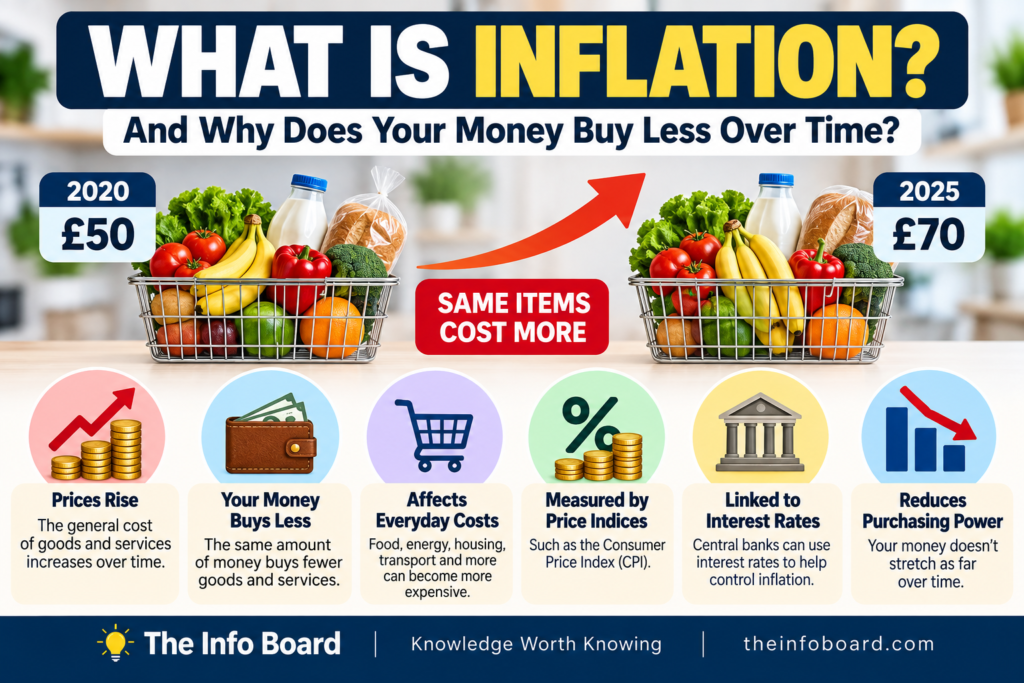
What Is Inflation?
Inflation describes a broad increase in the general level of prices across an economy over time.
The word broad is important.
If the price of one particular product increases, that alone doesn’t necessarily mean the economy is experiencing inflation.
For example, poor weather might cause the price of a particular fruit to rise temporarily.
Inflation refers to price increases occurring across a much wider range of goods and services.
These might include:
- food,
- housing costs,
- transport,
- clothing,
- energy,
- entertainment,
- and services.
When the overall price level rises, each unit of currency generally buys fewer goods and services than before.
Inflation Reduces Purchasing Power
Purchasing power means how much your money can buy.
Imagine you have £100.
At today’s prices, perhaps £100 buys a particular collection of groceries, household products and other items.
If the prices of those items increase while you still have £100, you won’t be able to buy exactly the same amount.
Your bank balance hasn’t changed.
The number printed on the money hasn’t changed.
But its purchasing power has fallen.
This is one of the most important concepts for understanding inflation.
A Simple Inflation Example
Suppose an item costs:
£100 today
If its price rises by 5%, it would cost:
£105
You would now need an additional £5 to buy exactly the same item.
Now imagine similar price increases occurring across many everyday goods and services.
That’s why inflation can affect household budgets even when people’s lifestyles haven’t changed.
How Is Inflation Measured?
Governments and statistical agencies generally monitor the prices of a large selection of goods and services.
Rather than looking at only one product, they construct a representative basket of things households commonly purchase.
This basket can contain categories such as:
- groceries,
- clothing,
- transport,
- household goods,
- recreation,
- communication,
- restaurants,
- and other services.
Changes in these prices are used to calculate price indices.
The exact methodology and index vary by country.
What Is the Consumer Price Index?
One commonly used measure is the Consumer Price Index, usually abbreviated to CPI.
The CPI tracks changes in consumer prices using a representative collection of goods and services.
If the index rises, it indicates that the overall price level represented by the basket has increased.
Inflation is often reported as a percentage change over a particular period, commonly compared with the same period one year earlier.
What Does a 3% Inflation Rate Actually Mean?
Suppose annual inflation is reported as 3%.
That doesn’t mean every product increased in price by exactly 3%.
Some prices may have:
- increased much more,
- increased less,
- stayed approximately the same,
- or even fallen.
The inflation rate summarises the overall movement in the measured basket.
Your personal experience can therefore feel very different from the headline inflation number.
Why Your Personal Inflation Rate Can Feel Higher
Imagine that food and energy prices rise sharply.
A household that spends a large proportion of its income on food and heating may feel those increases strongly.
Another household may spend money differently and experience a smaller impact.
This means there isn’t necessarily one inflation experience shared equally by every person.
The official measure represents a broad population.
Your own spending pattern determines how strongly particular price increases affect you.
How to Estimate Your Own Household Cost Increase
One practical way to understand rising living costs is to compare the cost of buying the same goods and services at two different points in time.
Imagine a household has the following monthly expenses:
| Expense | Earlier cost | New cost |
|---|---|---|
| Groceries | £320 | £352 |
| Energy | £120 | £144 |
| Transport | £100 | £104 |
| Total | £540 | £600 |
In this hypothetical example, the same collection of goods and services has become £60 more expensive.
To calculate the percentage increase:
(£600 − £540) ÷ £540 × 100 = 11.1% approximately
That household’s selected expenses have increased by around 11.1%.
You can try this with your own figures:
- Choose a few regular spending categories.
- Find what the same goods or services cost previously.
- Compare those prices with their current cost.
- Divide the difference by the original total and multiply by 100.
For a meaningful comparison, try to keep the quantities and types of goods or services consistent. A higher electricity bill caused by using more electricity, for example, isn’t necessarily evidence that electricity prices have risen.
This calculation is a personal spending illustration, not an official inflation statistic. The UK’s published inflation measures use a much broader range of prices and statistical methods.
Why Does Inflation Happen?
Inflation can result from several forces working together. Prices may rise when demand grows faster than supply, when businesses face higher production costs, or when disruptions make essential goods harder to obtain.
For example, higher energy costs can affect food production, manufacturing and transport. Those costs may eventually be passed on to households.
Expectations also matter. If businesses and workers anticipate continuing price increases, their decisions about prices and wages can influence inflation.
For a more detailed explanation of these causes, read our guide to why prices go up.
The practical result for households is that everyday spending may increase faster than income, reducing purchasing power.
What Do Interest Rates Have to Do With Inflation?
Central banks can use interest rates as one tool for influencing economic activity and inflation.
When interest rates rise, borrowing generally becomes more expensive.
This can affect:
- mortgages,
- business loans,
- consumer borrowing,
- investment,
- and spending decisions.
Higher rates can encourage some people to save more and borrow or spend less.
Reduced demand can help ease inflationary pressure.
However, monetary policy doesn’t work instantly.
Changes in interest rates can take time to affect the wider economy.
Why Not Simply Raise Interest Rates Until Inflation Disappears?
Because higher interest rates have consequences.
They can increase borrowing costs for households and businesses.
Very restrictive monetary policy can reduce investment, weaken economic activity and potentially contribute to unemployment.
Central banks therefore face a balancing act.
The objective isn’t normally to crush economic activity at any cost.
It’s to maintain price stability while considering broader economic conditions.
Is All Inflation Bad?
Not necessarily.
Many modern central banks aim for low and relatively stable positive inflation, rather than zero inflation forever.
Why?
Because predictable, modest inflation can be easier for an economy to manage than rapid inflation or persistent deflation.
The biggest problems often arise when inflation becomes:
very high, unpredictable or persistent.
Uncertainty makes financial planning more difficult for households and businesses.
Read:What Is an Overdraft and How Does It Actually Work?
What Is Hyperinflation?
Hyperinflation is an extreme situation in which prices rise extraordinarily rapidly.
Money can lose purchasing power at a dramatic rate.
Under severe hyperinflation, prices may change so quickly that ordinary economic activities become extremely difficult.
People may try to spend money quickly because holding it means watching its purchasing power disappear.
Hyperinflation is very different from the relatively modest inflation rates experienced in many normal economic periods.
What Is Deflation?
Deflation is a sustained decline in the general price level.
At first, that may sound wonderful.
Who wouldn’t want things to become cheaper?
But persistent economy-wide deflation can create serious problems.
If consumers expect prices to keep falling, they may postpone purchases.
Why buy something for £1,000 today if you expect it to cost £900 later?
If many people delay spending, businesses may receive less revenue.
They may respond by reducing:
- investment,
- production,
- wages,
- or employment.
Deflation can also increase the real burden of debt, because the amount owed doesn’t automatically fall simply because prices and incomes decline.
Inflation and Your Savings
Inflation matters even if you aren’t buying something immediately.
Suppose you keep £10,000 in cash for many years.
The number remains £10,000.
But if prices rise substantially over that period, the amount of goods and services that £10,000 can purchase declines.
This is why long-term financial planning needs to consider real purchasing power, not merely the number shown in an account.
Nominal Value vs Real Value
Economists often distinguish between nominal and real values.
A nominal amount is the amount expressed in current money.
A real amount adjusts for changes in purchasing power.
Suppose your salary rises by 3%.
That sounds like an improvement.
But if prices rise by 5% during the same period, your salary may buy less overall despite the higher number on your payslip.
Your nominal income increased, but your real purchasing power decreased.
A Simple Wage Example
Imagine your salary is:
£30,000
You receive a 4% pay rise.
Your new salary becomes:
£31,200
But suppose prices across the economy have increased by approximately 6%.
Your income is higher in pounds.
However, your purchasing power hasn’t necessarily kept pace with prices.
This is why discussions about wages often distinguish between:
nominal wage growth
and
real wage growth.
Inflation and Debt
Inflation can affect borrowers differently depending on the type of debt.
With fixed-rate borrowing, the required nominal payments may remain unchanged while prices and potentially wages rise.
In some circumstances, this can reduce the real value of future repayments.
But that’s only part of the story.
Inflation can also lead to higher interest rates, which can make new borrowing or variable-rate debt more expensive.
So saying “inflation is good for borrowers” is far too simplistic.
The effect depends on the loan structure, interest rate, income and wider economic environment.
Inflation and Mortgages
Mortgages illustrate this complexity particularly well.
A borrower with a long-term fixed rate may temporarily be protected from immediate interest-rate increases.
Someone with a variable rate may experience higher payments much sooner.
A borrower whose fixed-rate deal expires during a period of higher market rates may also face a substantial increase when refinancing.
Inflation therefore doesn’t affect every mortgage holder in the same way.
Why Food Prices Can Feel Especially Important
People notice certain prices more than others.
Food is purchased frequently.
If your weekly grocery bill increases from £70 to £85, you’re reminded of the change every time you shop.
By contrast, you may purchase a new television only once every several years.
Even if television prices fall, that reduction may not feel as important as repeated increases in everyday essentials.
Frequency matters to how we experience inflation.
Why Energy Prices Can Affect Almost Everything
Energy is an input into much of the economy.
It’s used to:
- manufacture products,
- heat buildings,
- power shops,
- operate data centres,
- transport goods,
- refrigerate food,
- and run machinery.
A large increase in energy costs can therefore affect far more than household electricity and gas bills.
Those higher costs can work their way into the prices of other goods and services.
Does Printing Money Cause Inflation?
You’ll sometimes hear the claim:
“Printing money always causes inflation.”
The reality is more complicated.
Changes in the money supply can influence inflation, but the outcome depends on many factors, including:
- demand,
- economic capacity,
- lending,
- spending behaviour,
- monetary policy,
- expectations,
- and the condition of the economy.
Simply observing that the money supply increased doesn’t tell you exactly what the inflation rate will be.
Economic relationships are rarely explained by one variable alone.
Why Can’t Governments Just Set Lower Prices?
Governments can regulate certain prices in particular circumstances, but simply ordering all prices to remain low doesn’t eliminate the underlying forces creating shortages or higher production costs.
Imagine a product costs £10 to produce but sellers are legally required to sell it for £8.
Businesses may reduce production or stop supplying it.
That can create shortages.
Price controls can have legitimate uses in specific policies, but they’re not a simple universal switch for eliminating inflation.
Why Doesn’t Everyone Just Get a Pay Rise?
If every worker’s income rose whenever prices increased, it might seem as though inflation wouldn’t matter.
But wages are themselves a cost to businesses.
If labour costs rise substantially, companies may respond through some combination of:
- higher prices,
- lower profits,
- reduced hiring,
- productivity improvements,
- automation,
- or reduced costs elsewhere.
Wages and prices interact with the broader economy.
There isn’t a mechanism that guarantees everyone’s income automatically rises exactly in line with their personal cost of living.
What Is the Cost of Living?
Inflation and the cost of living are related, but they aren’t identical concepts.
Inflation measures changes in overall price levels using a particular methodology.
The cost of living refers more broadly to how much money is required to maintain a certain standard of living.
Two households can face different costs of living because they may have very different:
- housing costs,
- transport requirements,
- family sizes,
- childcare expenses,
- energy usage,
- and locations.
This is why an inflation statistic can’t perfectly describe every household’s financial situation.
Can Some Prices Fall During Inflation?
Yes.
Inflation doesn’t mean every single price is rising.
Suppose during a particular year:
- restaurant prices rise,
- electricity prices rise,
- rent rises,
- some food prices rise,
- but the price of certain electronics falls.
The overall price level can still increase.
Inflation measures the combined movement of many prices.
Individual products can move in completely different directions.
What Does “Inflation Is Falling” Mean?
This phrase causes a lot of confusion.
Suppose inflation falls from:
8% to 4%.
That doesn’t necessarily mean prices have fallen.
It generally means prices are still increasing, but at a slower rate.
Think of a car.
If it slows from 80 mph to 40 mph, it’s still moving forward.
Likewise, if inflation drops from 8% to 4%, the overall price level can still be rising.
For prices themselves to decline broadly, you would need deflation rather than merely lower inflation.
A Simple Example
Imagine something costs £100.
After 8% inflation, it becomes:
£108
If inflation then falls to 4% the following year, the price doesn’t automatically return to £100.
A further 4% increase would take £108 to approximately:
£112.32
Inflation fell dramatically.
But the price still increased.
This distinction is essential when interpreting economic news.
Why Inflation Compounds Over Time
Price increases can build on previous price increases.
Suppose something costs £100 and its price increases by 3% each year.
After the first year:
£103
After the second year, another 3% is applied to £103, not the original £100.
That becomes approximately:
£106.09
After many years, the cumulative difference becomes much larger.
This is why even relatively modest annual inflation can significantly affect purchasing power over long periods.
Inflation Is One Reason Long-Term Planning Matters
Suppose you’re planning for an expense 20 years from now.
Using today’s price without considering future inflation could substantially underestimate how much money will eventually be required.
This is relevant to:
- retirement planning,
- education costs,
- long-term savings,
- insurance,
- and other future financial goals.
The further into the future you look, the more important the distinction between today’s money and future purchasing power becomes.
Can You Protect Yourself Completely From Inflation?
There is no universal strategy that guarantees complete protection against inflation without introducing other risks or trade-offs.
Different assets, savings products and investments behave differently under different economic conditions.
Be cautious of anyone promising a supposedly risk-free investment that always beats inflation.
Instead, understanding inflation should be part of broader financial planning.
The appropriate approach depends on factors including:
- when you’ll need the money,
- your tolerance for risk,
- your financial goals,
- and your personal circumstances.
What Can Households Do When Prices Rise?
You can’t personally control the national inflation rate.
But you can control parts of your household finances.
Useful steps may include:
Review your budget.
Identify which categories have increased most.
Compare recurring costs.
Insurance, utilities, subscriptions and other regular expenses deserve periodic review.
Prioritise essential spending.
Separate needs from lower-priority purchases when finances become tighter.
Avoid assuming all prices increased equally.
Comparing alternatives can still save money.
Protect your emergency savings.
Rising costs can make unexpected expenses harder to absorb.
Most importantly, respond to your actual household expenses, not just the headline inflation number.
Read:What Is Compound Interest and How Does It Actually Work?
Why Inflation Matters Even After It Falls
Suppose there has been a period of unusually high inflation.
Later, inflation returns to a lower level.
People may reasonably ask:
“If inflation is back down, why does everything still feel expensive?”
Because lower inflation doesn’t automatically reverse previous price increases.
If the general price level rose significantly during the high-inflation period, slower inflation means that prices are now increasing more slowly from that already higher starting point.
That’s why the effects of a high-inflation period can remain noticeable long after the inflation rate itself declines.
The Bottom Line
Inflation is a broad increase in the general price level over time.
As prices rise, the purchasing power of money falls — meaning the same amount of money buys fewer goods and services.
Inflation can result from several forces, including:
strong demand, rising production costs, supply disruptions and changing expectations.
Central banks may use interest rates to influence inflation, but monetary policy involves trade-offs and doesn’t work instantly.
Most importantly, remember the distinction between prices and the inflation rate.
When inflation falls, prices don’t necessarily fall.
They may simply be rising more slowly.
Understanding that one concept makes economic headlines much easier to interpret — and helps explain why £100 today may not buy nearly as much as £100 did years ago.
Frequently Asked Questions
What is inflation in simple terms?
Inflation is a broad rise in prices over time. As prices increase, the same amount of money generally buys fewer goods and services.
Why does inflation happen?
Inflation can have several causes, including strong demand, rising production costs, supply shortages and changes in economic expectations.
Does lower inflation mean prices are falling?
No. Lower inflation usually means prices are increasing more slowly. Falling overall prices are known as deflation.
Why does inflation reduce the value of savings?
If your savings don’t grow as quickly as prices, their purchasing power declines. The amount of money may remain the same while the goods and services it can buy become more expensive.
Is inflation always bad?
Not necessarily. Low and relatively stable inflation is common in modern economies. Rapid, unpredictable or persistent inflation tends to create greater economic problems.
What is deflation?
Deflation is a sustained decline in the general price level. Although cheaper prices may sound attractive, prolonged deflation can create problems for spending, employment, business investment and debt.
Why can my cost of living rise faster than official inflation?
Your spending pattern may differ from the representative basket used to calculate an inflation index. If the things you buy most frequently rise faster than average, your personal experience may feel worse.