Touch a metal door handle and a wooden door at the same time on a cold morning.
The metal usually feels much colder.
That seems perfectly logical — until you measure their temperatures
If both objects have been sitting in the same room long enough, they may actually be at almost exactly the same temperature.
So why does one feel colder?
The answer isn’t mainly about the temperature of the objects. It’s about how quickly heat moves between your hand and the material you’re touching.
Metal conducts heat much more effectively than wood. When you touch it, heat leaves your skin rapidly, creating a stronger sensation of cold.
This simple experience reveals something important:
Your sense of temperature measures heat transfer, not temperature alone.
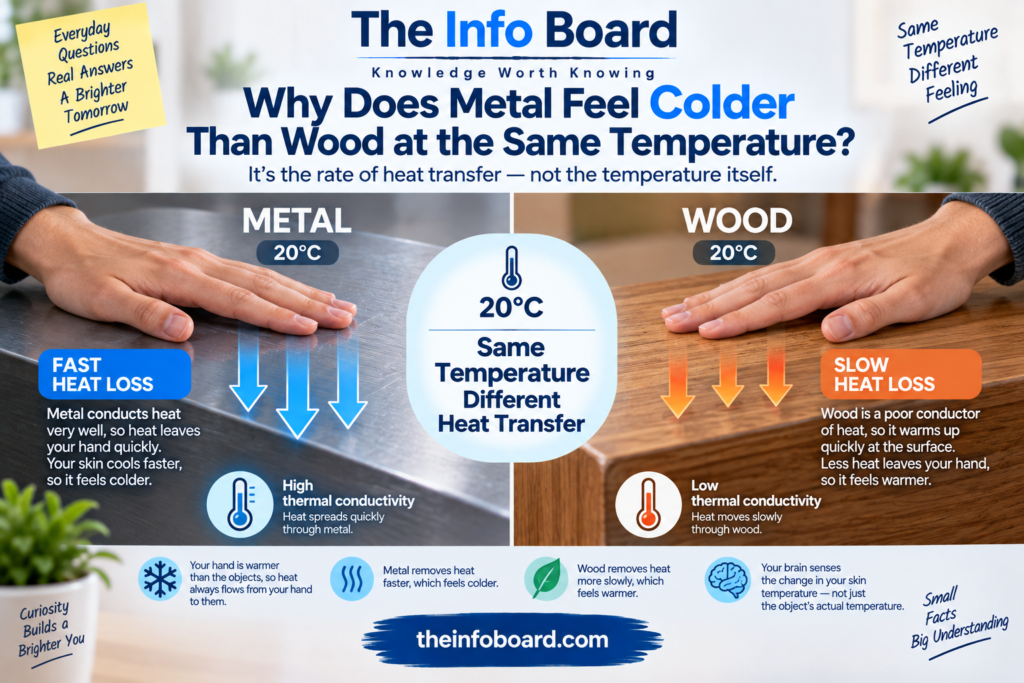
Are the Metal and Wood Really the Same Temperature?
If a metal object and a wooden object remain in the same stable room for long enough, both tend toward the temperature of their surroundings.
Suppose the room is around 20°C.
Eventually, the wooden table, metal spoon and glass cup may all be close to 20°C.
Yet touching them can produce very different sensations.
The metal spoon feels cool.
The wooden table may feel relatively neutral or even slightly warm.
The difference is caused largely by their thermal properties, not a large difference in their actual temperatures.
Why Does Your Hand Matter?
Your skin is normally warmer than most objects in an ordinary indoor room.
When your hand touches an object that is cooler than your skin, thermal energy begins moving from the warmer material — your hand — toward the cooler material.
Your temperature receptors respond to the resulting changes in your skin.
If heat leaves your skin quickly, your nervous system produces a stronger sensation of cold.
If heat leaves slowly, the object doesn’t feel nearly as cold.
So your brain isn’t acting like a laboratory thermometer.
It is interpreting what is happening to your skin.
What Is Thermal Conductivity?
Thermal conductivity describes how effectively a material conducts heat.
Materials with high thermal conductivity transfer thermal energy relatively efficiently.
Materials with low thermal conductivity resist heat transfer more strongly.
Metals generally have relatively high thermal conductivity.
Wood has much lower thermal conductivity.
This difference explains much of what you feel when touching them.
Why Is Metal Such a Good Conductor?
Metals have a structure that allows thermal energy to move through them efficiently.
One important reason involves their mobile conduction electrons.
These electrons can transport energy through the metal, helping heat spread rapidly.
The atomic lattice also participates in thermal-energy transfer.
The result is that many metals conduct heat far more effectively than materials such as wood, plastic or foam.
This property is useful in many applications — from cookware to radiators and heat sinks.
But it is also why a metal surface can feel surprisingly cold.
What Happens When You Touch Cold Metal?
Imagine your hand is warmer than a metal railing.
The moment you touch it, energy begins flowing from your skin into the metal.
Because the metal conducts heat effectively, energy entering the contact area can quickly spread into the surrounding material.
The surface touching your hand therefore doesn’t warm as quickly.
Heat continues leaving your skin relatively rapidly.
Your temperature receptors detect this cooling.
Your brain interprets the rapid heat loss as:
“Cold.”
What Happens When You Touch Wood?
Now touch wood at the same temperature.
Heat still moves from your warmer hand into the cooler wood.
But wood is a poor thermal conductor compared with metal.
The small area of wood directly beneath your hand warms relatively quickly, while heat moves away from that area much more slowly.
This reduces the rate at which your hand continues losing heat.
The wood therefore feels warmer than the metal even though both objects may have started at the same temperature.
Does This Mean Metal Is Actually Colder?
Not necessarily.
That’s the key point.
Feeling colder and being at a lower temperature are not the same thing.
A metal spoon and wooden spoon left in the same room overnight may reach nearly the same temperature.
But the metal spoon can still feel significantly colder because it removes heat from your skin faster.
Your senses are responding to heat flow.
A thermometer measures temperature more directly.
Why Does Tile Feel Colder Than Carpet?
Exactly the same principle helps explain another familiar experience.
Walk barefoot across a tiled floor and then onto a carpet.
The tile often feels cold.
The carpet feels warmer.
Yet both may have been in the same room all night.
Tile transfers heat away from your feet more efficiently than carpet.
Carpet contains fibres and trapped air that provide thermal insulation.
Heat leaves your feet much more slowly.
That’s why carpet can feel comfortably warm even without actually being warmer.
Read: Why Do Windows Fog Up? Understanding Condensation in Your Home
Why Is Trapped Air Such a Good Insulator?
Air has relatively low thermal conductivity when it isn’t moving freely.
Materials that trap many small pockets of air can therefore slow heat transfer.
This is why insulation often contains structures designed to trap air.
Examples include:
wool, foam, fibreglass, feathers and many fabrics.
Wood itself also contains a complex structure that makes it much less thermally conductive than typical metals.
The principle of trapping air is enormously important in insulation.
Is This Why Winter Clothes Keep Us Warm?
Yes, in large part.
A winter coat doesn’t normally generate significant heat.
Your body generates heat through metabolism.
The coat helps slow the rate at which that heat escapes to the environment.
Layers of fabric trap air and reduce heat transfer.
Down jackets are particularly effective because their structure creates many small pockets of trapped air.
So clothing keeps you warm primarily by reducing heat loss rather than producing warmth.
Why Do Metal Benches Feel So Cold in Winter?
Outdoor metal can become genuinely cold when the surrounding environment is cold.
But metal also transfers heat efficiently.
When you sit on or touch a cold metal bench, your body can lose heat rapidly into the material.
That combination makes metal particularly uncomfortable in winter:
low temperature + high thermal conductivity.
Wooden benches at the same outdoor temperature may still feel less severe because heat transfer is slower.
Why Can Metal Feel Hotter in Summer?
The same property works in the opposite direction.
Suppose a metal surface has been heated by sunlight until it becomes hotter than your skin.
Now heat flows from the metal into your hand.
Because metal conducts heat effectively, energy can enter your skin rapidly.
The surface feels intensely hot.
So metal can feel exceptionally cold when it is colder than your skin and exceptionally hot when it is hotter.
Its thermal conductivity increases the rate of energy transfer in either direction.
Why Are Frying Pans Made From Metal?
Cooking provides a useful example of why high thermal conductivity can be desirable.
A frying pan needs to transfer thermal energy from the stove to the food.
Metal is well suited to this job because it conducts heat efficiently.
Different metals have different thermal properties, which is one reason cookware can behave differently depending on its construction.
But there is an obvious problem.
If the whole pan were simply exposed conductive metal, the handle could become dangerously hot.
That’s why handles are often made from or covered with materials that conduct heat less effectively.
Why Are Saucepan Handles Often Plastic or Wood?
The pan needs to conduct heat.
The handle generally should not.
Plastic, wood and certain other materials are relatively poor thermal conductors compared with metal.
They slow the transfer of heat from the hot pan toward your hand.
That doesn’t mean such handles can never become hot.
Given sufficient temperature and time, they can still heat up.
But their lower thermal conductivity makes them much more practical for handling cookware.
Why Are Oven Gloves Thick?
Oven gloves work by putting insulating material between your skin and a hot object.
The glove slows the transfer of heat into your hand.
Thickness helps because heat must travel through more insulating material.
Many oven gloves also contain fibres that trap air.
But insulation has limits.
If you hold a hot tray for long enough, heat can eventually travel through the glove.
And a wet oven glove can be much less protective because water changes the heat-transfer behaviour.
Why Does Water Feel Colder Than Air at the Same Temperature?
Thermal conductivity isn’t the only factor involved in how cold something feels.
Water can remove heat from your body far more effectively than still air under comparable conditions.
That’s why water at a temperature that would feel comfortable as air can feel surprisingly cold when you are immersed in it.
Heat transfer also depends on factors including:
convection, movement, contact, temperature difference and the thermal properties of the surrounding material.
This is why falling into cold water is much more serious than simply standing outdoors in air at the same temperature.
What Is Thermal Effusivity?
For a more precise explanation of the immediate sensation when two materials touch, scientists and engineers sometimes consider a property called thermal effusivity.
Thermal effusivity describes how readily a material exchanges heat with its surroundings during contact.
It depends on more than thermal conductivity alone.
It also involves the material’s density and specific heat capacity.
This helps explain why the initial temperature at the contact surface depends on the properties of both your skin and the object.
For everyday understanding, however, the main lesson remains straightforward:
metal generally draws heat from your hand much faster than wood does.
Does Surface Texture Matter?
Yes.
Real-world temperature sensation isn’t determined by one material property alone.
Surface texture changes the amount and quality of contact between your skin and an object.
A smooth surface may contact your skin differently from a rough or porous surface.
Moisture, pressure, surface coatings and the thickness of the material can also affect heat transfer.
This is why two objects made from similar materials may not feel exactly alike.
Does the Size of the Object Matter?
It can.
Imagine touching a tiny metal object and a massive metal block at the same initial temperature.
The small object may warm noticeably from the heat transferred by your hand.
A large metal object has much greater thermal mass and may remain close to its original temperature for longer.
As a result, the large object may continue drawing heat from your hand more effectively.
So both material properties and the amount of material matter.
Why Does Aluminium Foil Warm Up So Quickly?
This seems contradictory.
Aluminium is a good thermal conductor, yet thin aluminium foil can quickly feel warm when you hold it.
The reason is its tiny mass.
There simply isn’t much material there.
Your hand transfers enough energy to change the foil’s temperature relatively quickly.
A thick aluminium block behaves very differently because much more energy is required to significantly change its temperature.
So high conductivity doesn’t mean an object must remain cold.
Why Does a Metal Bed Frame Feel Colder Than a Mattress?
Again, the materials exchange heat with your body at very different rates.
The metal frame conducts heat away rapidly.
A mattress contains foams, fibres and trapped air that slow heat transfer.
The mattress therefore feels much warmer.
This is also why bedding can become warm around your body.
The material helps retain heat close to your skin rather than continuously carrying it away.
Can Your Sense of Temperature Be Misleading?
Very much so.
Your temperature receptors are excellent biological warning systems, but they aren’t precision thermometers.
They help your nervous system detect potentially important changes in skin temperature.
This means two objects at identical temperatures can feel different.
It also means an object can stop feeling as cold after you’ve held it for a while because the temperatures at the contact area have changed.
For an accurate temperature measurement, use an appropriate thermometer rather than your hand.
A Simple Experiment You Can Try
Find three objects that have been in the same room for several hours:
a metal spoon, a wooden object and a plastic object.
Touch each one.
The metal will probably feel coldest.
Now measure them with an appropriate thermometer if you have one.
Their temperatures may be surprisingly similar.
Your hand detects a dramatic difference because the materials transfer heat at different rates.
It’s a simple demonstration of thermal physics using ordinary household objects.
Why Does This Matter Beyond Curiosity?
Understanding heat transfer explains many everyday design decisions.
It helps explain why:
- buildings use insulation,
- cooking pans are metal,
- pan handles use insulating materials,
- winter coats trap air,
- electronics use metal heat sinks,
- carpet feels warmer than tile,
- and metal furniture can be uncomfortable in extreme weather.
The same basic principles appear in engineering, construction, electronics, cooking and clothing.
A cold-feeling spoon is actually a small demonstration of a much larger branch of physics.
Read:Why Does a Mirror Fog Up After a Shower?
The Bottom Line
Metal often feels colder than wood even when both are at the same temperature because metal transfers heat much more efficiently.
Your hand is usually warmer than the objects around you.
When you touch metal, heat moves rapidly from your skin into the metal and spreads through it.
Your skin cools quickly, so your brain interprets the sensation as cold.
Wood conducts heat much less effectively.
The surface touching your hand warms relatively quickly, slowing further heat loss.
That’s why it feels warmer.
So when a metal object feels colder than a wooden one, your hand isn’t necessarily telling you:
“This object has a lower temperature.”
It’s telling you something slightly different:
“I’m losing heat faster.”
And that distinction explains everything from cold bathroom tiles to saucepan handles and winter coats.
Frequently Asked Questions
Why does metal feel colder than wood?
Metal generally conducts heat much better than wood, so it removes heat from your warmer skin more rapidly. Your temperature receptors interpret that rapid heat loss as a stronger sensation of cold.
Can metal and wood really be the same temperature?
Yes. If they’ve remained in the same stable environment long enough, they can be at nearly the same temperature while still feeling very different to your hand.
Why does tile feel colder than carpet?
Tile transfers heat away from your feet more efficiently, while carpet and the air trapped within it provide insulation.
Why does metal also feel hotter in the sun?
When metal is hotter than your skin, its high thermal conductivity helps transfer heat rapidly into your skin instead of away from it.
Why are pan handles made from plastic or wood?
These materials generally conduct heat less effectively than metal, reducing the rate at which heat reaches your hand.
Does touching something tell you its exact temperature?
No. Your skin primarily responds to changes and rates of heat transfer. An appropriate thermometer provides a more reliable temperature measurement.
Why does aluminium foil not feel cold for long?
Although aluminium conducts heat well, foil has very little mass, so heat from your hand can raise its temperature quickly.