You’re eating dinner, talking with friends or sitting quietly when suddenly:
Hic.
A few seconds later:
Hic.
Hiccups can appear with almost no warning. Most disappear within a few minutes, but while they’re happening they can be surprisingly annoying.
People have invented countless remedies — holding your breath, drinking water, swallowing sugar and even deliberately frightening someone.
But what is actually happening inside your body when you hiccup?
The answer starts with a muscle you use thousands of times every day without thinking about it: the diaphragm.
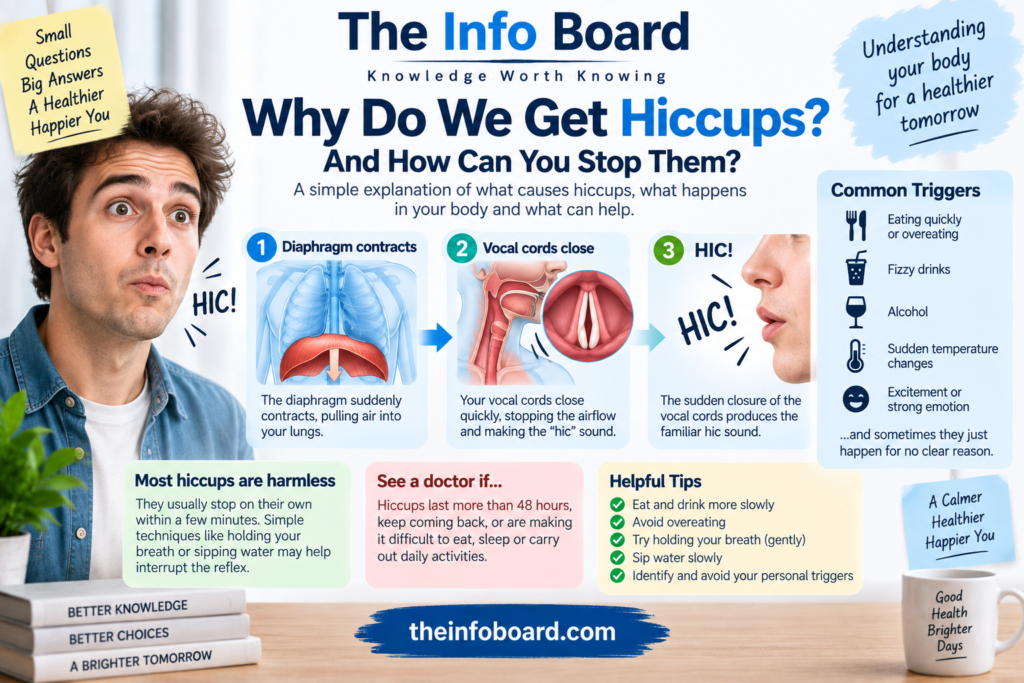
What Is a Hiccup?
A hiccup is an involuntary reflex involving a sudden contraction of the diaphragm and other breathing muscles, followed by rapid closure of the vocal cords.
That closure produces the familiar “hic” sound.
You aren’t consciously telling your body to hiccup.
Once the reflex begins, it can repeat every few seconds until the episode stops.
What Is the Diaphragm?
The diaphragm is a large, dome-shaped muscle underneath your lungs.
It separates your chest cavity from your abdominal cavity and plays a major role in breathing.
When you inhale, your diaphragm contracts and moves downward.
This helps increase the space inside your chest, allowing your lungs to expand and draw air in.
When you exhale normally, the diaphragm relaxes and moves upward again.
Most of the time, this process happens so smoothly that you don’t notice it.
What Happens During a Hiccup?
During a hiccup, the breathing muscles suddenly contract involuntarily.
Air begins moving inward.
Almost immediately afterward, the opening between the vocal cords closes.
That interruption of airflow produces the characteristic sound.
So a hiccup isn’t simply “air trapped in your stomach.”
It is a reflex involving your breathing system and nervous system.
Why Do Hiccups Start?
For ordinary short-lived hiccups, there isn’t always one identifiable cause.
However, certain behaviours are commonly associated with triggering them.
These can include:
eating quickly, eating a large meal, drinking carbonated drinks, drinking alcohol, sudden temperature changes, excitement or strong emotion.
The exact trigger varies from person to person.
Sometimes hiccups simply begin without an obvious explanation.
Why Can Eating Too Quickly Trigger Hiccups?
Eating rapidly can cause you to swallow additional air and can quickly distend the stomach.
A full or expanded stomach sits close to the diaphragm.
That may contribute to irritation or stimulation of the hiccup reflex.
Slowing down while eating isn’t guaranteed to prevent every episode, but it can reduce some of the conditions associated with hiccups.
Why Do Fizzy Drinks Sometimes Cause Hiccups?
Carbonated drinks contain dissolved carbon dioxide.
When you drink them, gas can be released inside the digestive system.
That can contribute to stomach distension and belching.
Because the stomach lies close to the diaphragm, rapid expansion may help trigger hiccups in susceptible people.
This doesn’t mean everyone will hiccup after drinking sparkling water or a fizzy drink.
Bodies respond differently.
Why Does Alcohol Sometimes Trigger Hiccups?
Alcoholic drinks can contribute in several ways.
Some are carbonated.
People may drink them quickly.
Alcohol can also affect the digestive system and nervous system.
For most people, occasional hiccups after drinking are temporary.
Persistent hiccups, however, are a different matter and shouldn’t automatically be dismissed as being caused by something you ate or drank.
Why Can Laughing Cause Hiccups?
Laughing changes your normal breathing pattern.
You may take rapid breaths, swallow air and repeatedly contract breathing muscles.
Strong excitement can similarly alter breathing.
These changes may sometimes help trigger the hiccup reflex.
That’s why an episode can appear in the middle of a conversation even when you haven’t eaten anything recently.
What Nerves Are Involved?
The hiccup reflex involves several parts of the nervous system.
Two important nerves associated with breathing and the diaphragm are the phrenic nerve and vagus nerve.
The phrenic nerves provide important motor control to the diaphragm.
The vagus nerve has extensive connections throughout the body, including the throat, chest and digestive system.
Signals involving these pathways and areas of the central nervous system contribute to the hiccup reflex.
This helps explain why hiccups can sometimes be associated with irritation in very different parts of the body.
Read:What Happens to Your Body When You Don’t Drink Enough Water?
Why Do Hiccups Repeat?
Once the reflex is activated, the involuntary contraction can repeat rhythmically.
You may hiccup every few seconds.
Eventually, in ordinary cases, the reflex settles and normal breathing continues.
Exactly why one episode lasts 30 seconds while another continues for 10 minutes isn’t always obvious.
Fortunately, most hiccup episodes are short.
Why Do Babies Get Hiccups?
Babies hiccup frequently.
The reflex can even occur before birth.
Hiccups in otherwise well babies are generally common and often cause parents more concern than they cause the baby.
Feeding can sometimes trigger hiccups, particularly when the stomach fills quickly or the baby swallows air.
As with adults, the diaphragm and nervous system are central to what’s happening.
Do Hiccups Have a Purpose?
Scientists don’t have a definitive answer showing that ordinary hiccups provide an important function in modern humans.
There have been several hypotheses about their evolutionary origins and possible roles during early development.
But it’s important to separate interesting hypotheses from established fact.
For everyday purposes, hiccups are best understood as a reflex, not as something your body deliberately does because it needs to accomplish a particular task.
Can You Stop Hiccups?
Sometimes.
The frustrating part is that there is no simple home remedy guaranteed to stop every ordinary hiccup episode immediately.
Most short episodes stop on their own.
Many traditional remedies attempt to alter breathing, stimulate the throat or change activity in nerve pathways associated with the reflex.
That’s where familiar tricks such as holding your breath and drinking water come from.
Does Holding Your Breath Work?
Holding your breath is one of the best-known hiccup remedies.
It changes your normal breathing pattern and increases carbon dioxide in the blood while you’re holding the breath.
For some people, this seems to interrupt an episode.
But it isn’t guaranteed.
If you try it, don’t push yourself to the point of significant discomfort or dizziness.
Normal breathing should resume whenever you need it.
Does Drinking Water Help?
Slowly drinking water is another common approach.
Swallowing involves coordinated activity in the throat and changes the pattern of breathing temporarily.
That may sometimes interrupt the hiccup reflex.
Drinking normally and carefully is sensible.
Trying elaborate methods that make you drink upside down or gulp water rapidly introduces unnecessary choking or spilling risk.
What About Drinking From the Far Side of a Glass?
You’ve probably seen this trick.
The idea is to bend forward and drink from the opposite edge of a glass.
It changes your posture and swallowing pattern.
Some people swear by it.
But you don’t need acrobatics to manage an ordinary episode of hiccups.
If simple, safe measures don’t work, waiting a few minutes is often all that’s required.
Does Swallowing Sugar Work?
Swallowing a small amount of granulated sugar is another traditional hiccup remedy.
One theory is that the strong sensory stimulation associated with swallowing it may influence the reflex pathway.
There is limited evidence around many home hiccup remedies, and results are inconsistent.
It’s better to think of these techniques as things that may interrupt the reflex, rather than proven cures guaranteed to work.
Does Being Scared Cure Hiccups?
The classic surprise remedy probably comes from the idea that a sudden shock changes breathing and nervous-system activity.
Occasionally, someone gets startled and their hiccups disappear.
That doesn’t make frightening people a reliable medical treatment.
Deliberately startling someone can also be inappropriate or unsafe depending on the person and situation.
So there’s no need to sneak up behind someone with hiccups.
Does Breathing Into a Paper Bag Help?
This is an old remedy you may have heard about.
It is not a method I’d recommend experimenting with, particularly because breathing techniques can be dangerous for people with certain health conditions and plastic bags create an obvious suffocation hazard.
There are safer approaches for an ordinary short episode: slow your breathing, sip water carefully or simply allow the hiccups to resolve naturally.
Can You Prevent Hiccups?
You can’t guarantee you’ll never hiccup again.
But if you notice specific triggers, changing those behaviours may reduce episodes.
For example:
- Eat more slowly.
- Avoid overeating.
- Drink carbonated beverages more slowly.
- Pay attention to foods or drinks that repeatedly trigger episodes.
- Avoid rapidly alternating extremely hot and cold foods or drinks if that seems to trigger you.
You don’t need to avoid everything associated with hiccups unless you’ve noticed a consistent pattern yourself.
When Do Hiccups Become Unusual?
This is where hiccups become medically more interesting.
A normal episode lasting a few minutes is very different from hiccups that continue for days.
Hiccups lasting more than 48 hours are generally considered persistent and warrant medical assessment.
Long-lasting hiccups can interfere with:
sleep, eating, drinking, speaking and general quality of life.
They may also occasionally be associated with an underlying medical condition or medication.
What Can Cause Persistent Hiccups?
Persistent hiccups have many possible causes.
Problems affecting areas involved in the hiccup reflex can sometimes contribute, including conditions involving the:
central nervous system, vagus or phrenic nerves, chest, digestive system or metabolism.
Certain medicines can also be associated with hiccups.
This doesn’t mean persistent hiccups automatically indicate a serious disease.
It means that hiccups lasting unusually long deserve investigation rather than endless home remedies.
Can Doctors Treat Persistent Hiccups?
Yes.
Treatment depends partly on whether an underlying cause can be identified.
A clinician may review medications, symptoms and medical history and investigate possible causes when appropriate.
There are also prescription medicines that may be considered for persistent or difficult hiccups in certain circumstances.
That’s very different from treating an ordinary five-minute episode at home.
Should You Worry About Normal Hiccups?
Usually, no.
Short episodes are extremely common and generally disappear without treatment.
The duration and context matter.
A few hiccups after eating quickly are one thing.
Continuous hiccups lasting several days are another.
If hiccups are persistent, severe, repeatedly disrupting daily life, or accompanied by concerning symptoms, medical advice is appropriate.
The Bottom Line
Hiccups happen when your diaphragm and other breathing muscles contract involuntarily, followed by rapid closure of the vocal cords.
That closure creates the familiar:
“Hic!”
Common triggers include eating quickly, overeating, fizzy drinks, alcohol and sudden changes in breathing or emotion.
Most episodes stop by themselves.
Simple techniques such as briefly holding your breath or carefully sipping water may sometimes interrupt the reflex, but no home trick works every time.
The important distinction is duration.
A few minutes of hiccups is usually ordinary. Hiccups continuing beyond 48 hours should be medically assessed.
So the next time one appears in the middle of dinner, you’ll know what’s happening:
It’s not your stomach making the sound.
It’s a surprisingly complex reflex involving your breathing muscles, vocal cords and nervous system.
Read:Why Do We Feel Tired After Eating? The Science Behind Post-Meal Sleepiness
Frequently Asked Questions
What causes the “hic” sound?
The sound occurs when a sudden involuntary contraction of breathing muscles is followed by rapid closure of the vocal cords.
Why do I get hiccups after eating?
Eating quickly or eating a large meal can distend the stomach and may trigger the hiccup reflex.
Can fizzy drinks cause hiccups?
They can in some people. Carbonation can increase gas and stomach distension, which may contribute to triggering hiccups.
Does holding your breath stop hiccups?
It sometimes appears to interrupt an episode, but it isn’t guaranteed to work.
Does drinking water cure hiccups?
Carefully sipping water may help some people, although ordinary hiccups often disappear naturally regardless.
Are hiccups dangerous?
Brief episodes are usually harmless. Persistent hiccups can interfere with eating and sleeping and may occasionally have an underlying medical cause.
When should I see a doctor about hiccups?
Seek medical advice if hiccups persist for more than 48 hours, are repeatedly severe or are associated with other concerning symptoms.