We use websites for almost everything: shopping, banking, booking holidays, reading news, downloading files and signing into important accounts.
Most of the time, everything works normally.
But criminals can create convincing fake websites designed to steal passwords, card details or personal information. Some fraudulent sites look almost identical to the genuine website they are copying.
That means knowing how to check a website before trusting it is an increasingly useful digital skill.
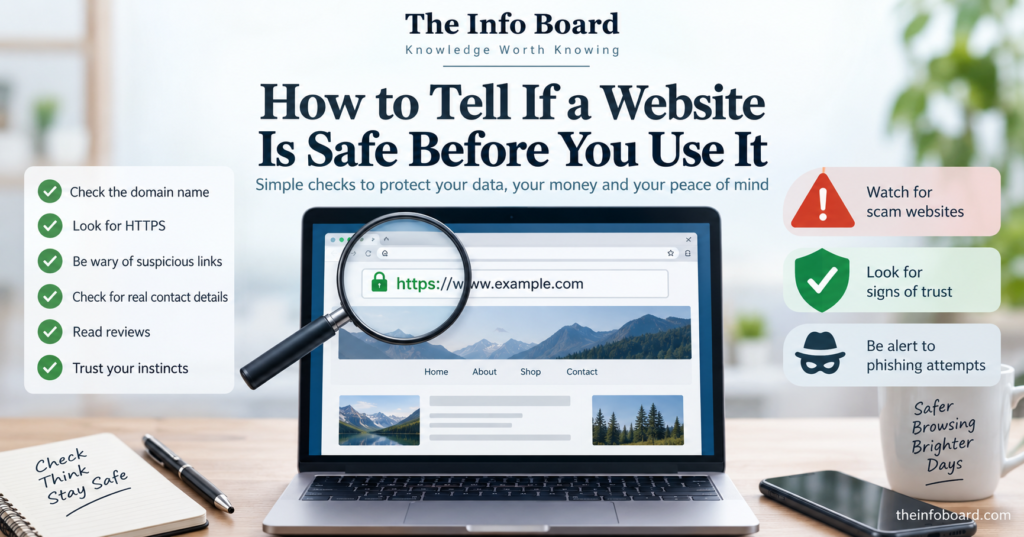
The good news is that you don’t need to be a cybersecurity expert. A few simple checks can help you identify many suspicious websites before you enter sensitive information.
Start With the Website Address
One of the most important things to check is the website’s domain name.
A scammer may create an address that looks similar to a legitimate company’s domain.
For example, imagine the genuine website is:
examplebank.co.uk
A fraudulent site might use something designed to look convincing at a glance, such as:
examplebank-secure-login.co.uk
The page itself could look almost identical to the real bank.
But the domain is different.
Always read the actual website address carefully, particularly before entering passwords or financial information.
Watch for Misspelled Domains
Some fraudulent websites rely on tiny spelling differences.
They might replace, remove or add a letter so that the domain looks familiar when viewed quickly.
This is sometimes known as typosquatting.
On a small phone screen, these differences can be particularly easy to miss.
Don’t rely entirely on the logo at the top of the page.
Logos can be copied.
The domain name is much more useful.
Does HTTPS Mean a Website Is Safe?
No.
This is one of the most important misconceptions about website security.
When a website uses HTTPS, the connection between your browser and that website is encrypted.
That’s useful.
But HTTPS does not prove that the person operating the website is trustworthy.
A scam website can also use HTTPS.
The padlock or secure-connection indicator therefore means roughly:
your connection to this website is encrypted.
It does not mean:
this website has been personally verified as honest and safe.
Be Careful With Links in Emails and Messages
A common way to reach a fake website is through a link in an email, text message or social-media message.
The message might claim:
Your account has been suspended.
Your parcel could not be delivered.
You are due a refund.
Unusual activity has been detected.
The goal is to create enough urgency that you click before thinking.
Instead of following an unexpected link, open your browser or the company’s official app and access your account independently.
Related: Read How to Spot a Phishing Email Before You Click.
Don’t Trust a Website Just Because It Looks Professional
Modern scam websites can look extremely convincing.
A criminal can copy:
logos, colours, photographs, product descriptions, navigation menus and even entire page layouts.
Poor spelling and ugly design can still be warning signs, but a polished website is no longer strong evidence that a business is legitimate.
Judge the website by more than its appearance.
Look for Real Contact Information
If you are considering buying from an unfamiliar business, investigate who is actually behind the website.
Look for information such as:
a physical business address, telephone number, company details, returns information and a genuine contact method.
Then consider whether those details make sense.
A contact page containing only a generic form does not automatically mean the website is fraudulent, but an online shop asking for substantial amounts of money should give you enough information to understand who you are dealing with.
Search for the Business Independently
If you’ve never heard of the website before, don’t limit your investigation to information published on the site itself.
Search independently for the business name.
Look for established information about the company and reports from customers.
Searching the company name together with terms such as reviews, scam or complaints may reveal useful information.
However, reviews also require judgement.
Fake businesses can publish fake reviews, and legitimate companies can receive unreasonable complaints.
Look for patterns rather than relying on one glowing or angry comment.
Be Suspicious of Prices That Make No Sense
Everyone likes a bargain.
Scammers know this.
An unfamiliar website offering a highly desirable £1,000 product for £149 should make you investigate carefully.
There are genuine sales and clearance offers, but enormous discounts on popular products can also be bait.
Ask yourself:
Why is this unknown website dramatically cheaper than every established retailer?
If there is no convincing answer, don’t allow the discount to override your caution.
Check How Long the Business Appears to Have Existed
A website claiming to be a long-established company should have some history.
Independent search results, business listings, older customer discussions and other evidence may help establish whether the company has genuinely existed for years.
A website that appeared very recently while claiming decades of experience deserves additional scrutiny.
Domain age by itself does not prove legitimacy, but inconsistencies can be informative.
Check the Returns and Refund Information
Before buying from an unfamiliar online shop, read its delivery, returns and refund information.
Look for vague or contradictory wording.
Does the company explain where returns go?
Are delivery times clear?
Does the policy appear relevant to the business, or does it look copied from somewhere else?
Poorly constructed legal and policy pages can sometimes expose a hastily assembled scam shop.
Be Careful What You Download
A suspicious website may try to convince you to download software.
You might see warnings such as:
Your device is infected. Download this cleaner now.
Or:
Your browser is outdated. Install this update immediately.
Do not install software simply because a random webpage tells you to.
Use your operating system’s built-in update system, trusted app stores or the genuine software developer’s website.
Related: Read Why Are Software Updates So Important?
Be Wary of Browser Security Warnings
Modern browsers can warn you about known dangerous websites or certificate problems.
Do not casually bypass those warnings just because you want to reach the page.
A warning does not always mean somebody is actively trying to steal your information — websites can be misconfigured — but it does mean you should understand the problem before continuing.
If you are trying to access an important service such as banking, it is safer to stop and reach the organisation through its official app or independently verified address.
Password Managers Can Provide a Useful Clue
Password managers do more than remember passwords.
They can also reduce the risk of entering credentials into the wrong domain.
Suppose your password manager has saved your login for a genuine website.
If you accidentally visit a convincing imitation on a different domain, the password manager may not automatically offer the saved credentials.
That can be an important warning that something is wrong.
It is another reason unique passwords and password managers can improve online security.
Related: Read How to Create a Strong Password You Can Actually Remember.
Use Two-Factor Authentication Too
Even careful people occasionally make mistakes.
Two-factor authentication provides an additional layer of protection if a password is stolen.
It does not make phishing impossible, and sophisticated attackers can sometimes attempt to steal authentication codes as well.
But enabling 2FA on important accounts makes a stolen password less useful by itself.
Related: Read What Is Two-Factor Authentication and Why Should You Use It?
Read:How to Create a Strong Password You Can Actually Remember
Check Before Entering Card Details
Before entering payment information on an unfamiliar website, stop for a final check.
Confirm:
Is this definitely the website I intended to visit?
Is the domain spelled correctly?
Do I trust the business?
Does the price make sense?
Are the contact and returns details credible?
A few seconds of checking is much easier than dealing with fraudulent transactions later.
Be Careful With Bank Transfer Requests
Payment method can be another warning sign.
If an unfamiliar seller insists that you send money directly by bank transfer and refuses normal payment methods, consider why.
Bank transfers can offer different protections from card payments.
Criminals may pressure victims into sending money quickly because recovering an authorised transfer can be difficult.
Unexpected pressure to pay immediately should increase your caution.
What About Websites Advertised on Social Media?
An advertisement appearing on a major social network does not automatically prove the advertiser is trustworthy.
Fraudulent shops can advertise online too.
If an advert offers something tempting from a company you’ve never heard of, investigate the business independently before purchasing.
Don’t assume:
I saw an advertisement, therefore somebody must have verified the company.
Do your own checks.
What If a Website Has No Padlock?
Modern browsers increasingly present connection security in different ways, so you may not always see the traditional padlock symbol.
The important point is whether the connection uses HTTPS and whether the browser reports a security problem.
For any website handling passwords, payment information or other sensitive data, an unencrypted connection is a serious reason not to proceed.
But remember: encryption alone still doesn’t establish trustworthiness.
What Should You Do If You’ve Already Used a Suspicious Website?
Act quickly.
If you entered a password, change it on the genuine service.
If you reused that password elsewhere, change those accounts too and give each account a unique password.
Enable two-factor authentication where available.
If you entered payment or banking information, contact your bank or card provider promptly and explain what happened.
Monitor your accounts for transactions you do not recognise.
If you downloaded suspicious software, stop using it and follow appropriate security guidance for your device.
The correct response depends on exactly what information you provided and what happened.
How to Check a Website Quickly
Before trusting an unfamiliar website, remember this simple sequence:
Check the address → check the business → check the offer → check the payment method → stop if something doesn’t feel right.
No single sign can identify every fraudulent website.
Instead, look at the overall picture.
One slightly unusual detail may have an innocent explanation.
Five unusual details together deserve much more caution.
Read:How to Spot a Phishing Email Before You Click
The Bottom Line
A safe-looking website is not necessarily a safe website.
Professional design, HTTPS, convincing logos and positive reviews can all be imitated.
The strongest defence is to slow down and verify what you’re looking at.
Check the domain name, investigate unfamiliar businesses independently, be sceptical of unrealistic bargains and avoid following unexpected login links from messages.
Most importantly, don’t allow urgency to make the decision for you.
Scammers want you to click first and think later.
Do the opposite.
Frequently Asked Questions
How can I tell if a website is safe?
Check the domain carefully, use HTTPS for sensitive connections, research unfamiliar businesses independently and look for suspicious payment requests, unrealistic offers or inconsistent company information.
Does a padlock mean a website is legitimate?
No. HTTPS encrypts the connection, but fraudulent websites can also obtain certificates and use encrypted connections.
Can a scam website look exactly like a real one?
Yes. Logos, images and layouts can be copied, which is why checking the actual domain name is important.
Should I click a bank link sent by email?
If the message is unexpected, it is safer to access your bank independently through its official app or a trusted address rather than following the link.
Are websites advertised on social media safe?
Not necessarily. Advertising does not guarantee that a retailer or website is trustworthy.
What should I do if I entered my password on a fake website?
Change the password on the genuine service immediately. If you reused it elsewhere, change those passwords too, and enable two-factor authentication where possible.
What should I do if I gave a suspicious website my card details?
Contact your bank or card provider promptly, explain what happened and follow their instructions. Monitor your account for transactions you do not recognise.
External source for publication:
NCSC — Shopping online securely
Leave a Comment