An unexpected car repair, broken boiler, sudden loss of income or urgent household expense can put immediate pressure on your finances.
If you don’t have money available to deal with it, you may have to use a credit card, overdraft or loan instead.
That’s where an emergency fund can help.
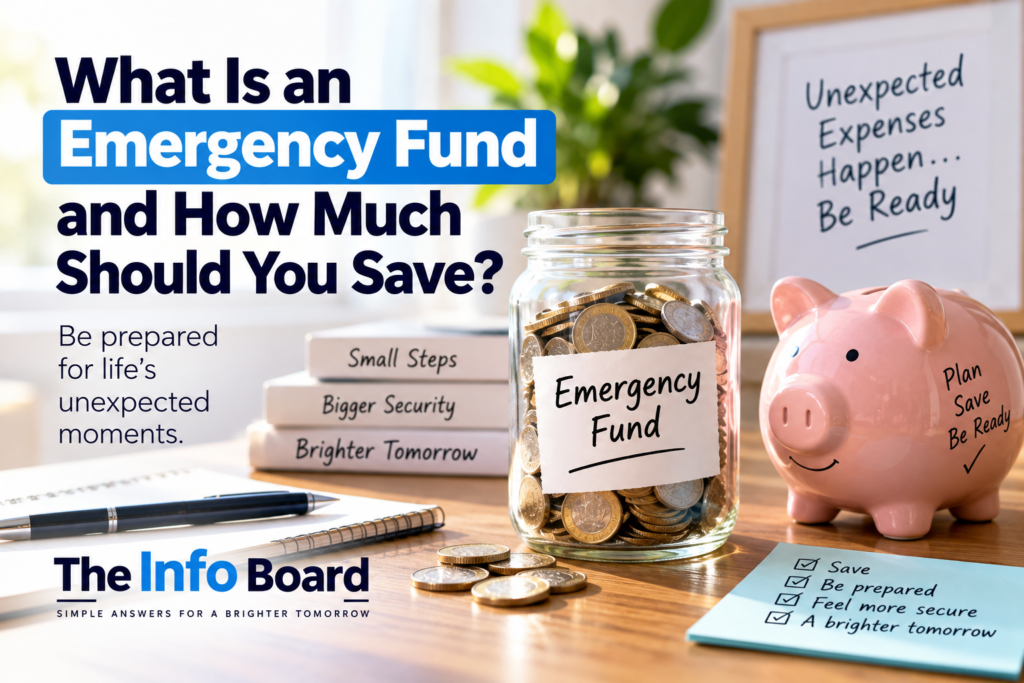
An emergency fund is money deliberately kept aside for unexpected and necessary expenses. It provides a financial buffer between an unforeseen problem and borrowing money to solve it.
What Is Inflation and Why Do Prices Go Up?
What Is an Emergency Fund?
An emergency fund is a pot of savings that you don’t normally spend.
Unlike savings for a holiday, new television or Christmas, the money doesn’t have a planned spending date.
It’s there for expenses you couldn’t reasonably predict.
Typical examples might include:
- an essential car repair
- an unexpectedly high household expense
- replacing an essential appliance
- emergency home repairs
- an urgent veterinary bill
- temporary loss or reduction of income
The important distinction is that an emergency fund is intended for genuine financial surprises, rather than ordinary spending.
Why Is an Emergency Fund Important?
Unexpected expenses are unavoidable over a lifetime.
The problem isn’t necessarily the expense itself. It’s how you pay for it.
Imagine your washing machine suddenly fails and replacing it costs £400.
If you have £400 available in emergency savings, you can pay for the replacement and then gradually rebuild your savings.
Without savings, you might have to borrow the money.
If that borrowing carries interest, the £400 problem could ultimately cost considerably more than £400.
An emergency fund can therefore help reduce your dependence on expensive borrowing.
How Much Should You Have in an Emergency Fund?
There isn’t one figure that works for everybody.
A commonly suggested longer-term goal is enough money to cover around three to six months of essential expenses.
But that doesn’t mean somebody starting from zero should feel they immediately need thousands of pounds.
A much smaller emergency fund can still be useful.
For example, your first targets could be:
£100 → £250 → £500 → £1,000
Reaching £500 won’t protect you against every financial emergency, but it could cover many smaller unexpected costs without requiring you to borrow.
Once you’ve established a starter fund, you can work towards a larger target.
Should It Be Three Months of Salary?
Not necessarily.
When calculating an emergency fund, it can be more useful to think about essential expenditure rather than your entire salary.
Suppose your household normally spends £2,500 each month, but only £1,600 of that represents expenses you would genuinely need to maintain during an emergency.
Your emergency-fund calculation could therefore start with £1,600.
Three months would be:
£1,600 × 3 = £4,800
Six months would be:
£1,600 × 6 = £9,600
Those numbers are targets, not requirements.
Your appropriate amount depends on your circumstances.
What Counts as an Essential Expense?
Think about the bills you would still need to pay if your income suddenly stopped.
These might include housing costs, council tax, energy, water, basic food, essential transport, insurance, minimum debt repayments and necessary childcare.
Subscriptions, entertainment, restaurant meals and discretionary shopping generally wouldn’t be considered essential emergency expenditure.
The objective is to estimate the cost of maintaining your basic household commitments.
Who Might Need a Larger Emergency Fund?
Some people’s finances are naturally less predictable than others.
A larger cash buffer may be particularly valuable if you’re:
Self-employed — income can fluctuate considerably.
Working on variable hours — monthly earnings may not be guaranteed.
The household’s sole earner — losing one income could affect the entire household.
Responsible for children or other dependants — unexpected expenses may be harder to postpone.
A homeowner — boilers, plumbing, roofs and appliances can generate expensive surprises.
Dependent on a vehicle for work — an unexpected repair may affect your ability to earn.
Someone with two stable household incomes and relatively low essential expenses may view the risk differently from somebody whose income varies every month.
Where Should You Keep an Emergency Fund?
Emergency savings have a different purpose from long-term investments.
The priorities are generally security and accessibility.
You want to be able to reach the money reasonably quickly when a genuine emergency occurs.
A separate easy-access savings account can therefore be useful.
Keeping the money separate from your everyday current account also reduces the temptation to spend it.
At the same time, it’s worth comparing savings accounts rather than automatically leaving a substantial balance somewhere earning little or no interest.
Should an Emergency Fund Be Invested?
Usually, money that may be needed at short notice shouldn’t depend on the value of volatile investments.
Investments such as shares can rise and fall.
Imagine investing your entire emergency fund and then needing the money during a market downturn. You could be forced to sell investments after their value has fallen.
Emergency savings and long-term investments therefore serve different purposes.
Emergency money prioritises availability and capital stability. Long-term investing generally accepts more uncertainty in pursuit of potential future returns.
How Do You Build an Emergency Fund From Nothing?
The easiest way is often to make saving automatic.
Instead of waiting until the end of the month to see what’s left, arrange an automatic transfer shortly after you’re paid.
Even relatively modest amounts accumulate.
For example:
£25 per month = £300 per year
£50 per month = £600 per year
£100 per month = £1,200 per year
That’s before taking any savings interest into account.
The amount matters less initially than establishing the habit.
What If You Can’t Afford to Save Much?
Start smaller.
An emergency fund doesn’t have to appear overnight.
Saving £5 or £10 at a time is still progress if the alternative is saving nothing.
You could also direct occasional windfalls into the fund, such as refunds, bonuses, money from selling unused belongings or other unexpected income.
A £200 emergency fund is clearly smaller than a £5,000 fund, but £200 can still prevent a relatively small problem from becoming debt.
Should You Save an Emergency Fund or Pay Off Debt?
This can be a difficult balance.
High-interest debt can be expensive, so reducing it may be an important priority.
However, using every available pound to repay debt while keeping no emergency savings whatsoever can create another problem.
If an unexpected expense then occurs, you may have to borrow again.
One approach is to establish a modest starter emergency fund while tackling expensive debt, then increase the emergency fund after the highest-cost borrowing has been addressed.
Your best approach will depend on the type of debt, interest rate, repayment terms and personal circumstances.
What Is Actually an Emergency?
This is where discipline matters.
An emergency is generally an unexpected, necessary expense.
A broken boiler during winter may qualify.
A discounted television probably doesn’t.
An urgent car repair needed to get to work may qualify.
A spontaneous weekend away doesn’t.
Before taking money from your emergency fund, ask:
Was this expense unexpected?
Is it necessary?
Does it need to be dealt with now?
If the answer to all three is yes, using the emergency fund may be entirely appropriate.
What About Expenses You Know Are Coming?
Predictable expenses should ideally have their own savings pots.
If you know your car insurance is due every year, for example, it isn’t really an emergency.
The same applies to Christmas, annual subscriptions, birthdays, holidays and routine car maintenance.
Some people call savings for these predictable expenses sinking funds.
Separating them from your emergency fund means predictable bills don’t repeatedly empty your emergency savings.
Read:What Is Inflation and Why Do Prices Go Up?
What Happens After You Use Your Emergency Fund?
Using emergency savings isn’t a failure.
That’s what the money is there for.
If you spend £600 repairing your car, your next financial objective can simply be to rebuild that £600.
Resume your regular contributions until the fund returns to your preferred level.
Does Inflation Affect Emergency Savings?
Yes.
If your essential household expenses rise over time, the amount needed to cover three or six months of those expenses will also increase.
For example, a £5,000 emergency fund might represent more months of essential spending today than it does several years from now.
It’s therefore sensible to review your target periodically rather than choosing a number once and never reconsidering it.
You can learn more about this in our guide to what inflation is and why prices go up.
Should Couples Have Separate Emergency Funds?
There’s no universal rule.
Some couples maintain one household emergency fund, while others prefer a combination of shared and individual savings.
What’s more important is knowing how much emergency money is actually available and what expenses it is intended to cover.
Is £1,000 Enough for an Emergency Fund?
It depends on your circumstances.
£1,000 could provide valuable protection against many everyday emergencies, but it may not cover several months of essential expenses if you lose your income.
It can therefore be an excellent milestone without necessarily being the final target.
Frequently Asked Questions
How much should I save each month?
Choose an amount that is sustainable. A smaller automatic contribution that continues every month can be more effective than an ambitious amount you regularly have to cancel.
Should I keep emergency money in cash at home?
Keeping a very small amount of physical cash can be useful in some circumstances, but storing a substantial emergency fund at home creates risks including theft, loss and fire. A suitable savings account will normally provide greater protection.
Can I use my credit card as my emergency fund?
A credit card provides access to borrowing, not savings. It may be useful in certain circumstances, but relying entirely on credit means an emergency can create debt and potentially interest charges.
Should I have an emergency fund if I have insurance?
Yes. Insurance can protect against particular risks, but policies have limits, exclusions and excesses. They also don’t cover every unexpected household expense.
When should I stop adding to my emergency fund?
Once you’ve reached a level appropriate for your circumstances, you can redirect future savings towards other goals. Review the amount periodically as your income, expenses and responsibilities change.
The Bottom Line
An emergency fund is one of the simplest financial safety nets you can build.
You don’t need to start with thousands of pounds. Start with an achievable amount, keep the money separate, contribute regularly and gradually work towards several months of essential expenses if appropriate for your circumstances.
The purpose isn’t to maximise investment returns.
It’s to give you options when something unexpectedly goes wrong.
A financial emergency is stressful enough without immediately having to work out how to borrow money to pay for it.
This article provides general financial information and does not constitute personalised financial advice. Savings products, interest rates and individual circumstances vary.
Leave a Comment